For the past two years, marketers have treated ChatGPT as an emerging discovery surface, experimenting with how generative AI interprets brands, categories, and intent. That phase is now moving into a more commercial reality. OpenAI has confirmed that advertising will begin testing inside ChatGPT in the U.S., signalling the platform’s shift toward a monetised model.
Early signals suggest a cautious and premium rollout. Selected advertisers are reportedly being asked to commit at least $200,000 upfront to participate in the beta, with some quoted higher. Scale is limited by design, with OpenAI focused on understanding how advertising can exist in a conversational environment without undermining trust.
To understand where this might land longer term, it is useful to look at the closest live comparison. Google’s evolving ad model around AI Overviews and AI Mode offers an early indicator of how users and advertisers may respond when paid media is introduced into AI-driven answers.
What ChatGPT Ads Look Like So Far
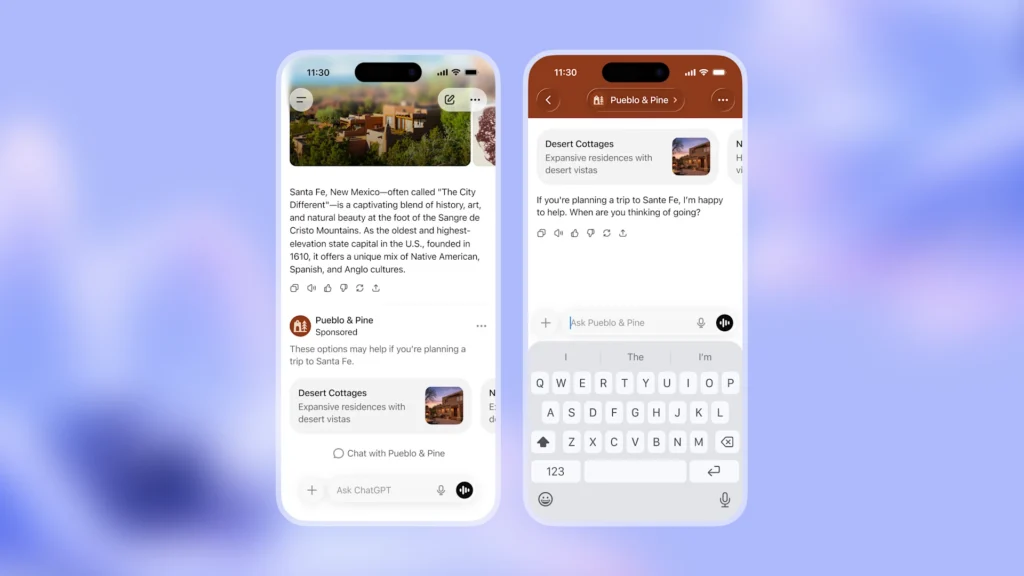
OpenAI has stated clearly that ads will not influence ChatGPT’s answers. Paid placements will be clearly labelled and appear separately, typically at the bottom of a response when a sponsored product or service is relevant to the conversation.
Initial formats are simple and contextual. A recipe query may surface a grocery product, while a travel-related question could include a promoted accommodation option. OpenAI has suggested that future formats may allow users to ask questions directly within an ad, keeping interaction inside the conversation rather than forcing a click-out.
Ads will not appear for users under 18, will be excluded from sensitive categories such as health and politics, and will not be shown to Pro, Business, or Enterprise users.
Targeting in a Chat Environment
At launch, targeting appears to be driven almost entirely by conversational context. Ads are triggered by what the user is asking in that moment, rather than by behavioural profiles, browsing history, or third-party audience data.
That approach mirrors search intent more closely than social targeting and aligns with OpenAI’s stated principles around privacy and answer independence. Conversations are not shared with advertisers, and personal data is not sold.
For marketers, targeting effectiveness will depend on how closely a product or service aligns with specific user questions. Brands that understand the language buyers use, and the problems they are trying to solve, are likely to perform better as targeting options evolve.
Attribution Challenges Are Inevitable
Attribution is likely to be one of the most complex aspects of ChatGPT advertising. Conversational interfaces compress discovery, evaluation, and intent-building into a single flow, often without a clean click event.
A user may see a sponsored recommendation, ask follow-up questions, and later visit a brand directly or convert via another channel. Traditional last-click attribution will struggle to reflect that influence accurately. Early measurement is more likely to focus on assisted conversions, brand search uplift, or directional impact rather than direct ROI.
Variability in AI responses adds another layer of complexity. The same query can produce different answers, making impression-based reporting less stable than in conventional search environments.
What Google’s AI Ads Are Showing Us
Google’s rollout of ads alongside AI Overviews and within AI Mode provides a useful reference point. In these environments, ads are clearly separated from AI-generated answers and labelled, often appearing above or below the overview rather than embedded within it.
Early observations suggest a few emerging patterns.
First, ads around AI Overviews tend to skew toward high-intent, commercially clear queries. Google appears cautious about inserting ads where intent is ambiguous or informational, likely to protect trust in the AI-generated response.
Second, click-through rates on ads near AI Overviews have been mixed. In some categories, ads benefit from increased intent clarity, as users asking longer, more complex questions are closer to decision-making. In others, users rely heavily on the AI summary itself and do not feel the need to click at all.
Third, attribution remains challenging. AI Overviews often reduce overall click volume to organic results, while paid ads sometimes absorb a greater share of remaining clicks. That has led some advertisers to see stable or improved conversion quality, but lower absolute traffic volumes.
Taken together, Google’s experience suggests that AI-driven search environments prioritise usefulness and resolution over exploration. Ads can perform, but only when they align tightly with intent and add clear value at the moment they appear.
Brand Versus Performance in AI Interfaces
In its current form, ChatGPT advertising looks more like a brand and consideration channel than a pure performance engine. High entry costs, limited scale, and unresolved attribution models all point in that direction.
Google’s AI ad experiments reinforce that view. Performance outcomes are possible, but they tend to favour brands with strong existing demand, clear propositions, and credibility. Lesser-known brands without authority often struggle to gain traction, even with paid support.
Over time, the distinction may blur. OpenAI has hinted at a future where ads support transactions, bookings, or service fulfilment directly within the conversation. In that scenario, performance would be measured by completed actions rather than clicks.
Organic Visibility Still Sets the Ceiling
Both ChatGPT and Google AI experiences underline the same principle. Paid presence works best when it reinforces an existing foundation of trust and relevance. Brands that are already referenced organically, cited in authoritative sources, and understood clearly by AI systems are better positioned to benefit from paid placements.
The work marketers have done around clearer messaging, structured data, and consistent narratives remains critical. Paid AI ads are shaping up as an amplifier, not a substitute.
Where This Is Likely to Land
Google’s cautious integration of ads around AI Overviews suggests a likely trajectory for ChatGPT. Limited formats, strong separation between answers and ads, and a focus on intent clarity rather than volume.
For senior marketers, the immediate opportunity is not scale but insight. Early tests will help define how targeting, attribution, and user behaviour adapt in conversational environments. ChatGPT ads are unlikely to replace search or social budgets in the near term, but they will influence how brands think about discovery, authority, and presence in AI-mediated decision-making.
The question for the next phase is not simply how to advertise in AI, but how to remain credible when recommendations feel personal, immediate, and trusted.

RECOMMENDED FOR YOU
[STUDY] LinkedIn Becomes Top Source In AI Answers
LinkedIn has become the most cited domain for professional…
LinkedIn has become the most cited domain for professional…
AI Traffic Fails To Replace Search Losses
New data from Ahrefs, spanning more than 74,000 websites,…
New data from Ahrefs, spanning more than 74,000 websites,…
ChatGPT Ads Highlight Early Search Trends
Four weeks into OpenAI’s rollout of ads in ChatGPT,…
Four weeks into OpenAI’s rollout of ads in ChatGPT,…