
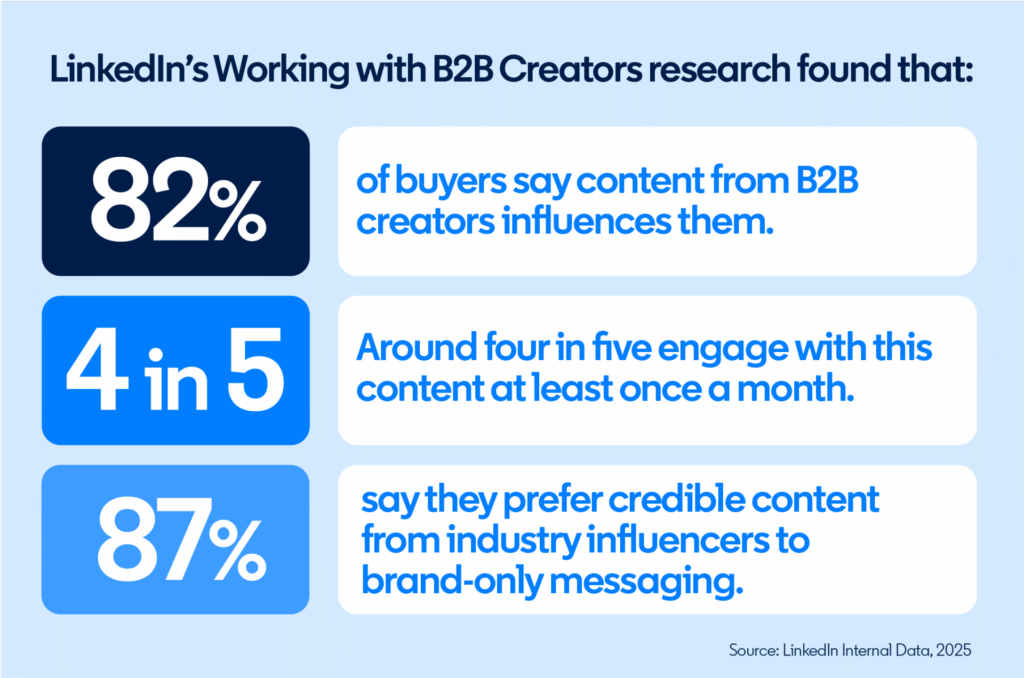
LinkedIn has shared new insights into how B2B marketing is evolving, with a clear emphasis on trust, credibility, and human connection. The findings bring together several trends that have been emerging over recent years and position people-powered thought leadership as a central driver of B2B performance heading into 2026.
While video adoption, full-funnel events, improved measurement, and long-term pipeline thinking continue to shape the market, LinkedIn’s research suggests these approaches are only effective when buyers trust the voices behind them. Increasingly, that trust is placed in individuals rather than corporate brands.
Trust and the B2B Buying Process
According to LinkedIn and Edelman research, 94% of marketers agree that trust is critical to B2B success. Decision-makers are also clear about where that trust comes from. Around three quarters say thought leadership is a more reliable way to assess a company’s capabilities than product sheets or traditional marketing materials.
This reflects a broader change in buyer behaviour. B2B purchasing decisions are rarely made by a single person, and many influential stakeholders are difficult to reach through standard sales and marketing activity. LinkedIn’s 2025 research highlights the role of so-called hidden buyers, individuals who may not engage directly with sales teams but still shape outcomes. Among this group, 95% say strong thought leadership makes them more open to outreach.
As a result, thought leadership is increasingly seen as a practical tool for influencing buying groups, rather than a brand awareness exercise.
Buyers Are Turning to Creators
LinkedIn’s data shows that creators now play a significant role across the entire B2B buyer journey. In the early awareness stage, nearly six in ten buyers say they discover new brands through creator content. During consideration, around two thirds say creator perspectives help them evaluate options and distinguish credible solutions from noise. At the decision stage, almost half report visiting a vendor website after engaging with creator content, and more than a third say it prompted a conversation with sales.
These patterns suggest that creator content is not limited to top-of-funnel discovery. Instead, it supports decision-making throughout the process by providing context, interpretation, and real-world perspective.
In B2B, the distinction between creators and influencers is less important than their role. Influencers tend to apply established credibility to shape opinion, while creators focus on building audiences through educational or practical content. The most effective B2B partners often combine both approaches, using subject-matter expertise to inform and influence at the same time.
The Role of Employees
External creators are only one part of a people-led thought leadership strategy. LinkedIn also points to employee advocacy as an underused but highly credible channel. Internal data shows that the combined networks of employees are typically around 12 times larger than a company’s own LinkedIn following.
When employees share insights from their day-to-day work, they often resonate more strongly than branded posts. This is particularly true when employees communicate as practitioners rather than as formal brand representatives. For many buyers, this type of content feels more grounded and relevant, especially in complex or technical categories.
As a result, some organisations are investing more deliberately in helping employees build a presence on LinkedIn. Support can range from light editorial guidance to video coaching or structured content prompts.
Scaling Human Voices With Paid Media
Organic reach remains important, but LinkedIn notes that paid amplification is often required to achieve consistent visibility, especially in competitive markets. Thought Leader Ads are designed to address this by allowing brands to promote posts from individuals rather than company pages.
These ads retain the original format and tone of personal posts while extending their reach to defined audiences. LinkedIn reports that campaigns using Thought Leader Ads often deliver stronger engagement and higher conversion likelihood than traditional single-image brand ads.
Video plays a growing role here as well. Short-form video uploads on LinkedIn continue to increase, and buyers consistently report that video helps them better understand expertise and intent. Video-based Thought Leader Ads and formats like BrandLink, which places brand messages alongside premium creator and publisher content, are designed to build familiarity through repeated exposure to trusted voices.
Practical Considerations for 2026
LinkedIn’s research highlights five characteristics common to effective people-first thought leadership programmes:
-
Audience fit over reach: Credibility and relevance matter more than follower count. The most effective voices are those already respected by the target audience.
-
Activation of internal expertise: Employees often have the deepest insight into customer challenges and industry change. Supporting them to share that knowledge can increase impact.
-
Co-creation rather than control: Overly scripted content tends to reduce authenticity. Clear context and guardrails work better than rigid messaging.
-
Paid amplification of proven content: Investment in paid distribution is most effective when applied to content that already performs well organically.
-
Use of video to support understanding: Video allows buyers to see and hear the person behind the perspective, which can strengthen credibility.
A Broader Strategic Shift
Taken together, these insights point to a broader shift in B2B marketing strategy. Success is less about volume of messaging and more about who delivers it. Buyers are actively seeking informed perspectives from people who understand their challenges and can speak with authority.
For senior marketers, the implication is clear. Building trust at scale increasingly depends on enabling the right people, inside and outside the organisation, to represent the brand through credible thought leadership. LinkedIn’s platform and ad formats are positioned as tools to support that approach, but the underlying change is behavioural rather than technological.
As B2B marketing continues to evolve in 2026, organisations that prioritise credible voices, consistent expertise, and measured amplification are likely to be better aligned with how modern buying decisions are made.


RECOMMENDED FOR YOU
[NEW STUDY] Meta And TikTok Battle For Engagement
New data from Buffer’s State of Social Media Engagement…
New data from Buffer’s State of Social Media Engagement…
[STUDY] Instagram Growth Holds As Reach Declines
Most social strategies still treat platforms as a portfolio…
Most social strategies still treat platforms as a portfolio…
LinkedIn Reveals Top Marketing Skills 2026
LinkedIn has released its 2026 Skills on the Rise…
LinkedIn has released its 2026 Skills on the Rise…