
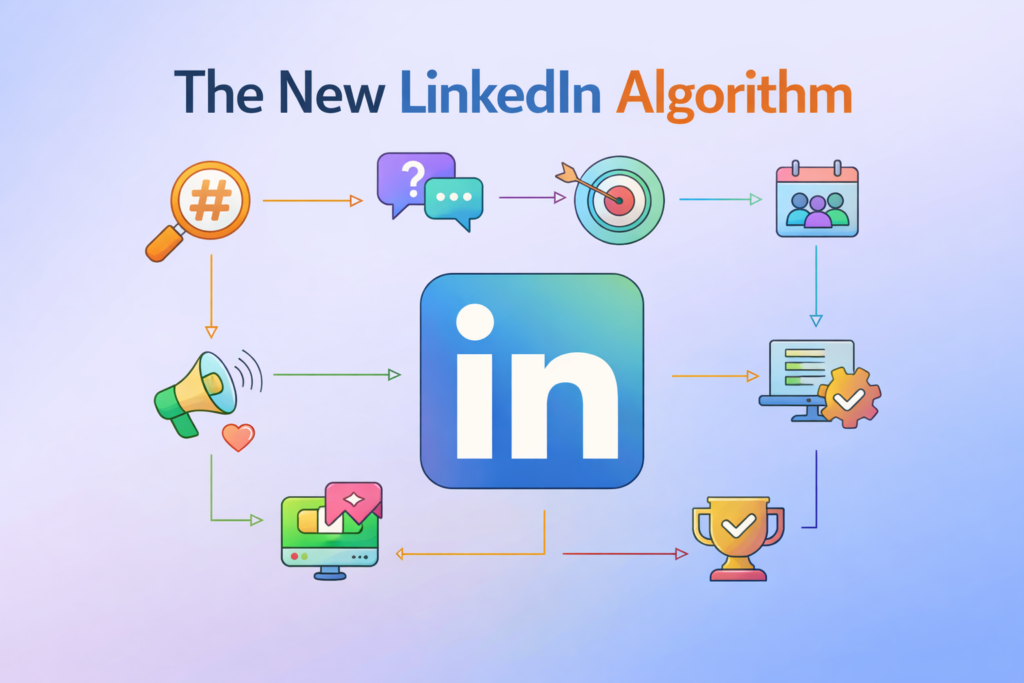
LinkedIn has overhauled its Feed, introducing a new AI-driven ranking system built on large language models. Detailed in a post from the LinkedIn Engineering blog, the update marks a significant shift in how content is understood, ranked, and distributed.
The change moves the platform away from traditional engagement signals and towards a deeper, more contextual understanding of both content and user intent.
For marketers, that has direct implications for how visibility is earned.
LinkedIn Moves From Keywords To Context
At the core of the update is a move away from keyword matching and fragmented retrieval systems towards a unified, LLM-powered approach.
As outlined by LinkedIn’s engineering team, the new system generates rich representations of both users and content. It can interpret meaning, not just language. That allows it to connect related topics, even when they are described differently.
An interest in electrical engineering, for example, can now be linked to adjacent areas such as energy infrastructure or nuclear innovation without explicit keyword overlap.
That shift reduces the effectiveness of surface-level optimisation tactics. Visibility is no longer driven by how content is phrased, but by what it actually conveys.
Freshness And Intent Now Shape The Feed
The Engineering blog also highlights a major improvement in how quickly the Feed adapts.
LinkedIn has built near real-time systems that continuously update its understanding of both content and user behaviour. As a result, the Feed responds far more quickly to new signals.
When a user engages with a new topic, their Feed can reflect that change within minutes. When industry news begins to trend, relevant posts are surfaced almost immediately.
This creates a more dynamic environment where timing and relevance are closely linked. Content aligned to emerging conversations has a greater opportunity to gain traction, while static or delayed content may be deprioritised.
The Feed Now Understands Behaviour As A Journey
One of the more advanced elements of the update is how LinkedIn now interprets user behaviour.
Instead of treating each interaction in isolation, the system analyses sequences of engagement over time. The Engineering team describes this as modelling a user’s professional journey rather than a series of individual actions.
That means the Feed is not only reacting to what users have done, but also anticipating what they are likely to find valuable next.
A user exploring new topics will see progressively more relevant content as their interests develop. The Feed becomes more predictive, shaping discovery rather than simply reflecting past behaviour.
Expertise Is Becoming The Primary Growth Lever
A key outcome of this shift is how content is distributed beyond a user’s immediate network.
Because the system can assess semantic relevance at scale, it is better able to match posts with audiences who have a demonstrated interest in the topic, regardless of connection.
The Engineering blog notes that this is particularly valuable for specialised or niche content, where traditional systems often struggled.
For marketers and creators, that increases the importance of genuine expertise. Content that demonstrates clear knowledge, perspective, or insight is more likely to reach relevant audiences.
Distribution becomes less about network size and more about topical authority.
Engagement Bait And Low-Value Content Lose Visibility
Alongside improvements in relevance, LinkedIn is also refining how it filters content.
The platform has confirmed it will reduce the visibility of engagement bait and repetitive, low-value posts. Tactics designed to prompt superficial interaction are becoming less effective as ranking systems evolve.
This aligns with the broader direction of the update. The Feed is moving away from popularity signals and towards quality and relevance.
Content that lacks substance, even if it generates initial interaction, is less likely to sustain visibility.
New Creators And Niche Topics Gain Ground
The new system also addresses long-standing challenges around discovery.
LinkedIn’s previous reliance on historical engagement made it difficult for new users or creators to gain traction. The updated model can infer interests from limited data, including profile information and early interactions.
That improves content matching from the outset, allowing newer voices to reach relevant audiences more quickly.
Niche topics also benefit. The model’s ability to understand relationships between ideas means specialised content is more likely to surface, even if it does not align with mainstream trends.
Distribution Becomes More Targeted
While the update creates more opportunities for relevant content, it may also reduce broad, uniform reach.
As the Feed becomes more personalised, content is distributed to more specific audiences. Fewer users see the same posts, but those who do are more likely to find them relevant.
That reflects a wider shift across social platforms. Reach is fragmenting, while precision is increasing.
For marketers, that requires a change in how performance is evaluated. Scale alone is no longer the primary objective.
Relevance Becomes The Core Performance Driver
LinkedIn’s latest update reinforces a broader trend in social media.
Feeds are becoming more intelligent, more personalised, and more selective. Engagement tactics and distribution hacks are losing effectiveness as platforms prioritise meaningful relevance.
The Engineering blog makes it clear that LinkedIn is investing heavily in systems that understand intent, context, and professional value at a deeper level.
For marketers, the implication is straightforward. Content strategies need to align with how these systems work.
Insight, clarity, and expertise are becoming the primary drivers of visibility. Content that genuinely helps or informs its audience is more likely to be surfaced.
The opportunity is not to optimise for the algorithm in a traditional sense. It is to create content that the algorithm recognises as valuable.
Relevance, not reach, is now the metric that matters most.



















RECOMMENDED FOR YOU
[STUDY] LinkedIn Ads Influence More Than Leads
LinkedIn advertising remains expensive by most conventional performance measures.…
LinkedIn advertising remains expensive by most conventional performance measures.…
LinkedIn Builds Its Creator Marketplace
LinkedIn is expanding its B2B creator offering through two…
LinkedIn is expanding its B2B creator offering through two…
[STUDY] LinkedIn Engagement Benchmarks Shift Again
LinkedIn’s latest benchmark data points to a platform evolving…
LinkedIn’s latest benchmark data points to a platform evolving…