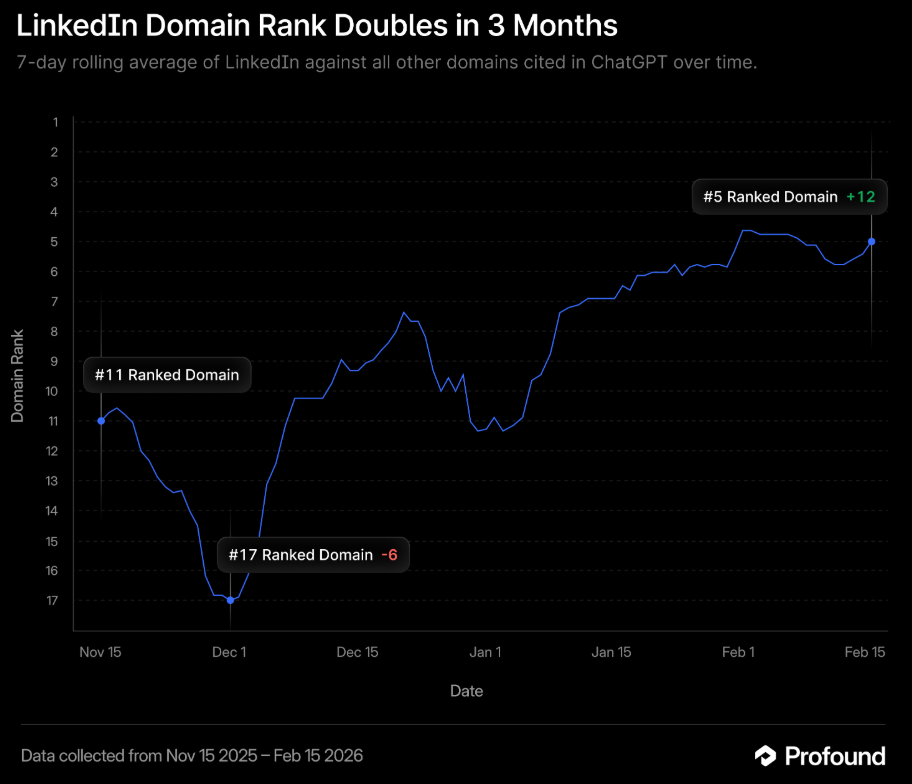
LinkedIn has become the most cited domain for professional queries across major AI platforms, marking a significant shift in how expertise is surfaced in AI-generated answers. New data from Profound shows the platform surged from outside the top 20 to the top five most cited sources on ChatGPT in just three months, one of the fastest gains in authority seen in AI search to date.
Across platforms including ChatGPT, Gemini, Google AI Overviews, Microsoft Copilot, and Perplexity, LinkedIn now holds the number one position for professional query citations. For marketers, that signals a clear change in where authority is being built and discovered.
LinkedIn’s Rapid Rise In AI Search
The speed of LinkedIn’s growth is as important as the scale. Moving from around eleventh place to fifth in overall AI citations within a single quarter reflects a broader shift in how large language models source information.
Unlike traditional search engines, AI systems do not rely on a fixed hierarchy of domains. After a small group of consistently trusted sources, citation patterns become more fragmented and dynamic. That creates opportunities for platforms like LinkedIn to rapidly gain influence.
Separate analysis from SEMrush reinforces this trajectory. Based on 325,000 prompts across leading AI tools, LinkedIn ranks as the second most cited source overall, just behind Reddit.
Taken together, the data points to LinkedIn becoming a key layer in AI-driven discovery.
AI Is Changing How Users Discover Content
The rise in LinkedIn citations aligns with a broader behavioural shift. Discovery is increasingly starting within AI tools rather than traditional search engines.
Recent research suggests that 37% of consumers now begin their search journeys using AI platforms. As adoption grows, AI-generated responses are becoming the first touchpoint between brands and audiences.
That shift is driving the emergence of generative engine optimisation, where the goal is not just to rank, but to be cited within AI answers. In that context, platforms that AI models trust and frequently reference gain outsized importance.
LinkedIn is now firmly in that category.
Content, Not Profiles, Is Driving Visibility
Profound’s data also highlights a structural change in what type of LinkedIn content is being surfaced.
There has been a clear move away from static profile pages towards actively published content. Over the three-month period analysed, posts and long-form content saw meaningful gains in citation share.
Key shifts include:
-
LinkedIn posts increased from 20.9% to 26% of citations
-
Long-form articles grew from 6% to 8.9%
-
Combined, posts and articles now account for nearly 35% of LinkedIn citations
At the same time, profile-based citations declined significantly.
The implication is clear. Authority in AI search is increasingly tied to active contribution and demonstrated expertise, not just professional credentials.
A More Open Playing Field For Visibility
One of the more interesting consequences of this shift is accessibility. AI systems are not limited to traditional publishers or high-authority websites.
Anyone publishing on LinkedIn can, in theory, become a cited source.
Posts, newsletters, and articles are now being indexed and attributed within AI responses, often linking back to individuals as well as brands. That creates new opportunities for visibility without relying entirely on external media or organic search rankings.
For organisations, it also expands the pool of contributors who can influence brand presence in AI search, from leadership teams through to subject matter experts across the business.
A Note Of Caution On The Data
While the findings are directionally important, they have not gone unchallenged.
Some industry voices, including Rand Fishkin, have raised questions around how representative these studies are of real-world AI usage. Criticism has focused on methodology, including the use of synthetic prompts and whether citation frequency truly reflects influence or user behaviour at scale.
There is also the broader point that AI search remains highly fluid. Citation patterns can shift quickly as models update, retrain, or adjust how they source information. A strong position today does not guarantee long-term dominance.
In addition, AI systems often provide answers without explicit citations, meaning visibility is not always fully captured by these types of studies.
For marketers, that means treating these insights as directional rather than definitive. They highlight emerging trends, but should not be the sole basis for strategy.
Why LinkedIn Still Matters
Even with those caveats, the underlying trend is difficult to ignore. Multiple datasets point to LinkedIn playing an increasingly prominent role in AI-generated answers, particularly for professional and business-related queries.
The platform’s combination of high domain authority, structured professional data, and a constant stream of fresh content makes it well suited to how AI models evaluate relevance and credibility.
That structural advantage is unlikely to disappear, even if specific rankings fluctuate.
Early Opportunity, But Not A Guaranteed Advantage
Timing remains a key factor. LinkedIn’s rapid rise has created a window of opportunity, but it is unlikely to stay underexploited for long.
Many brands have yet to adapt their strategies to account for AI search. That creates space for early movers to build visibility and authority.
However, as more organisations invest in LinkedIn content with AI discovery in mind, competition will increase. The advantage will shift from simply being present to consistently producing high-quality, differentiated content.
What Marketers Should Do Next
Rather than overcorrecting based on a single trend, marketers should take a balanced approach.
LinkedIn should be treated as an increasingly important part of a broader content and discovery strategy, not a replacement for other channels.
Practical priorities include:
-
Investing in original, insight-led LinkedIn content
-
Encouraging consistent publishing across multiple voices
-
Aligning content with real professional questions and use cases
-
Monitoring how content surfaces in AI tools over time
-
Maintaining a diversified presence across search, social, and owned media
A Platform To Watch Closely
LinkedIn’s growing role in AI search reflects a wider convergence between social platforms and discovery engines. Content created within social ecosystems is now shaping what users see in AI-generated answers.
That shift is still unfolding, and the rules are not yet fixed.
For now, LinkedIn represents a meaningful opportunity to influence how expertise is surfaced in AI environments. Marketers who engage with that shift thoughtfully, while remaining cautious about overinterpreting early data, will be better positioned to adapt as AI search continues to evolve.























RECOMMENDED FOR YOU
[STUDY] AI Search Shapes Brand Decisions
AI search is starting to influence purchase decisions well…
AI search is starting to influence purchase decisions well…
LinkedIn Lets AI Multiply Ad Creative
LinkedIn is giving advertisers far more freedom to vary…
LinkedIn is giving advertisers far more freedom to vary…
Copilot Lets Marketers Build Apps By Chatting
Microsoft is giving Copilot users the ability to build…
Microsoft is giving Copilot users the ability to build…