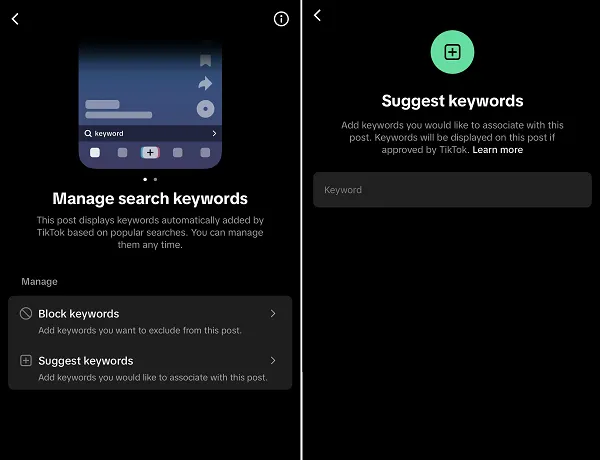
TikTok has introduced keyword controls that give brands more influence over how their content is categorised and discovered. The update allows users to manage the keywords automatically assigned to their videos, offering the option to remove irrelevant terms and suggest more accurate alternatives.
Although the feature applies to all users, the strategic value sits firmly with brands and marketing teams. As TikTok continues to evolve into a search-first platform, control over metadata is becoming a meaningful lever in content performance.
Social Search Is Reshaping Discovery
Search behaviour has shifted rapidly over the past few years. Platforms like TikTok and Instagram are no longer just channels for passive consumption. They are now primary discovery tools, particularly among younger audiences looking for recommendations, reviews, and how-to content.
That shift has significant implications for brands. Visibility is no longer driven solely by follower count or paid reach. Instead, it is increasingly tied to how well content aligns with user intent at the moment of search.
Keyword relevance sits at the centre of that change. TikTok’s new controls signal a move towards more structured discoverability, where metadata plays a supporting role alongside engagement signals.
Greater Precision In Audience Targeting
The ability to refine keywords gives brands a practical way to improve targeting accuracy. Automated classification can sometimes misinterpret content, especially in complex or niche categories. Incorrect tagging can push videos towards the wrong audience, reducing both reach and engagement quality.
With manual input, brands can correct those misalignments. A beauty brand, for example, can ensure its content is tied to specific product categories or concerns, rather than broader and less relevant themes. A B2B company can align videos with industry terminology that automated systems might overlook.
Such precision is increasingly important as competition for attention intensifies. Reaching the right audience matters more than reaching the largest one.
Aligning Content With Search Intent
Keyword management also opens the door to more deliberate alignment with search demand. TikTok Trends and similar tools already provide insight into what users are actively searching for. The new feature allows brands to connect that insight directly to their content.
A more structured approach to TikTok SEO is beginning to emerge. Brands can plan content around high-intent queries, then reinforce that positioning through keyword selection. Over time, that could improve consistency in discoverability and reduce reliance on algorithmic guesswork.
That said, discipline is required. Adding keywords simply because they are popular, without genuine relevance, is unlikely to deliver results. TikTok maintains oversight of keyword suggestions, reinforcing the need for accuracy over opportunism.
Reducing Wasted Reach
One of the less obvious benefits of keyword control is the ability to limit irrelevant distribution. Blocking certain keywords can prevent content from being surfaced to audiences with little interest in the topic.
For brands, that translates into more efficient reach. Engagement rates improve when content is shown to users with genuine intent, which in turn can strengthen overall performance signals within the algorithm.
In paid media terms, it mirrors the value of negative keywords in search advertising. Excluding the wrong audiences can be just as powerful as targeting the right ones.
Implications For Content Strategy
The introduction of keyword controls suggests that TikTok is moving towards a more hybrid discovery model, blending algorithmic recommendations with elements of traditional search indexing.
For brands, that requires a shift in mindset. Content should not only be entertaining or visually engaging, but also structured in a way that supports discoverability through search.
Practical steps include reviewing keyword assignments post-publication, aligning terminology with customer language, and integrating search insights into the content planning process.
Cross-functional collaboration may also become more important. Search teams and social teams have historically operated in silos, but the convergence of disciplines means their strategies should now be closely aligned.
The Bigger Picture For Social Platforms
TikTok’s update is part of a broader trend across the social landscape. Platforms are investing heavily in search capabilities, recognising that discovery is no longer limited to feeds and recommendations.
LinkedIn has been enhancing its search features for professional content. Instagram continues to refine keyword-based discovery. Even YouTube is leaning further into search optimisation tools for creators and brands alike.
That convergence is reshaping digital marketing. Social content is becoming evergreen, searchable, and intent-driven, rather than purely time-bound.
Strategic Takeaways For Brands
Keyword controls should be seen as an optimisation layer rather than a standalone solution. Strong creative and clear messaging remain essential, but they now need to be supported by structured discoverability.
Brands that treat TikTok as a search channel, not just a social platform, will be better positioned to capture demand. That means investing in keyword research, aligning content with user queries, and continuously refining metadata based on performance insights.
There is also a broader opportunity to rethink measurement. Success should not only be judged on views or engagement, but also on how effectively content captures high-intent audiences.
Looking Ahead
TikTok’s move reinforces the growing importance of social search in the digital ecosystem. As user behaviour continues to evolve, the distinction between search engines and social platforms will become increasingly blurred.
Brands that adapt early will gain a competitive advantage. Those that continue to rely on traditional social tactics risk losing visibility in a more structured, intent-driven environment.
Keyword control may appear to be a small update, but it reflects a much larger shift. Discovery is becoming more deliberate, more data-driven, and more aligned with user intent.
For brands, that presents both a challenge and an opportunity.
*Images via Jonah Manzano.

























RECOMMENDED FOR YOU
Instagram Looks Beyond Short Form Video
Instagram is preparing for a future where short-form video…
Instagram is preparing for a future where short-form video…
[NEW STUDY] Meta And TikTok Battle For Engagement
New data from Buffer’s State of Social Media Engagement…
New data from Buffer’s State of Social Media Engagement…
[STUDY] Instagram Growth Holds As Reach Declines
Most social strategies still treat platforms as a portfolio…
Most social strategies still treat platforms as a portfolio…