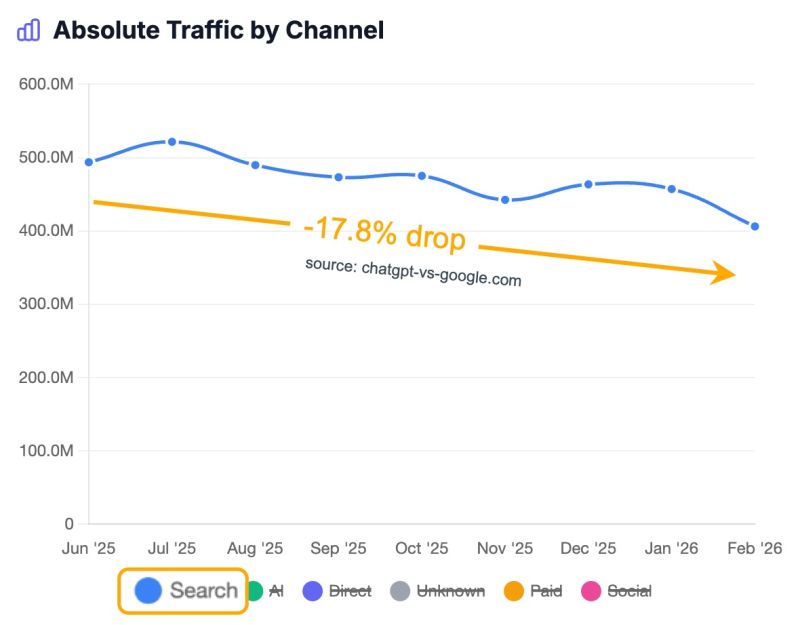
New data from Ahrefs, spanning more than 74,000 websites, offers one of the clearest views yet of how traffic is shifting in the AI era. Nearly 90 million search visits have disappeared over the past nine months, a figure that immediately raises concerns about the future of organic discovery.
However, the more important story sits beneath that headline. AI has not replaced that loss in any meaningful way.
At its peak, AI assistants such as ChatGPT, Perplexity, and Gemini collectively drove just 4 million visits. That equates to less than 5% of the traffic lost from search. In share terms, AI accounts for just 0.25% of total traffic, with ChatGPT alone contributing around 0.22%.
The implication is not that AI is irrelevant. It is that the shift in behaviour is not translating into traffic in the way many expected.
Search Is Losing Volume, Not Relevance
A decline of 90 million visits is significant, but it does not signal collapse. Google still commands close to 39% of total traffic share, and that proportion has remained relatively stable.
That distinction matters. Search is not being replaced by a single alternative. It is being gradually eroded and redistributed across a broader ecosystem.
Some of that decline is structural. Richer search results, featured snippets, and AI-generated answers are reducing the need to click through to external sites. Users are finding what they need faster, often without leaving the interface.
Search is still central to discovery. It is just becoming less reliant on the click.
AI Is Capturing Attention, Not Traffic
The gap between AI adoption and AI-driven traffic is one of the most important insights in the data.
Consumers are increasingly using AI tools for research, recommendations, and problem solving. Yet those interactions rarely result in outbound visits. The reason is built into the product experience.
AI platforms are designed to resolve queries within the interface. Answers are synthesised and delivered directly, which removes the need to visit source content in many cases.
That positions AI less as a traffic driver and more as an influence layer.
For marketers, this creates a measurement challenge. If visibility does not lead to a click, traditional performance metrics begin to understate impact.
Zero Click Is Redefining What Performance Looks Like
One of the clearest explanations for declining traffic is the continued rise of zero-click behaviour.
Users are increasingly getting answers directly within search results or AI interfaces. The journey is shorter, more efficient, and often ends without a site visit.
That reduces traffic, but it does not necessarily reduce effectiveness.
A brand that appears in a featured snippet or is referenced within an AI-generated response can still shape decisions, even without generating a click. In some cases, that visibility may carry more influence than a traditional visit.
The challenge is that this value is harder to measure.
Traffic has long been the default proxy for performance. As zero-click behaviour grows, that proxy becomes less reliable. Visibility, inclusion, and influence begin to matter more than raw visits.
Lower Traffic Does Not Always Mean Lower Performance
The Ahrefs data shows a clear drop in search-driven visits, but that needs to be interpreted in context.
If users are resolving queries faster, fewer clicks are required. That is not necessarily a failure of content or strategy. It reflects a more efficient discovery environment.
Informational content is particularly affected. A user may find the answer they need directly in search or AI, without visiting the source. The content still performs a role, but the traffic signal disappears.
For marketers, this requires a shift in mindset.
Performance can no longer be evaluated solely on how many users arrive on-site. It needs to account for how effectively a brand shows up across search features, AI responses, and other discovery surfaces.
Paid Media Is Absorbing The Shortfall
One of the clearest compensatory trends in the data is the growth of paid traffic.
Visits from paid channels have increased by 13.8%, rising from 188 million to 214 million. As organic search becomes less predictable, brands are investing more heavily in paid media to maintain consistent acquisition.
This points to a more commercialised search landscape.
Visibility is still available, but it is increasingly bought rather than earned. Paid media is filling the gaps left by declining organic reach.
Direct Traffic Reflects Growing Brand Importance
At the same time, direct traffic has grown to represent over 39% of total visits, nearly matching search.
This suggests that users are increasingly navigating directly to known destinations rather than relying on discovery channels alone.
Brand is becoming a more important driver of traffic stability.
As search fragments and AI reshapes discovery, strong brands provide a shortcut. Users go straight to sources they trust, reducing dependence on intermediaries.
Social Remains Stable, Not Transformational
Social traffic has remained broadly flat, moving from 103 million to 105 million visits.
Despite its role in distribution and engagement, social is not compensating for declines in search traffic. It continues to operate as a supporting channel rather than a primary driver of high-intent visits.
AI Adoption Is Broad, But Impact Is Shallow
Across regions and industries, AI traffic remains consistently low.
In Europe, ChatGPT accounts for around 0.30% of traffic. In North America, it is closer to 0.22%. Most industries see contributions between 0.1% and 0.5%.
AI is clearly being used, but it is not yet sending users to external sites at scale.
That reinforces its role as an influence channel rather than a traffic engine.
Traffic Is Fragmenting Across Channels
The most useful way to interpret this data is not as a story of replacement, but of fragmentation.
Search is declining in volume. Paid is increasing. Direct is strengthening. Social is stable. AI is emerging, but not scaling as a traffic source.
No single channel is taking over. Instead, traffic is being distributed more thinly across a wider mix.
For marketers, that creates a more complex operating environment. Predictability decreases, and reliance on any single channel becomes riskier.
Search Is Evolving, Not Disappearing
The loss of 90 million visits is significant, but it does not represent a collapse of search.
It reflects a shift in how value is delivered and measured.
Search is becoming less about driving clicks and more about facilitating outcomes, whether that happens on-platform, within AI interfaces, or through direct navigation.
AI will play a growing role in that ecosystem, but current data suggests its impact will be gradual and structurally different from traditional search.
For now, the takeaway is clear.
Traffic is harder to earn, less concentrated, and no longer the sole indicator of success. Marketers need to adapt not just to new channels, but to a new definition of performance.

RECOMMENDED FOR YOU
[STUDY] LinkedIn Becomes Top Source In AI Answers
LinkedIn has become the most cited domain for professional…
LinkedIn has become the most cited domain for professional…
ChatGPT Ads Highlight Early Search Trends
Four weeks into OpenAI’s rollout of ads in ChatGPT,…
Four weeks into OpenAI’s rollout of ads in ChatGPT,…
[STUDY] AI Brand Tracking Isn’t Easy
AI platforms are rapidly becoming part of the discovery…
AI platforms are rapidly becoming part of the discovery…