Four weeks into OpenAI’s rollout of ads in ChatGPT, early data suggests a familiar pattern. Despite the shift in interface, user behaviour and advertiser strategy look strikingly similar to traditional search.
New insights from Sensor Tower provide one of the first clear views into how ads are appearing within ChatGPT responses, and what that reveals about both usage and opportunity.
Retail Dominates Early ChatGPT Ad Spend
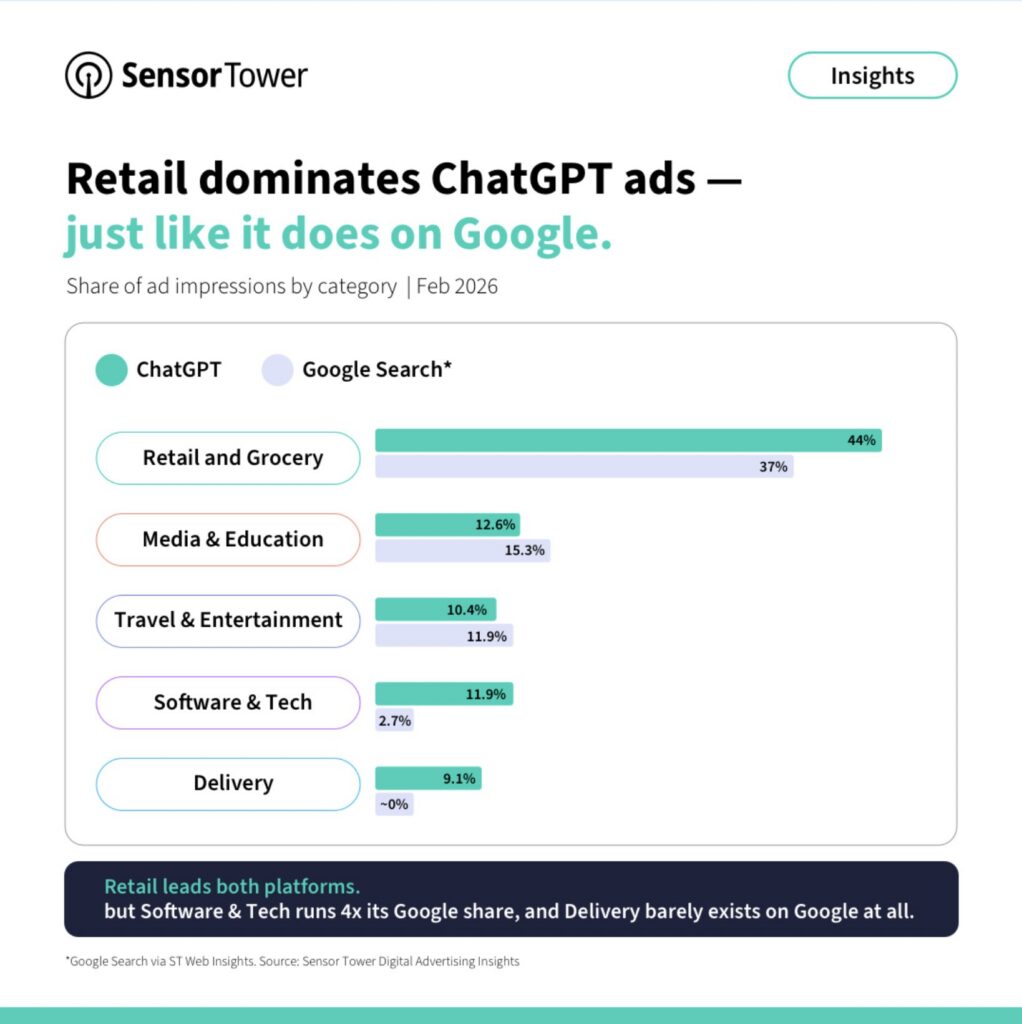
Sensor Tower tracked more than 100 brands running ads in ChatGPT over a two-week period, with a clear concentration in retail and grocery.
Retail alone accounts for around 44 percent of observed ads, with brands such as Target, Sephora, Wayfair, and Chewy already active in the space. Grocery, food delivery, and travel also feature heavily.
That distribution is not surprising. These are categories that have historically dominated search advertising, and they map closely to high-intent, purchase-driven queries.
The early takeaway is clear. ChatGPT is not replacing search behaviour. It is absorbing it.
ChatGPT Is Becoming A Discovery Layer
The types of ads being served reflect how users are engaging with the platform.
Rather than being limited to complex or exploratory queries, ChatGPT is increasingly being used for everyday discovery. Product research, recommendations, and purchase decisions are all moving into conversational formats.
That shift has significant implications.
Search has always been driven by intent, but ChatGPT adds context. Queries are longer, more nuanced, and often embedded within broader conversations. That gives the platform more signals to work with when matching ads.
For marketers, this creates an opportunity to reach users earlier in the decision-making process, not just at the point of conversion.
Google Playbooks Are Being Reused
Early advertiser behaviour suggests a degree of caution.
Sensor Tower notes that many brands are effectively importing their existing Google strategies into ChatGPT. That includes focusing on core retail categories, performance-led messaging, and direct response objectives.
This is typical of new channels. Marketers start with what they know before adapting to platform-specific dynamics.
However, ChatGPT is not simply another search engine.
The conversational interface changes how users engage with information, and how ads are integrated into that experience. Over time, strategies will need to evolve beyond keyword-driven thinking.
Some Brands Are Already Experimenting
While many advertisers are replicating search approaches, others are beginning to test what works in a conversational environment.
Brands such as Best Buy, Canva, and Preply are experimenting with how messaging and positioning can align with user queries in a more contextual way.
This is where the real opportunity lies.
Ads in ChatGPT are not isolated units. They sit within generated responses, which means relevance and tone matter more. The most effective executions are likely to feel like a natural extension of the conversation, rather than a traditional interruption.
That requires a different creative approach, one that blends performance marketing with content strategy.
Major Advertisers Are Holding Back
One of the more notable findings is which brands are not yet participating.
Major players such as Amazon, Walmart, Apple, and Costco are currently absent from the data set. That suggests a degree of hesitation among some of the largest advertisers.
There are several possible reasons.
Uncertainty around performance, brand safety, and measurement is likely a factor. ChatGPT ads are still in testing, and the format is not yet standardised.
There is also a broader question around how ads fit within AI-generated responses, and how users will respond to that experience over time.
For now, the absence of major spenders creates an opportunity for more agile brands to establish an early presence.
Ad Formats Reflect Intent, Not Interruption
One of the defining characteristics of ChatGPT ads is how they are delivered.
Ads are tied directly to the context of the conversation. That means relevance is not optional. It is fundamental to how the system works.
In traditional social feeds, ads interrupt content. In search, they align with intent. ChatGPT sits closer to the latter, but with an added layer of contextual understanding.
This raises the bar for targeting and creative. Ads that do not align closely with user intent are less likely to be effective, and potentially more likely to be ignored.
Measurement And Trust Remain Open Questions
While early data is promising, there are still unanswered questions around performance.
Attribution in a conversational environment is more complex. User journeys are less linear, and actions may not happen immediately after exposure.
Trust is another factor. Users may perceive AI-generated responses differently to traditional search results, which could influence how ads are received.
OpenAI’s broader positioning, and ongoing scrutiny, may also impact advertiser confidence as the product evolves.
For now, most brands are testing rather than committing significant budget.
Search Behaviour Is Shifting, Not Disappearing
The most important insight from early ChatGPT ad data is not about formats or categories. It is about behaviour.
Users are bringing familiar discovery habits into a new interface. Product research, comparison, and recommendation are still core use cases.
What is changing is how those behaviours are expressed.
Queries are more conversational. Context is richer. Expectations around relevance are higher.
That creates both opportunity and complexity for marketers.
Early Movers Will Shape The Channel
ChatGPT advertising is still in its early stages, but the direction is clear.
The platform is becoming a new layer of discovery, sitting alongside search rather than replacing it. Retail and performance-driven categories are leading the way, but other sectors will follow as formats mature.
The brands that move early have an advantage. They can test, learn, and adapt before competition intensifies.
However, success will not come from simply replicating existing strategies.
ChatGPT requires a different approach, one that understands conversation, context, and intent at a deeper level.
The fundamentals of performance marketing still apply. The execution will need to evolve.

RECOMMENDED FOR YOU
[STUDY] LinkedIn Becomes Top Source In AI Answers
LinkedIn has become the most cited domain for professional…
LinkedIn has become the most cited domain for professional…
AI Traffic Fails To Replace Search Losses
New data from Ahrefs, spanning more than 74,000 websites,…
New data from Ahrefs, spanning more than 74,000 websites,…
[STUDY] AI Brand Tracking Isn’t Easy
AI platforms are rapidly becoming part of the discovery…
AI platforms are rapidly becoming part of the discovery…