
AI is changing not just how content is discovered, but how it is read.
For years, brands have structured long-form content around narrative build. Context first. Insight later. The strongest point saved for the conclusion. That format worked in a traditional search environment where depth and dwell time signalled value.
AI systems reward something different.
An analysis led by Kevin Indig, former Director of SEO at Shopify and former VP of SEO and Content at G2, examined 1.2 million ChatGPT answers and more than 18,000 verified citations to understand how AI selects sources. The findings show that large language models behave less like patient students and more like busy editors. They prioritise early clarity, direct definitions and information density.
For senior marketers, the implication is structural. Content format now directly influences AI visibility.
The Ski Ramp Effect
One of the most striking patterns in the dataset is what has been described as the “ski ramp”.
44% of citations come from the first 30% of a page.
31% come from the middle section.
25% come from the final third, with a sharp drop near the footer.
The pattern held across randomised validation batches, with a reported p-value below 0.0001.
ChatGPT heavily favours the top of the document.
Many brand articles still build context before revealing the key insight. In an AI retrieval environment, that structure reduces citation probability. When core definitions, positioning statements or differentiators appear deep in the article, the likelihood of being surfaced declines.
At paragraph level, the pattern becomes more nuanced. In a subset of 1,000 highly cited articles, 53% of citations came from the middle of paragraphs. Around 25% came from first sentences and 23% from final sentences.
AI is not simply grabbing opening lines. It reads within paragraphs. Yet it disproportionately selects from paragraphs that appear early in the article.
Front-loading insight at page level is critical. Within paragraphs, clarity and information density matter more than rigid structural formulas.
Why AI Reads This Way
The explanation appears rooted in training data and efficiency.
Large language models are trained on journalism and academic writing that follow a bottom line up front structure. The most important information appears early. Models learn to weight early framing more heavily.
Even though modern systems can process large token windows, they establish context quickly and interpret subsequent information through that initial frame.
Slow narrative reveals can therefore register as weaker signals. Immediate classification of entities and facts is rewarded.
Five Traits Of Highly Cited Content
Beyond position, the analysis identified five linguistic characteristics that increase citation likelihood.
1. Definitive Language
Cited passages were nearly 2x more likely to use definitive phrasing such as “is defined as” or “refers to”.
Direct subject-verb-object constructions create stronger semantic links. When a user asks “What is X?”, a sentence structured as “X is Y” provides a clean match.
Declarative clarity outperforms vague framing.
2. Question And Answer Structure
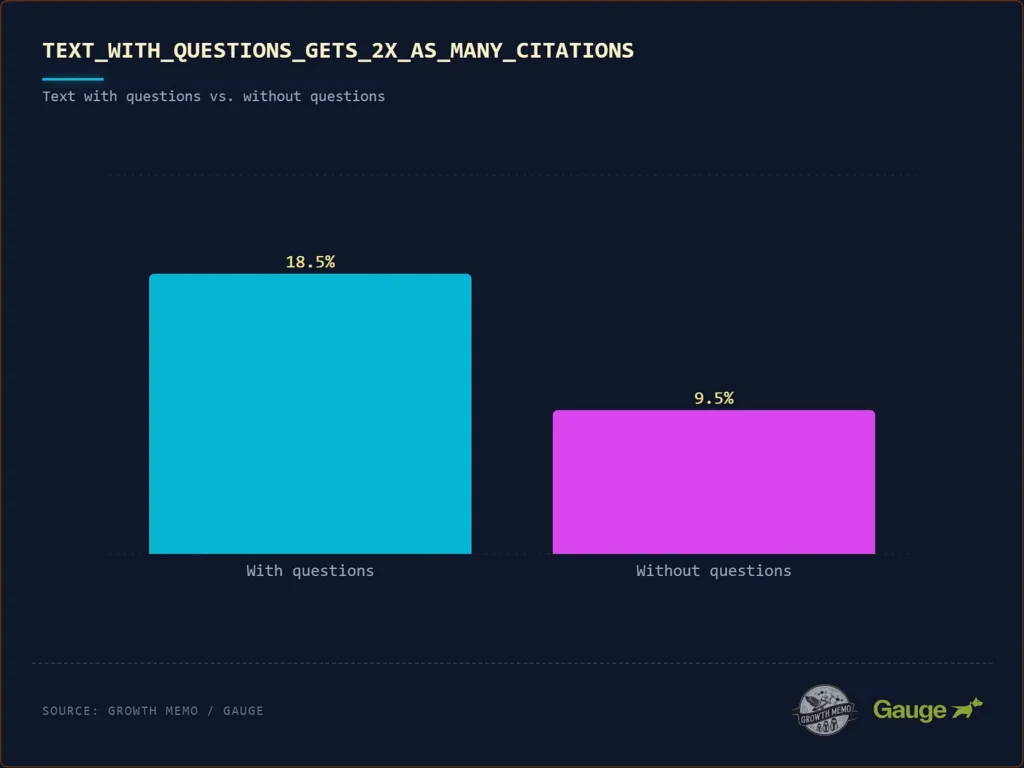
Highly cited content was around 2x more likely to include a question mark. Approximately 78% of citations tied to questions came from headings.
AI systems appear to treat H2 headings as prompts, with the following paragraph functioning as the answer.
A heading such as “What Is Retail Media?” followed immediately by “Retail media is advertising placed within a retailer’s owned digital properties” mirrors user intent and reinforces entity alignment.
Structural alignment increases citation likelihood.
3. Entity Richness
Typical English prose contains 5% to 8% proper nouns. In the heavily cited sample, the figure averaged 21%.
Specific entities such as Google Ads, Amazon, Salesforce or TikTok Shop anchor statements in verifiable context. Named entities reduce ambiguity and increase informational value.
Generic phrasing such as “leading platforms” carries less weight in probabilistic systems.
4. Balanced Sentiment
Subjectivity was measured on a scale from 0 to 1. Cited content clustered around 0.47.
Purely factual writing resembles an encyclopaedia entry. Highly emotional writing resembles opinion content. The strongest performers combined fact with interpretation, creating an analyst tone.
Explanation outperforms hype or sterile fact alone.
5. Business Grade Clarity
Winning content averaged a Flesch-Kincaid grade level of 16. Lower performing content averaged 19.
The difference reflects sentence structure rather than expertise. Shorter, clearer constructions make factual extraction easier for models.
Complexity without clarity reduces citation probability.
The Clarity Tax
The findings point to what has been described as a clarity tax. Writers must surface definitions, entities and conclusions early rather than saving them for narrative impact.
Long-form storytelling built for engagement is not automatically optimised for AI retrieval. Structured, briefing-style content performs better in citation environments.
For marketing leaders, the operational implications are tangible:
-
Move explicit definitions and key entities into the first 20% of priority pages.
-
Rework subheadings into query-led formats that mirror real prompts.
-
Increase entity density where appropriate, including competitors and category leaders.
-
Encourage subject matter experts to combine fact with measured interpretation.
-
Simplify sentence construction without diluting expertise.
These adjustments are not stylistic tweaks. They are distribution levers.
The Strategic Implication
A growing misalignment exists between narrative writing conventions and information retrieval systems.
High-visibility content increasingly functions like a structured briefing. It states the conclusion early, anchors it in entities and supports it with balanced analysis.
For senior marketers navigating AI-mediated discovery, clarity is no longer stylistic preference. It is a competitive advantage.


RECOMMENDED FOR YOU
[STUDY] AI Brand Tracking Isn’t Easy
AI platforms are rapidly becoming part of the discovery…
AI platforms are rapidly becoming part of the discovery…
Google Is Reshaping Paid And Organic Search
Search is not just becoming more AI driven. Paid…
Search is not just becoming more AI driven. Paid…
Google Expands AI Insights In GA4
Google Analytics is introducing two updates aimed at improving…
Google Analytics is introducing two updates aimed at improving…