Trust is no longer a soft brand metric in B2B. It is a measurable growth lever.
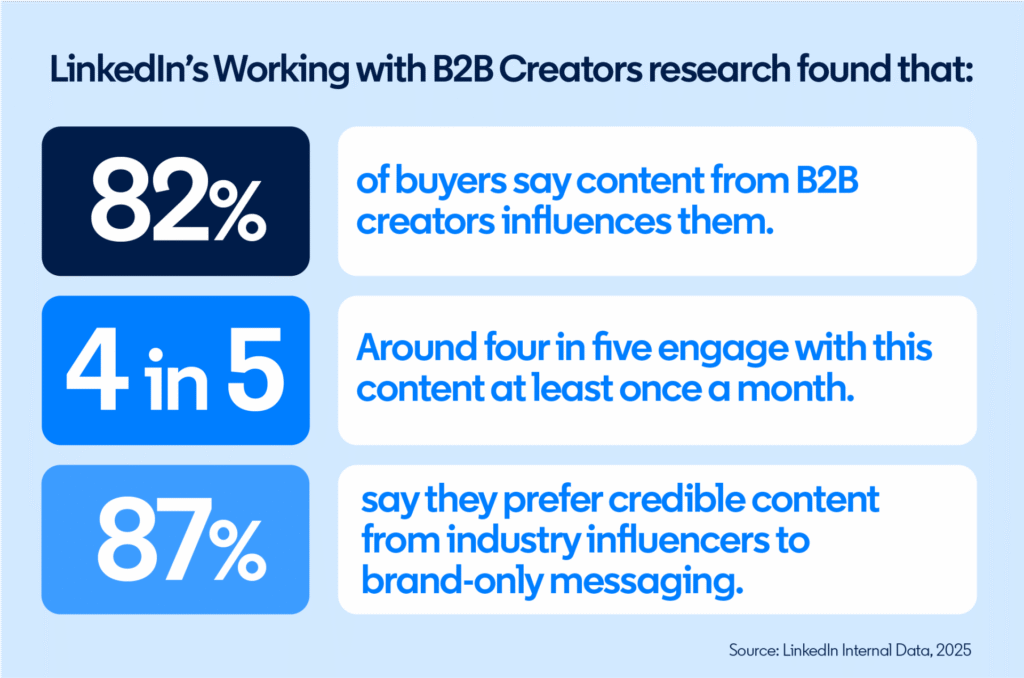
LinkedIn’s latest research into the 2026 B2B landscape makes the shift explicit. 75% of decision-makers say thought leadership is a more trustworthy way to assess a company’s capabilities than product sheets or marketing materials. 95% of hidden buyers say strong thought leadership makes them more open to outreach. Nearly 60% of buyers discover new brands through creator content. Almost 50% visit a vendor website after engaging with it, and more than a third speak with sales.
Employee networks on LinkedIn are, on average, 12x larger than a company’s own following.
Those figures point to a structural change in how influence is built. People are now the primary interface between brands and buying groups.
People Centric Influence Is Platform Agnostic
Employee advocacy programmes are scaling across enterprise organisations. Internal experts are building professional audiences not just on LinkedIn, but also on TikTok and Instagram. Influencer marketing investment continues to rise across B2C channels, supported by more mature measurement models and clearer links to revenue.
B2B is not witnessing a niche trend. It is aligning with a broader shift that has already reshaped consumer marketing. Audiences increasingly evaluate brands through people. They look for context, credibility and lived experience before they commit budget or loyalty.
LinkedIn’s data quantifies that expectation in a professional environment. The same mechanics underpin performance in B2C, where creators, community voices and employee advocates drive discovery and conversion at scale.
Thought Leadership Now Carries Commercial Weight
When 75% of decision-makers rank thought leadership above traditional marketing materials, content strategy becomes central to growth.
Product collateral explains capability. Thought leadership signals judgement.
Buyers use it to assess whether a partner understands market direction, regulatory pressure and operational reality. That is why 95% of hidden buyers report being more open to outreach when thought leadership is strong. Influence is being built before intent is declared.
Marketing teams optimising solely for short term lead capture risk overlooking this wider persuasion layer. Authority compounds over time, shaping buying group perception long before sales engagement.
Creators Influence The Full Funnel
Nearly 60% of buyers discovering brands through creator content elevates creators into the acquisition mix.
Influence deepens during evaluation. Around two thirds of buyers say creator perspectives help them assess options and cut through category noise. That interpretive role is critical in complex B2B environments.
At decision stage, almost 50% of buyers visit vendor websites after engaging with creator content, and more than a third initiate sales conversations. Creator impact extends directly into pipeline.
For senior marketers, the implication is clear. Creator partnerships should be aligned to revenue objectives, not positioned as experimental brand activity.
Scaling Human Authority With Paid Media
LinkedIn’s Thought Leader Ads are designed to scale posts from individuals while preserving their original voice. Instead of converting insight into traditional corporate creative, brands can promote authentic content directly to priority audiences.
Similar mechanics are visible across platforms.
Meta’s Partnership Ads allow brands to run ads from a creator’s handle, combining individual credibility with advanced targeting. TikTok’s Spark Ads enable advertisers to amplify organic creator posts natively, retaining engagement signals and social proof. Equivalent formats are now standard across major social channels.
The strategic principle is consistent across B2B and B2C. Identify credible human content that resonates organically. Then use paid distribution to extend its reach and accelerate performance.
Employees As Strategic Media Channels
The 12x network multiplier associated with employees reframes internal advocacy as a media asset.
Company pages operate within finite follower pools. Employees collectively hold expansive networks that often include prospects and partners beyond the brand’s owned audience.
Credibility compounds the distribution advantage. Engineers, consultants, retail associates or product specialists speak from proximity to the work. Their perspective carries weight because it reflects lived experience.
Structured programmes that provide narrative direction, enablement and light governance can unlock significant organic reach. When paired with paid amplification, employee content can perform as efficiently as traditional campaigns, often with stronger engagement and trust signals.
The Operating Model For Modern Growth
Video growth, improved measurement and the shift from short term lead generation towards long term pipeline and lifetime value are shaping strategy across sectors. People powered content sits at the centre of that evolution.
Creators drive discovery and evaluation. Employees extend reach and authenticity. Paid formats such as Thought Leader Ads, Partnership Ads and Spark Ads scale credible voices without diluting them.
The common denominator is simple. Influence now flows through individuals.
People centric content is not a passing tactic. It is the new infrastructure of B2B growth and B2C growth alike.


RECOMMENDED FOR YOU
LinkedIn Lets AI Multiply Ad Creative
LinkedIn is giving advertisers far more freedom to vary…
LinkedIn is giving advertisers far more freedom to vary…
LinkedIn Builds Its AI Search Advantage
LinkedIn is making a stronger case for its role…
LinkedIn is making a stronger case for its role…
[STUDY] LinkedIn Ads Influence More Than Leads
LinkedIn advertising remains expensive by most conventional performance measures.…
LinkedIn advertising remains expensive by most conventional performance measures.…