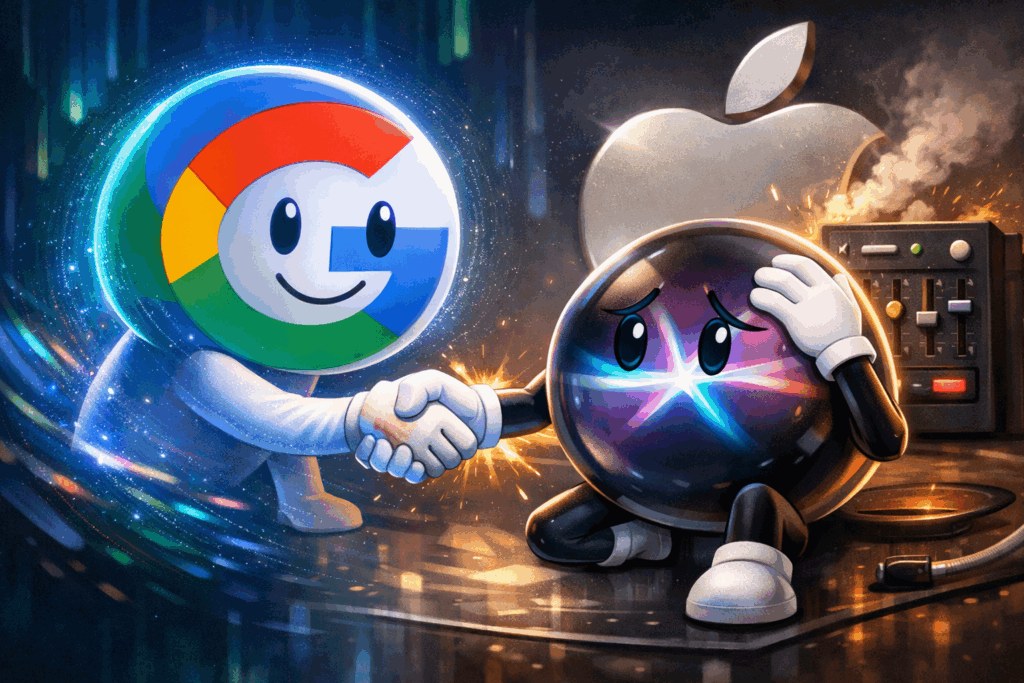
Apple has officially teamed up with Google in a landmark multi-year deal that puts Gemini AI models at the heart of its future AI strategy, including a long-awaited revamp of Siri. This agreement signals a major pivot for Apple, which is turning to an external partner to accelerate its foundation model development and expand its Apple Intelligence ecosystem.
After months of speculation and internal testing with OpenAI, Anthropic, and others, Apple confirmed it has selected Google’s Gemini models and cloud infrastructure to support future Apple Foundation Models. These will underpin new AI-powered features across iOS, macOS, and other platforms. For marketers, the significance lies not only in Apple’s renewed AI momentum but also in how this partnership could profoundly alter the mechanics of digital discovery.
Gemini to Power a Smarter Siri
At the centre of this partnership is a completely reimagined Siri. Long viewed as an underperformer in the AI assistant race, Siri has trailed behind the likes of ChatGPT, Google Assistant and Alexa in both capability and user experience. The Gemini integration promises to change that.
The new Siri, expected to launch in spring 2026, will be powered by Google’s most advanced models, offering more personalised responses, greater contextual understanding and deeper integration with Apple’s apps and devices. This is a critical leap for Apple, particularly after it delayed its planned Siri upgrade multiple times over the past year.
The company’s spokesperson confirmed that the new assistant is on track to launch later this year. When it does, it could significantly shift how millions of users interact with their devices and access information.
A New Era for Online Discovery
Beyond technical integration, the Apple and Google deal could spark a profound shift in how people discover information and engage with brands. The reimagined Siri, now backed by a capable foundation model, may become the first stop for many users when they need answers, recommendations or support.
This has direct implications for search and content discovery. As voice and AI assistants become more capable, they increasingly replace traditional web-based search. Why open a browser when Siri can answer a question directly, recommend a product or complete a task?
For marketers, this changes the rules of engagement. Visibility in AI-driven environments does not follow the same mechanics as SEO. There are fewer opportunities to optimise, limited visibility into how answers are ranked and minimal attribution. AI assistants operate as black boxes, making content and product discovery more opaque than ever.
Apple Could Build Its Own Discovery Layer
Given its control over both hardware and software, Apple has a unique opportunity to build a closed-loop discovery ecosystem. While Gemini provides the intelligence layer, Apple still determines what sources are prioritised, which apps integrate and how users are guided through information and commerce journeys.
That could mean prioritising Apple-owned content sources like Apple News, Maps, Music or App Store listings. It might also mean limiting outbound web referrals in favour of in-app results. This walled garden model mirrors what Meta and TikTok have done with algorithmic feeds, but applied across devices, operating systems and voice interfaces.
Marketers must now account for a discovery landscape where AI mediates the experience and Apple controls the destination.
Preparing for the Next Discovery Frontier
To stay ahead, senior marketers should take practical steps to prepare for this shift:
-
Review Structured Data and Schema Markup
Gemini-powered assistants will rely heavily on structured content to provide fast, accurate responses. Optimising for this now is essential. -
Integrate with Apple’s Ecosystem
Presence in Apple Maps, Business Connect, App Store and other first-party services will likely influence discoverability within Siri. -
Adapt for Voice and Conversational Formats
As voice interactions grow, marketers must create content that is concise, conversational and useful in spoken-word contexts. -
Monitor AI Assistant Performance
Begin testing brand visibility within Siri and other AI platforms to assess how your business is surfaced or overlooked. -
Explore New Attribution Models
AI-generated answers often obscure traditional referral paths. Consider how to capture value from zero-click and voice-first experiences.
What It Means for Marketers
For senior marketers, the implications of this partnership are far-reaching. As Siri evolves into a more capable, AI-powered assistant, Apple users may shift how they search, consume content and interact with brands. Voice interactions are likely to become richer and more action-oriented, especially within the Apple ecosystem. This may open up new discovery and engagement paths that are not tied to traditional web or app experiences.
Moreover, Apple’s privacy-first approach means marketers will need to rethink how they approach data collection, targeting and personalisation. If Apple Intelligence begins mediating more user interactions, brands will need to optimise for new types of in-app and voice-based engagement.
Apple’s collaboration with Google also underscores a broader convergence in the tech landscape. Even the most fiercely independent platforms are being drawn into strategic AI alliances. As generative AI becomes more integral to operating systems, browsers and assistants, marketers should expect faster cycles of change and greater fragmentation in user behaviour across platforms.
The Road Ahead
The Apple and Google Gemini partnership is more than a technical collaboration. It represents a major realignment in how two of the world’s biggest tech companies see the future of discovery, content delivery and AI-driven assistance. For Apple, it is a long-overdue AI catch-up. For Google, it is a strategic win that extends Gemini’s reach even further.
For marketers, it is a wake-up call. The AI layer is no longer a side feature. It is rapidly becoming the gateway to customers. As discovery shifts from browser to assistant, brands must be ready to meet users wherever the conversation starts.



RECOMMENDED FOR YOU
[STUDY] LinkedIn Becomes Top Source In AI Answers
LinkedIn has become the most cited domain for professional…
LinkedIn has become the most cited domain for professional…
AI Traffic Fails To Replace Search Losses
New data from Ahrefs, spanning more than 74,000 websites,…
New data from Ahrefs, spanning more than 74,000 websites,…
ChatGPT Ads Highlight Early Search Trends
Four weeks into OpenAI’s rollout of ads in ChatGPT,…
Four weeks into OpenAI’s rollout of ads in ChatGPT,…