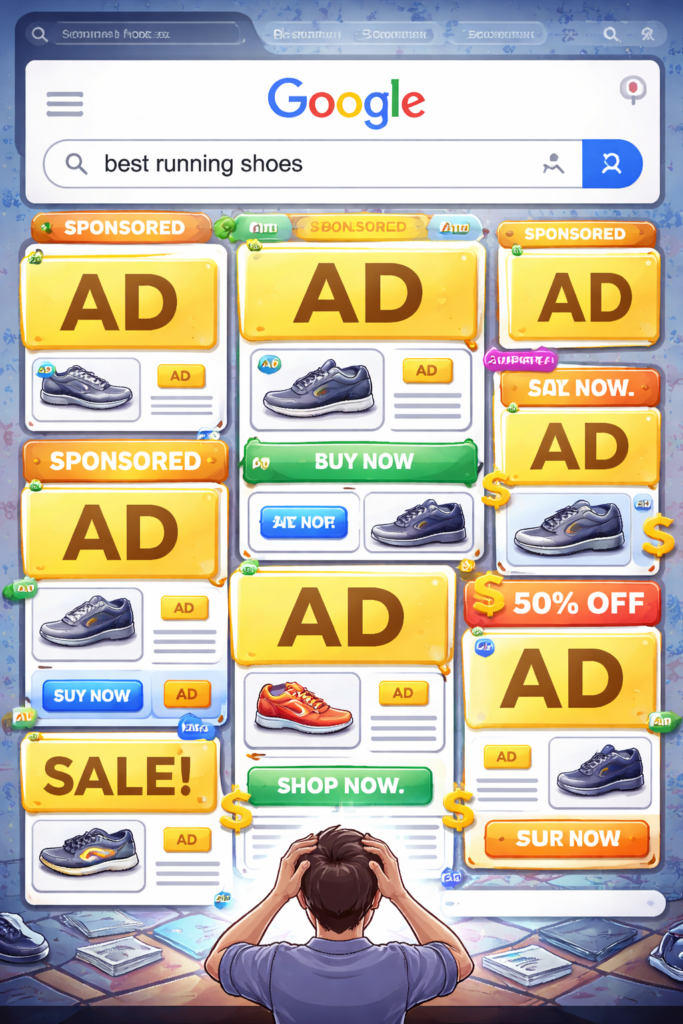
Search is not just becoming more AI driven. Paid listings are taking up more of the results page and more of the clicks.
Much of the recent debate has focused on AI Overviews and how generative answers are reshaping organic visibility. However, new data suggests a parallel shift that is just as commercially significant. Across multiple major verticals, classic organic click share has declined materially year over year, while paid ads have expanded their share of user clicks.
In some product categories, paid listings now account for roughly one third of all clicks. When users do click, an increasing proportion of those clicks are going to ads rather than traditional organic results.
The findings come from research by Aleyda Solis using Similarweb data, comparing January 2025 with January 2026 across thousands of U.S. queries in headphones, jeans, online games and greeting cards. The analysis tracked how clicks were distributed between classic organic listings, paid text ads, Product Listing Ads, AI Overviews and zero click searches.
Although the dataset is U.S. focused, the structural dynamics are unlikely to be confined to one market. Google’s monetisation strategy and AI rollouts are global. For brands operating across the UK and Europe, the direction of travel is commercially relevant even if precise percentages differ.
The pattern is consistent. Organic click share is shrinking. Paid share is expanding.
Organic Click Share Is Contracting
Across all four verticals analysed, classic organic click share fell year over year:
-
Headphones: 73% to 50%
-
Jeans: 73% to 56%
-
Greeting cards: 88% to 75%
-
Online games: 95% to 84%
These are double digit percentage point declines within a single year.
In headphones and jeans, total clicks across the analysed query sets also declined over the same period. Brands are therefore competing for a smaller share of traffic, and in some cases within a shrinking overall click pool.
The commercial implication is straightforward. Organic visibility alone is becoming a less predictable driver of traffic at scale. Ranking stability does not guarantee traffic stability when the underlying click distribution is shifting.
Paid Listings Are Expanding Their Share
While organic share fell, text ads gained ground consistently across every vertical analysed:
-
Headphones: 3% to 16%
-
Jeans: 7% to 16%
-
Online games: 3% to 13%
-
Greeting cards: 9% to 16%
No other measurable surface demonstrated this level of uniform uplift.
In product led categories, Product Listing Ads compounded the shift. In headphones and jeans, the combined share of text ads and PLAs roughly doubled year over year, pushing paid listings towards approximately one third of total clicks.
This redistribution of click behaviour has direct implications for media investment. Search is already one of the most mature performance channels. As paid surfaces expand, the baseline cost of maintaining visibility rises.
According to WARC’s 2026 global marketing priorities research, performance marketing continues to command the largest share of planned budget allocation, with marketers citing measurable ROI and conversion efficiency as their primary investment criteria. Search sits at the centre of that performance ecosystem.
If more brands are increasing paid budgets to offset organic decline, and if more of the results page is paid, competitive intensity within performance channels will increase further.
AI Overviews Are Expanding, But Paid Growth Is Measurable
AI Overview presence increased materially across all four verticals, in some cases by more than 20 percentage points.
However, while AI is clearly reshaping the results page, the most consistent and measurable shift in click share is toward paid ads. The decline in organic performance cannot be explained solely by generative answers appearing at the top of the page.
Search is evolving in two directions simultaneously. It is becoming more AI mediated and more heavily monetised.
Brand Behaviour Reinforces The Cycle
The response from brands illustrates how quickly this dynamic can reinforce itself.
In headphones, Amazon increased paid clicks by 35% while organic volume declined. Walmart increased paid activity nearly sixfold. Bose increased paid clicks by 49%.
In jeans, Gap increased paid clicks by 137% to become the leading paid advertiser in the category.
In online games, CrazyGames quadrupled paid clicks while organic traffic declined sharply, and Arkadium entered paid search after losing 68% of organic clicks.
Solis describes this as a migration cycle from organic to paid. Organic share declines. Competition intensifies. Brands increase paid investment to defend visibility. Paid surfaces capture a larger share of clicks.
Over time, that cycle resets expectations around what proportion of traffic can realistically be captured organically.
Implications For Performance And Media Strategy
For senior marketing leaders, this is not simply a search trend. It is a structural shift in the economics of online advertising.
If performance marketing already commands the largest share of marketing budgets, then increased paid density within search means higher competition for the same measurable outcomes. Auction pressure is likely to intensify. Defending category presence may require increased investment simply to maintain share.
Historical channel mix models may need revision. In categories where paid share has doubled within a year, assumptions about organic contribution are likely outdated.
Attribution frameworks also require scrutiny. If paid surfaces are capturing a larger proportion of clicks, performance gains may reflect redistribution within search rather than incremental demand generation.
Search remains commercially critical. However, it is becoming more expensive to compete purely through paid defence, and more difficult to rely on organic dominance.
For brands planning 2026 media investment, the question is not whether to prioritise performance marketing. It is how to compete effectively in a search environment where paid listings occupy more space and capture a growing share of user intent.
In that context, search strategy cannot sit in isolation. It must align with brand building, demand generation and long term authority, all of which influence performance efficiency in an increasingly monetised results page.

RECOMMENDED FOR YOU
[STUDY] LinkedIn Becomes Top Source In AI Answers
LinkedIn has become the most cited domain for professional…
LinkedIn has become the most cited domain for professional…
AI Traffic Fails To Replace Search Losses
New data from Ahrefs, spanning more than 74,000 websites,…
New data from Ahrefs, spanning more than 74,000 websites,…
ChatGPT Ads Highlight Early Search Trends
Four weeks into OpenAI’s rollout of ads in ChatGPT,…
Four weeks into OpenAI’s rollout of ads in ChatGPT,…