Most social strategies still treat platforms as a portfolio decision. Increase TikTok. Defend Instagram. Maintain Facebook. Test LinkedIn.
The problem is not budget allocation. It is structural misunderstanding.
Emplifi’s 2026 Social Media Benchmarks, built on analysis of more than 200,000 branded profiles across Facebook, Instagram, TikTok, X, YouTube and LinkedIn, shows growth, engagement and visibility behaving very differently depending on where brands show up .
Some platforms reward scale. Others reward resonance. Some amplify shares. Others prioritise retention.
The key takeaway is not that one platform is winning.
It is that each platform now has clear strengths and clear limitations.
For brands aiming to maximise performance in 2026, the challenge is not simply choosing where to invest. It is designing a unified approach that leverages those differences strategically rather than treating channels in isolation.
Engagement Metrics Need Reframing
Before examining individual platform dynamics, measurement itself needs context.
As platforms pivot aggressively towards video, interaction increasingly becomes passive. Watch time, average view duration and completion rates are emerging as dominant performance signals. Traditional engagement metrics such as likes and comments remain useful, but they no longer tell the full story of content effectiveness.
Short form video rewards attention, not reaction. Algorithms optimise for retention and session length. Engagement benchmarks measured in a traditional sense remain directionally valuable, yet they capture only part of performance.
This shift is platform agnostic. It affects TikTok, Instagram, Facebook and LinkedIn alike. Senior teams must evolve KPI frameworks accordingly.
TikTok Leads On Growth And Discovery
TikTok stands out as the fastest growing platform in the dataset, with median brand follower counts increasing by more than 200% year on year .
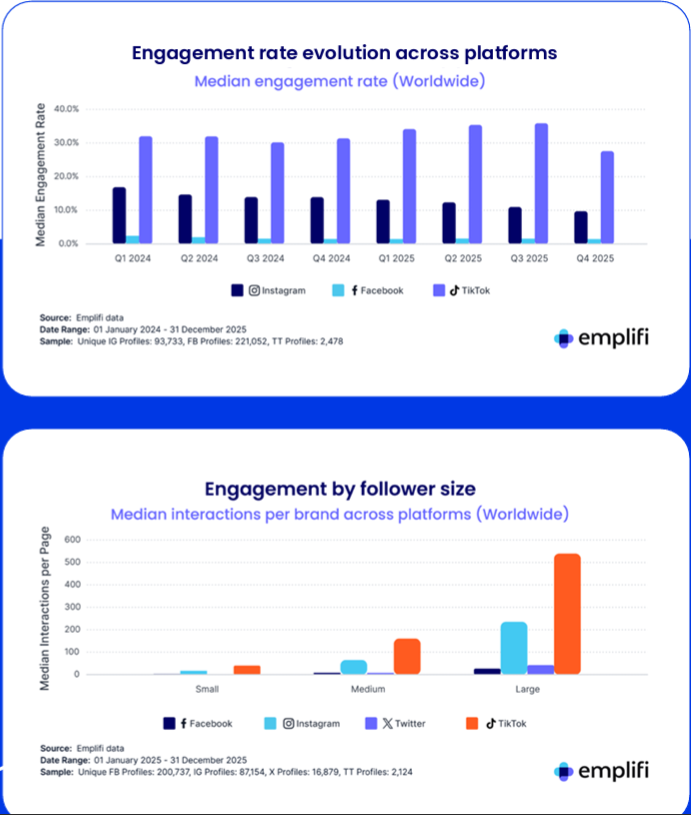
Engagement data reinforces its momentum. TikTok delivered the highest median engagement rates globally, peaking at 35.9% in Q3 2025 before easing to 27.6% in Q4, yet still outperforming other networks . Large brands generate more than double the median interactions of Instagram and more than 20× those of Facebook .
Discovery mechanics are increasingly algorithm led. More than 70% of TikTok video views now originate from the For You feed, up from the mid 50% range in early 2024 . Follower count is no longer the primary growth driver. Content resonance and early engagement signals dictate reach.
With TikTok’s US sale process progressing, market confidence is stabilising. Brands that previously limited exposure are expected to scale activity, particularly those targeting younger demographics and creator led storytelling. TikTok’s growth and discovery mechanics make it a primary acceleration engine in 2026.
Instagram Remains Foundational But More Competitive
Instagram continues to anchor audience scale, delivering steady mid single digit median follower growth . However, median engagement rates declined from 16.9% in Q1 2024 to 9.7% by Q4 2025 .
Organic reach has tightened materially. Median reach fell by 30 to 40% across carousels, images and Reels . At the same time, shares per reach increased by more than 150%, becoming the fastest growing engagement action on the platform .
Carousels and Reels generate roughly 44% more median interactions than image posts . Redistribution is becoming more important than passive appreciation.
Instagram remains essential for scale. However, visibility now depends on shareability, retention and format fluency rather than follower count alone.
Facebook Reels May Not Outperform Yet, But They Matter
Emplifi’s data shows that Facebook Reels do not dramatically outperform other non-Live formats in terms of median engagement . Links, images, standard video and Reels sit within a relatively narrow engagement band.
However, engagement rate alone does not capture platform direction.
Meta has consistently indicated that a majority of time spent on Facebook now sits within video and Reels environments. If approximately 60% of user time is concentrated in video surfaces, then Reels represent the structural focus of the platform, regardless of whether per post interaction rates currently spike.
Two realities can coexist:
-
Reels are not yet a breakout engagement lever on Facebook.
-
Reels are clearly the behavioural priority within the platform’s architecture.
For brands, that means ignoring Reels because they do not outperform in traditional engagement metrics would be short sighted. As attention consolidates around video surfaces, visibility and retention will increasingly be shaped by how effectively brands operate within that environment.
In other words, Reels may not be delivering outsized interaction today. They are still where user attention is consolidating.
LinkedIn Gains Targeted Momentum
LinkedIn demonstrates double digit median follower growth aligned to professional, employer branding and thought leadership objectives .
While overall audience sizes are smaller than Facebook or Instagram, LinkedIn’s growth is more concentrated and intention driven. The dataset includes more than 3,000 LinkedIn brand profiles , reinforcing that this momentum is observable at scale, not anecdotal.
LinkedIn’s positioning as a professional network creates structurally different engagement dynamics. Interaction may be lower in absolute volume than TikTok, yet context and intent are significantly higher. Content aligned to executive visibility, industry authority and sector insight performs disproportionately well within this environment.
As B2B buying cycles lengthen and employer branding intensifies, LinkedIn’s double digit growth trajectory signals strategic relevance. Brands investing in expertise led content and consistent professional storytelling are positioned to capture high value attention.
Video adoption is also rising on LinkedIn, particularly short form commentary and insight led posts. As attention metrics gain prominence across all platforms, LinkedIn is unlikely to remain text dominant. Creative adaptation will be essential.
X Plays A Tactical Role
X shows flat to slightly negative median follower growth, indicating limited momentum for broad audience expansion . Its value lies primarily in real time conversation and specific campaign moments rather than scalable growth.
For most brands, X operates as a tactical layer rather than a primary growth engine.
Social Should Function As A Strategic Layer
The deeper implication of Emplifi’s benchmark data is integration .
Every platform presents both opportunity and constraint. Optimising each independently risks fragmentation. A unified approach strengthens performance within platforms and beyond them.
Consistent messaging, repeated proof points and cohesive creative systems reinforce algorithmic familiarity across networks. That cohesion also matters in an AI mediated discovery environment.
As AI powered search engines and generative answer systems aggregate brand signals across the web, fragmented presence weakens authority. Unified positioning and aligned expertise signals increase the likelihood that brands surface accurately within AI driven results.
Platforms are not interchangeable. They are specialised.
Brands that treat social as an integrated reputation and content layer, rather than a series of disconnected feeds, will be better positioned for both platform performance and AI powered discovery in 2026.



RECOMMENDED FOR YOU
[NEW STUDY] Meta And TikTok Battle For Engagement
New data from Buffer’s State of Social Media Engagement…
New data from Buffer’s State of Social Media Engagement…
LinkedIn Reveals Top Marketing Skills 2026
LinkedIn has released its 2026 Skills on the Rise…
LinkedIn has released its 2026 Skills on the Rise…
LinkedIn Data Redefines B2B Influence
Trust is no longer a soft brand metric in…
Trust is no longer a soft brand metric in…