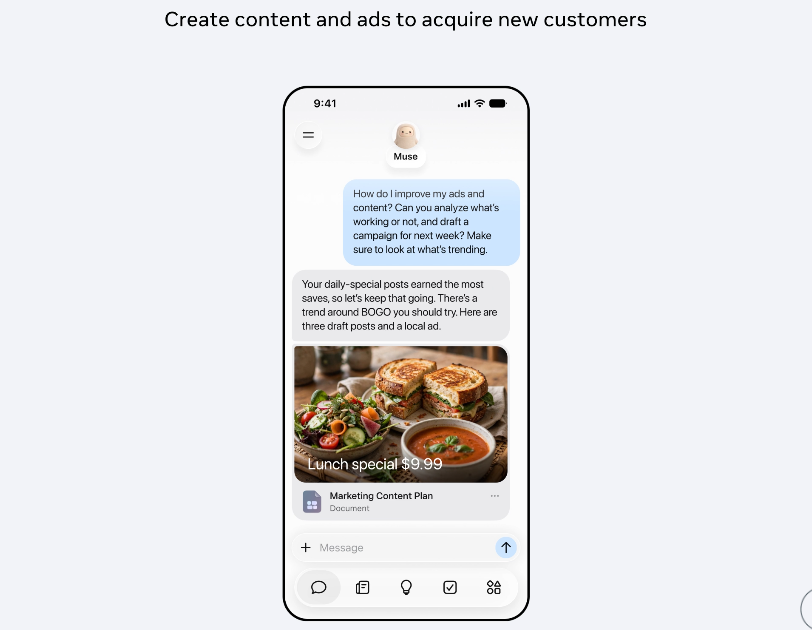
Meta is extending its AI capabilities beyond Facebook, Instagram and Ads Manager, introducing new integrations that allow its Muse AI agent to work across marketing, customer data, creative production and business applications.
The company has launched Muse for Small Business, expanding its recently introduced personal AI agent with connections to platforms including Canva, Shopify, Klaviyo, Slack, Stripe and QuickBooks.
Businesses can also connect Facebook Pages, Instagram professional accounts and Meta advertising accounts, allowing Muse to access information about campaign performance, social media activity and customer interactions.
Once connected, the agent can analyse business information, develop marketing plans, prepare content and coordinate tasks across supported applications. Meta says Muse can continue working after users close the application, although publishing content, sending communications and spending money require approval.
The launch follows similar developments from OpenAI, Microsoft and Anthropic, which are introducing AI agents capable of working across multiple applications. Meta’s particular focus is connecting its advertising and social media ecosystem with the wider activities involved in marketing operations.
Meta Muse Connects Advertising With Marketing Workflows
Meta has spent several years expanding automation across Facebook and Instagram advertising, particularly through Advantage+ and its growing collection of AI creative tools.
Those capabilities primarily operate within Meta’s advertising environment, helping advertisers automate campaign delivery, audience selection, optimisation and elements of creative production.
Muse extends automation into the activities surrounding advertising, bringing information from different applications into a single AI environment.
For example, a marketing team could potentially ask Muse to examine recent Meta advertising performance alongside Shopify sales data, identify changes in product demand and develop recommendations for an upcoming campaign.
Meta’s suggested use cases include analysing a year’s sales, advertising and social media performance to prepare a growth plan, or reviewing campaign results before drafting new creative activity.
Campaign reporting, customer information and commercial results frequently sit across separate applications. Bringing those sources together could reduce some of the manual work involved in gathering information and preparing recommendations.
However, the quality of the resulting analysis will depend on the accuracy of the underlying data, the information available through individual connectors and Muse’s ability to interpret it correctly.
Meta has demonstrated several potential applications, although independent evidence of improvements in productivity or marketing performance remains limited.
Canva, Shopify And Klaviyo Expand Meta’s AI Capabilities
Muse supports connections to a range of third-party applications, extending its potential usefulness beyond Meta’s own products.
Several integrations are particularly relevant to marketing and communications teams.
Canva provides a connection to creative assets and design tools, allowing Muse to incorporate existing brand materials into content development.
Klaviyo connects customer information and email marketing activity, supporting campaign analysis and the preparation of customer communications.
Shopify provides access to ecommerce information, potentially allowing sales and product performance to inform advertising recommendations.
Other supported applications include Slack, Notion, Asana, Figma, Stripe and QuickBooks, extending Muse into collaboration, planning and financial information.
Together, the integrations could allow an agent to work across several stages of a campaign, from analysing commercial performance to preparing creative assets and coordinating activity.
However, the depth of functionality varies between connectors. Some may primarily support information retrieval, while others allow the agent to create content or modify records.
Muse also supports custom connectors, potentially allowing organisations to link additional services.
Businesses will need to assess what each integration supports before incorporating it into regular marketing workflows.
AI Agents Could Reshape Social Media Strategy And Operations
Meta’s expansion into connected workflows has implications for how organisations plan, produce and manage social media activity.
Social media management typically involves content planning, creative production, publishing, community engagement, paid advertising and performance analysis. Coordinating those activities across separate applications can involve considerable manual work.
Muse could potentially bring several processes together, particularly for teams managing substantial Facebook and Instagram activity.
A social media team might use an agent to review organic and paid performance, identify topics generating engagement, examine customer feedback and develop recommendations for the following month’s content calendar.
Connections to creative applications could support content preparation, while workplace integrations could help coordinate internal reviews and approvals.
The ability to connect social media activity with wider business information is potentially more significant.
An organisation might combine customer enquiries from social channels with information from sales, customer service or ecommerce systems.
An agent could help identify recurring questions, emerging product issues or changes in audience interests, informing content planning and broader communications activity.
The practical value will depend on what information Muse can access and how accurately it interprets that information. Meta has yet to demonstrate that its integrations can reliably support all these potential workflows.
Routine activities such as preparing reports, developing initial content drafts and coordinating approvals may become easier to automate.
However, decisions about audience priorities, editorial direction, reputation management and community relationships require wider organisational context and human judgement.
A post generating strong engagement, for example, may contribute little to an organisation’s commercial or communications objectives, while content attracting less attention may serve an important reputational purpose.
Teams adopting AI agents will need to assess recommendations against broader objectives rather than relying exclusively on the performance indicators available within individual platforms.
Meta Joins ChatGPT, Claude And Copilot In AI Workflows
OpenAI, Microsoft and Anthropic are also developing AI environments capable of accessing business information, operating applications and completing multistep tasks.
Their products approach these activities from different starting points.
Microsoft Copilot is integrated with Microsoft 365, including Outlook, Teams and SharePoint.
ChatGPT Work supports research, document creation and more substantial activities involving connected applications.
Claude Cowork provides similar capabilities for documents, research and other workflows.
Meta Muse combines direct access to Facebook, Instagram and Meta advertising accounts with third-party business integrations.
For organisations already using workplace AI, the available capabilities increasingly overlap.
Campaign analysis, content preparation and reporting may be possible through several AI environments, depending on their connectors and permissions.
Meta’s direct relationship with its advertising platforms could provide advantages in certain workflows, although the extent of those advantages remains unclear.
The practical comparison centres on which tasks each product can reliably complete, the information available to it and the amount of human intervention required.
Organisations will also need to consider the implications of introducing additional AI subscriptions and managing potentially duplicated workflows.
Meta Muse Raises Data Access And Governance Questions
Allowing an AI agent to access advertising accounts, customer records, creative assets and financial information introduces additional governance considerations.
Meta says Muse requires approval before publishing content, sending communications or spending money.
Users can review an activity history showing what the agent has completed and what it intends to do next.
Organisations will still need to decide which employees can connect applications and what information those connections make available.
An employee authorised to review campaign performance, for example, may have different permissions from someone responsible for approving advertising expenditure or accessing customer records.
There are also questions about the reliability of automated analysis.
Muse may identify declining campaign performance or changing customer behaviour, although interpreting those developments can require information about seasonality, promotional activity, product availability and wider business conditions.
Similarly, content prepared by an agent may require checks for accuracy, brand consistency, regulatory compliance and suitability for the intended audience.
Meta’s approval requirements retain human involvement in consequential actions. Effective oversight will depend on employees having sufficient information and expertise to assess the agent’s work.
Meta Muse Pricing And Availability
Muse for Small Business is currently available to users aged 18 and over in the United States and Canada. Meta has indicated that it intends to expand internationally.
Muse provides free access for many activities, with paid subscription options available for users requiring additional capacity. Specific capabilities and usage allowances depend on the subscription and supported integrations.
Although Meta has initially positioned the offering towards smaller businesses, the underlying capabilities have wider relevance to organisations managing advertising, customer information and marketing activity across multiple applications.
Larger organisations may have more complex requirements around data access, governance and existing technology investments, making the suitability of Muse dependent on how its capabilities develop.
Meta Expands Beyond Advertising Automation
Meta’s existing advertising automation primarily supports activities within Ads Manager. Muse extends its involvement into business analysis, campaign planning, content preparation and operational coordination.
The company is entering an increasingly competitive market where several AI platforms are developing similar capabilities.
For marketing and communications teams, a practical starting point would be to evaluate a recurring workflow involving Meta advertising data and another business application.
Combining campaign performance with ecommerce or customer information, for example, could help establish whether Muse produces useful analysis, reduces manual work and supports better decisions.
The evaluation should also consider data permissions, the accuracy of recommendations and the time required to review outputs.
Meta’s direct access to its advertising ecosystem may prove useful for organisations with substantial Facebook and Instagram activity. However, its value will depend on the reliability of its integrations and whether it provides meaningful advantages over existing workplace AI tools.
As AI agents become more capable of working across applications, organisations will increasingly need to determine which systems manage particular workflows and who remains accountable for their outputs.




RECOMMENDED FOR YOU
ChatGPT Introduces Visual Advertising
OpenAI is expanding ChatGPT advertising with new visual formats,…
OpenAI is expanding ChatGPT advertising with new visual formats,…
[STUDY] AI Search Shapes Brand Decisions
AI search is starting to influence purchase decisions well…
AI search is starting to influence purchase decisions well…
LinkedIn Lets AI Multiply Ad Creative
LinkedIn is giving advertisers far more freedom to vary…
LinkedIn is giving advertisers far more freedom to vary…