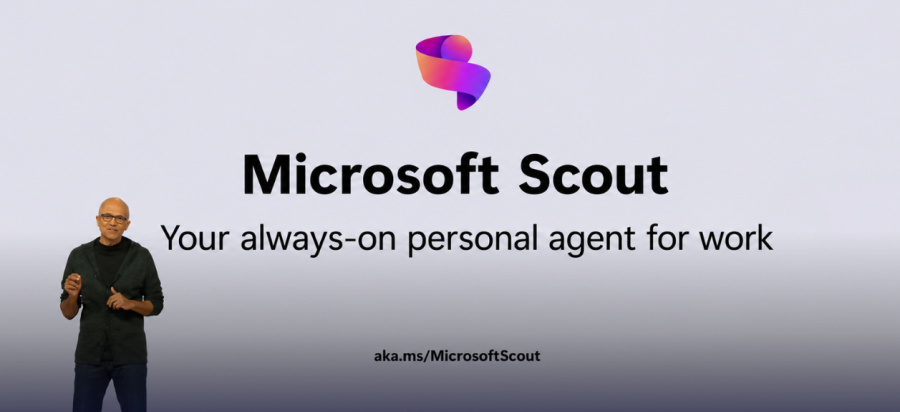
Microsoft is moving AI agents from the chat window into the working day.
Its new assistant, Microsoft Scout, is designed to sit across Microsoft 365, desktop and web environments, helping users coordinate meetings, prepare materials, identify deliverables and keep work moving without needing to be prompted every time.
For marketing, communications, digital and customer teams, Scout points to a more important shift than another AI writing tool. Microsoft 365 AI is becoming a suite of different generative and agentic tools, each serving different types of work.
Some help people create, summarise and reason. Some execute delegated tasks. Some sit across workflows. Some allow organisations to build custom agents. Others govern the agent layer.
The distinction matters because Scout is not simply another place to ask AI for a draft. It suggests Microsoft is starting to separate AI assistance, task execution, workflow coordination and governance into different parts of the stack.
Copilot Is Becoming A Suite
Scout needs to be understood within the wider Microsoft 365 AI stack.
Microsoft 365 Copilot is still the most familiar layer, helping users draft, summarise, analyse and reason across workplace content. Cowork moves closer to delegated execution, where a user gives an outcome and an agent works through a set of steps with approval points along the way. Copilot Studio allows organisations to build more specific agents for defined business processes. Agent 365 sits closer to the governance layer, helping organisations manage, observe and secure agents as they spread across the business.
Scout appears to sit in a different space again. Rather than simply responding to a prompt or completing a delegated task, it is designed to keep track of work over time. Its role is closer to persistent coordination: watching meetings, deadlines, materials, decisions and follow-up, then helping the user keep momentum without restarting the conversation each time.
For marketing and comms teams, the use cases are not interchangeable. A content team may use Copilot to summarise research or draft campaign copy. A marketing operations team may use Cowork to prepare a status update or assemble launch materials. A digital team may use Copilot Studio to build a repeatable reporting or intake workflow. A senior comms leader may use Scout to keep track of approvals, upcoming announcements, stakeholder gaps and unresolved decisions.
Lumping these tools together as “AI” misses the operational point. Microsoft is building different tools for different forms of work, and the value will sit in matching the tool to the task.
Agents Are Moving Beyond The Prompt
Microsoft describes Scout as its first “Autopilot” agent. In simple terms, that means an always-on agent with its own identity, working in the background and acting on behalf of the user within approved permissions and policies.
Instead of answering a single question, Scout is meant to hold context over time. It connects to Teams, Outlook, OneDrive, SharePoint, chats, email, calendar and contacts. Users interact with it through Teams, while the desktop experience extends its reach into the browser, local resources and model context protocol servers.
Scout is built on OpenClaw, the open-source agent framework that created a surge of attention in early 2026. OpenClaw’s appeal was its flexibility. Its problem was also its flexibility. More autonomous agents can do more useful things, but they can also behave unpredictably when permissions, context and oversight are weak.
Microsoft’s bet is that the same agentic capability becomes more viable when placed inside the Microsoft 365 environment, wrapped in enterprise controls and connected to systems many organisations already use every day.
Coordination Work Is The First Target
Scout’s initial use cases are deliberately practical. It can coordinate meeting times across time zones, flag important meetings, draft agendas, generate preparation materials, identify upcoming deliverables and block time in a user’s calendar.
That may sound mundane, but coordination work is one of the least visible drains on modern teams. Marketing and comms leaders spend plenty of time chasing inputs, aligning stakeholders, preparing updates, summarising meetings, nudging decisions and trying to work out what has quietly stalled.
Scout is not being positioned as a campaign strategist or brand expert. More realistically, it is being positioned as an administrative and operational layer that can reduce the drag around professional work.
Many AI conversations in marketing still drift quickly towards content production. Yet the more useful use cases may sit one layer underneath content: briefing, planning, workflow, approvals, reporting, internal coordination and governance.
An agent that can understand where work is stuck, who needs to respond and what needs to happen next could be more useful than another tool that writes five subject line options.
Persistent Context Changes The Relationship
The more ambitious part of Scout is its ability to develop persistent context. Users can name their own Scout instance, give it ongoing feedback and build up memories and skills around how they work.
Microsoft says Scout is powered by Work IQ, learning what users care about, how work gets done and what should happen next. In practice, the assistant should become more useful as it observes patterns, receives corrections and builds familiarity with a user’s preferences and recurring tasks.
That creates a different adoption model. With most AI tools, value comes from the immediate exchange. Ask a better question, get a better answer. With persistent agents, value builds through training, routines and trust.
For senior teams, the question becomes which recurring patterns are worth codifying, which tasks can be safely delegated, and where human judgement needs to stay close to the work.
Marketing and comms teams already have plenty of recurring patterns an agent could support: preparing campaign status updates, tracking approval delays, compiling stakeholder briefing packs, monitoring launch timelines, summarising meeting actions, checking whether content dependencies are ready, or surfacing gaps before a campaign slips.
None of that is glamorous. Much of it is exactly what makes work work.
Trust Becomes Part Of The Product
Scout also shows how quickly the AI agent conversation is becoming a governance conversation.
Microsoft says each Scout agent operates under its own governed Entra identity rather than a shared service account. Access controls determine which resources and destinations the agent can use, while sensitive actions can require human approval.
Microsoft is also introducing a policy conformance system that checks whether the agent is operating within set guidelines and creates an audit trail. The company says it is contributing policy conformance back upstream to OpenClaw, so organisations using the open-source framework can validate whether their own environments meet security and compliance requirements.
The detail may feel technical, but the implication is practical. Agents will not be allowed to roam freely through enterprise systems just because vendors would like adoption to move faster. If an AI system can read files, schedule meetings, message colleagues or act on behalf of a user, trust becomes part of the product.
Marketing and comms teams should pay close attention because these systems may touch sensitive material: campaign plans, customer data, internal announcements, executive communications, media issues, stakeholder lists and unpublished content. A useful agent is one that can access context. A risky agent is also one that can access context.
Workflow Design Becomes More Visible
Scout is currently being released through Microsoft’s Frontier programme as an experimental product, so it is not yet a mainstream rollout. Its significance is what it signals.
AI adoption is shifting away from isolated productivity moments and towards embedded workflow systems. The question is becoming less “which AI tool should we use?” and more “which parts of the work now benefit from AI support because agents can hold context, take action and follow through?”
That is a more demanding question than it first appears. It involves process design, data access, governance, team capability, accountability and change management. It also brings the messy reality of everyday work into sharper view.
Scout may reduce coordination work for teams already operating with clear priorities, clean information structures and sensible permissions. For teams with sprawling channels, unclear ownership and weak approval discipline, it may simply expose the mess more quickly.
Scout is not proof that autonomous agents are ready to run the office. It is a sign that the next phase of AI in the workplace will be less about clever prompts and more about operational judgement.
The organisations that benefit first will not necessarily be the ones with the most tools. They will be the ones with a clear enough view of their workflows to know what should be automated, what should be assisted, and what should remain human.












RECOMMENDED FOR YOU
[STUDY] Only 6% Of Marketing Teams See Major AI Returns
AI adoption is almost universal across marketing departments, yet…
AI adoption is almost universal across marketing departments, yet…
Canva’s New AI Model Targets Everyday Design Work
Canva has launched its own AI image generation model,…
Canva has launched its own AI image generation model,…
Instagram Edits Gets A Major AI Upgrade
Instagram is bringing AI-powered content analysis and planning into…
Instagram is bringing AI-powered content analysis and planning into…