
Marketing teams have spent the past two years being encouraged to use AI more often.
Use it for campaign planning, research, content repurposing, reporting, customer insight, social copy, presentation development and every awkward first draft nobody wants to write from scratch.
The message was simple enough: experiment first, work out the model later.
That phase is now meeting the finance department.
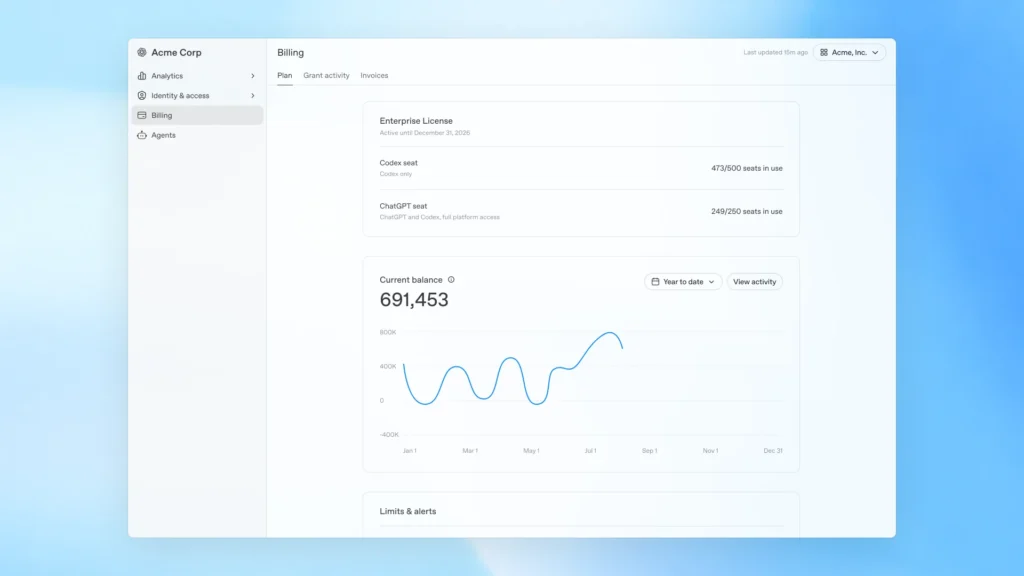
OpenAI has introduced new usage analytics and spend controls for ChatGPT Enterprise, giving admins more visibility over how credits are being used across users, products and models. Admins can also set usage limits at workspace, group and individual level, with employees able to request higher limits when needed.
On paper, it is an admin update. In practice, it reflects a larger shift in enterprise AI adoption. The conversation is moving from access to accountability.
Tokenmaxxing Was Never A Strategy
The early AI adoption playbook rewarded activity.
High usage was often treated as a sign of progress. If teams were running more prompts, using more tools and experimenting across more workflows, the organisation could tell itself adoption was happening.
In some technology circles, the behaviour picked up a name: tokenmaxxing. Heavy token consumption became a rough proxy for ambition.
That may be tolerable in a small pilot. It becomes harder to defend when AI costs start behaving less like software subscriptions and more like metered infrastructure.
Several high-profile examples have made the issue difficult to ignore. Uber reportedly burned through its 2026 AI budget in four months after heavy use of Claude Code, before introducing a monthly token cap per user. Fortune reported that Uber’s COO said it was hard to draw a clean line between rising AI usage and more useful consumer features.
Microsoft has also reportedly pulled back on internal Claude Code use, moving engineers towards GitHub Copilot CLI after concerns about cost and tool alignment.
Harvey, the legal AI company, has shown how quickly usage can escalate. Its CEO said the company’s AI usage rose from around one trillion tokens a month in January to an estimated 12 to 13 trillion by May. Legal AI work may justify high usage, but the example shows how quickly token consumption can move once AI becomes embedded in daily work.
For marketing and communications teams, the warning is not that AI use is bad. Usage volume alone says very little.
A team can run hundreds of prompts and still produce average work. Another team can use AI less visibly but build better briefs, stronger campaign planning, faster research cycles and more consistent reporting.
Token usage is a cost signal. It is not an impact measure.
Visibility Is Becoming An AI Requirement
Most organisations know how many AI licences they have purchased. Fewer know which teams are using AI heavily, which workflows are consuming the most credits, which models are driving cost, or whether expensive usage is connected to valuable work.
OpenAI’s new analytics are designed to make that picture clearer. The Global Admin Console can show ChatGPT and Codex credit consumption across users, products and models. Admins can track usage trends, identify top users and export the data through a Cost API for deeper analysis.
Visibility will matter more as AI use moves beyond simple chat prompts.
Deep research, coding agents, image generation, advanced voice, reasoning models and workflow agents all have different cost profiles. Some may deliver meaningful productivity gains. Others may burn compute because people are using powerful tools for low-value tasks.
Marketing teams are a good example. A premium AI workflow may be justified when it improves market analysis, customer insight, campaign architecture or content operations. It is harder to justify if the same expensive model is being used for quick subject lines, light rewrites or low-stakes ideation.
The licence-count view of software adoption is too blunt for AI. Usage now needs to be understood as a variable operating cost.
Cost Control Cannot Mean Cutting Off Useful Work
Spend controls can easily become a blunt instrument.
A CFO sees a rising bill. Access is capped. Teams complain that innovation is being slowed. The organisation lurches from enthusiasm to restriction without ever working out which use cases were worth scaling.
OpenAI’s updated controls allow for a more nuanced approach. Admins can set default workspace limits, configure limits for specific groups and create individual overrides for people who need more capacity. Employees can see their own credit usage and request increases with context about what they are working on.
AI should not be rationed evenly.
A marketing operations team building campaign workflows may need heavier usage than a team using ChatGPT for occasional copy support. A sales team using AI for account research may have different needs from a comms team using it for message testing.
Good AI governance should not punish serious use. It should distinguish between valuable usage, casual experimentation and waste.
AI Budgets Are Becoming Harder To Forecast
Enterprise AI costs are no longer neatly contained inside fixed-seat subscriptions.
ChatGPT Enterprise and Edu workspaces use shared credit pools for advanced capabilities, with credits applying to features such as Deep Research, Thinking models, Image Gen, Advanced Voice and Codex. OpenAI’s new controls sit in that context.
One employee using ChatGPT for short drafting tasks may create modest cost. Another using deep research, image generation or agentic workflows may consume far more. Two teams with the same number of licences can have very different usage patterns.
The broader market is moving the same way. AI agents can be particularly expensive because they read, reason, retry, search, inspect files and run multi-step workflows. A recent academic study of agentic coding tasks found that agent tasks can consume far more tokens than simpler code reasoning or chat, with large variability between runs.
Marketing leaders will need more discipline than “everyone gets access”.
Teams need to decide which jobs deserve premium model use, which can be handled by lighter tools, and which workflows need redesign before extra AI spend makes sense.
Marketing Needs Its Own AI Operating Model
Marketing and communications teams cannot leave AI cost control entirely to IT.
The heaviest business use cases often sit close to marketing work: content production, audience research, reporting, customer analysis, campaign planning, social media, sales enablement and brand governance. Those activities carry cost, but also genuine potential value.
Marketing leaders should be able to explain where AI is being used, which workflows it supports, what quality controls sit around it, and where heavier usage is commercially justified.
A useful review should ask:
- Which marketing workflows genuinely benefit from premium AI use?
- Which tasks can use lighter models or reusable templates?
- Where are teams duplicating prompts, research or content production?
- Which AI use cases reduce external cost, improve speed or lift quality?
- Who approves heavier usage when teams request more capacity?
Those questions are not designed to slow adoption. They are designed to make adoption survive contact with budgeting.
AI Enablement Is Becoming Cost Enablement
OpenAI’s spend controls acknowledge where enterprise AI is heading.
Access alone is no longer enough. Training alone is not enough. Governance alone is not enough. Organisations also need visibility into usage, cost and value.
The risk is familiar. Businesses encourage broad experimentation, costs rise, limits arrive, and everyone decides AI has become harder to use. That is not an AI problem. It is an operating model problem.
A better approach starts earlier. Define the workflows where premium AI use is justified. Train teams to choose the right tool for the right task. Review usage before it becomes a budget shock. Give serious users enough room to work, while making casual consumption visible.
Marketing teams should not wait for finance or IT to define those rules on their behalf. If AI is becoming part of campaign planning, content operations, reporting and customer insight, marketing needs a clear view of both the value being created and the cost being consumed.
The first wave of enterprise AI rewarded enthusiasm. The next one will reward judgement.




















RECOMMENDED FOR YOU
Google Gives Advertisers More AI Max Visibility
Google is introducing new AI Max reporting capabilities, giving…
Google is introducing new AI Max reporting capabilities, giving…
[STUDY] AI Content Production Keeps Accelerating
93% of marketers now use AI to support content…
93% of marketers now use AI to support content…
Meta Launches AI Agent For Businesses
Meta is extending its AI capabilities beyond Facebook, Instagram…
Meta is extending its AI capabilities beyond Facebook, Instagram…