
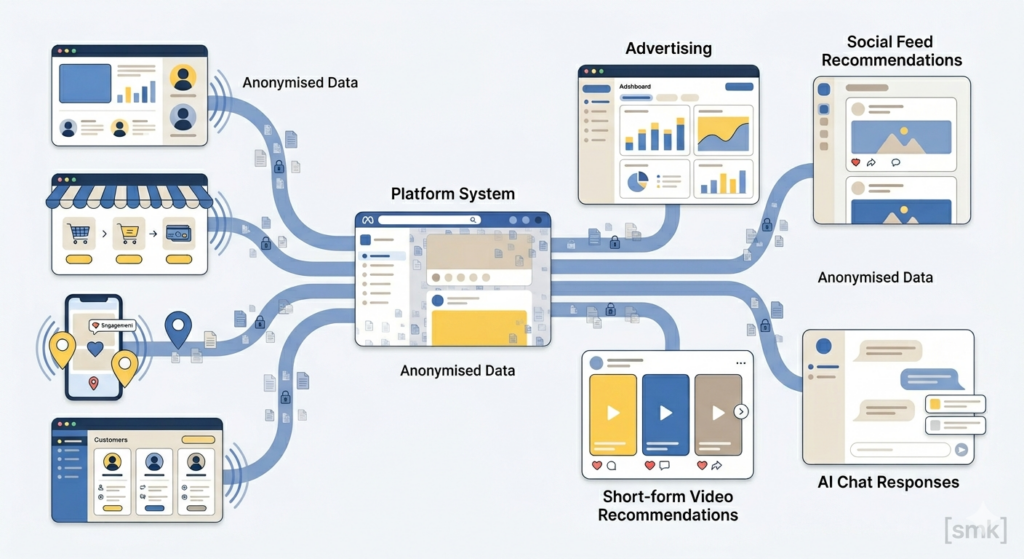
For years, marketers have been told to improve the data they send back to Meta because it helps ads work better.
Cleaner conversion events. Better server-side tracking. Stronger match quality. More reliable optimisation. All sensible enough, especially after Apple’s iOS 14.5 update weakened parts of Meta’s old tracking model.
Now that same business-shared data may do more than help campaigns attribute and optimise. Meta says activity from other businesses can also be used to personalise feeds, Reels recommendations and AI responses across Facebook and Instagram.
That changes the practical question for marketers.
Conversions API and related data-sharing tools were often treated as performance plumbing. Useful, technical, largely owned by media teams and their agencies. Meta’s latest update makes that harder to sustain. Data sent to improve campaign performance may now sit inside a broader personalisation system shaping what people see, what they are recommended and how AI interfaces respond.
The issue is not that Meta has found a magic way around Apple’s privacy changes. The post-iOS 14.5 signal environment is still more constrained than it once was, particularly on iOS. The issue is that the signals businesses still choose to send into Meta are becoming more valuable across more parts of the platform.
Apple Weakened The Old Signal Model
Apple introduced App Tracking Transparency with iOS 14.5 in 2021, requiring apps to ask users for permission before tracking them across other companies’ apps and websites for advertising purposes.
For Meta, the impact was severe. Its ad system had relied heavily on rich behavioural signals, mobile identifiers and cross-app activity to support targeting, measurement and optimisation. Once users could refuse that tracking, the system became less precise.
Advertisers felt the impact in performance reporting, audience building and campaign optimisation. Attribution windows narrowed. Conversion data became less complete. Some of the clean reporting lines marketers had grown used to started looking rather less clean.
Meta did not lose all off-platform signal. Website pixels, app events, CRM data, partner integrations and modelled conversions continued to play a role. But the easy abundance of user-level mobile data was weakened, particularly on iOS.
Since then, the industry has rebuilt performance infrastructure around less device-level tracking, more first-party data, more modelling, more aggregated measurement and more direct sharing of server-side events.
Conversions API Became The New Plumbing
Conversions API became central to that rebuild.
It is not a secret backdoor. It is a legitimate server-side tool that businesses choose to implement. Instead of relying only on a browser pixel or mobile app signal, a business can send event data directly from its own systems to Meta.
For ecommerce brands, lead-generation businesses and advertisers with longer sales journeys, CAPI became part of the new performance toolkit. The pitch was practical. Browser tracking was under pressure. Mobile tracking had become less reliable. Server-side data could help improve attribution, optimisation and campaign delivery.
Plenty of organisations implemented it for exactly that reason. The agency recommended it. The platform rep recommended it. The ecommerce plugin made it easier. The reporting looked better. The optimisation improved enough to justify the effort.
Governance often lagged behind implementation.
Many businesses know they have Meta tracking in place. Fewer have a current, detailed understanding of what events are being sent, where those events come from, how consent is handled, what customer identifiers are included, and whether the setup still reflects the organisation’s current expectations around data use.
Meta Is Widening Where The Data Works
Meta’s latest change gives those old implementation decisions new relevance.
The company says it is not collecting new information through the update. Instead, it is expanding how activity from other businesses can be used. A product view, purchase, app action or other off-platform signal may help personalise a person’s Facebook or Instagram experience beyond advertising.
A user who interacts with camping products elsewhere may see more camping-related content in Feed or Reels. Someone browsing a product category may receive a more tailored Meta experience, even when the next touchpoint is not presented as an ad.
Marketers should not read that too literally. Meta is not offering a simple cause-and-effect machine where one off-platform action produces one predictable feed outcome. The system remains algorithmic, probabilistic and largely opaque.
Even so, business-shared data is becoming more valuable to Meta outside the narrow boundaries of ad targeting and attribution.
AI Responses Raise The Stakes
The AI element makes the update more consequential.
Meta says activity from other businesses may also help personalise AI responses. That pushes business-shared data into conversational interfaces, where users may ask for recommendations, explanations, comparisons or suggestions.
A feed recommendation is one thing. An AI response that draws on inferred interests, previous actions or commercial signals feels closer to advice.
For brands, the quality of data being passed into Meta starts to matter in a different way. Poor event mapping, outdated product information, messy customer data or over-broad tracking may not only affect campaign optimisation. It may influence the broader recommendation environment around the brand or category.
Data hygiene has often been treated as a technical performance task. Fix the pixel. Improve event matching. Clean up conversion tracking. Make the campaigns optimise better.
As AI systems and recommendation engines absorb more business-shared signals, data quality becomes part of brand experience, customer relevance and platform governance.
User Controls Show How Blended The System Has Become
Meta says users will be able to manage whether activity from other businesses is used to personalise ads, feeds and AI responses through a combined setting.
For users, one control may be simpler than three. For marketers, the grouping is revealing. Ads, feed recommendations and AI responses are not being treated as entirely separate systems. They are increasingly different outputs of the same personalisation infrastructure.
Many organisations are still structured as though these areas are cleanly divided. Paid media owns the ad account. Social owns content. Web owns the site. Analytics owns tagging. Legal or privacy reviews consent. CRM owns customer data. Customer experience owns the downstream journey.
Meta’s product direction is collapsing some of those boundaries at platform level. Internal operating models will need to catch up.
The Governance Gap Is The Real Story
Businesses do not need to rip out every Meta integration because one privacy-control update has arrived.
They do need to understand what they are feeding into the system.
A useful review would start with practical questions:
- What off-platform events are currently being sent to Meta?
- Which events come through the pixel, Conversions API, app integrations or offline uploads?
- Are those events still accurate, necessary and proportionate?
- Are privacy notices and consent processes aligned with current data use?
- Who owns the setup internally?
- Does the business understand how data used for attribution and optimisation may now support wider personalisation?
Many organisations improved their Meta data setup because they wanted better campaign performance after iOS 14.5. They may now find that the same infrastructure sits inside a broader personalisation system spanning ads, content recommendations and AI responses.
That does not make the original implementation wrong. It does make passive ownership risky.
Platform Personalisation Is No Longer A Media Issue
Meta benefits when business-shared data can improve more parts of Facebook, Instagram and its AI experiences. Users may benefit when recommendations become more relevant. Advertisers may benefit when signals improve campaign delivery and commercial intent is easier to interpret.
The trade-off is deeper dependence on platform systems that are difficult to inspect from the outside.
Paid media teams can manage budgets, audiences, creative and campaign settings. They cannot, by themselves, resolve messy customer data, vague consent processes, poor event governance or outdated platform implementations.
Meta’s update exposes the old fiction that tracking infrastructure is merely technical plumbing. It is now part of how platforms decide what people see, what they are recommended and how AI interfaces respond.
Marketers do not need to abandon personalisation. Relevance still matters. Better data can improve customer experience and commercial performance.
They do need to treat business-shared data as a strategic asset with consequences beyond reporting dashboards. The post-iOS 14.5 rebuild pushed more responsibility back onto advertisers to feed cleaner signals into Meta. Meta is now making those signals work across more of its ecosystem.
For organisations that have not reviewed their tracking, consent, CAPI setup and internal ownership for a while, the timing could be awkward. Which, in digital marketing, is usually a sign that the audit is overdue.

















RECOMMENDED FOR YOU
Google Gives Advertisers More AI Max Visibility
Google is introducing new AI Max reporting capabilities, giving…
Google is introducing new AI Max reporting capabilities, giving…
[STUDY] AI Content Production Keeps Accelerating
93% of marketers now use AI to support content…
93% of marketers now use AI to support content…
Meta Launches AI Agent For Businesses
Meta is extending its AI capabilities beyond Facebook, Instagram…
Meta is extending its AI capabilities beyond Facebook, Instagram…