At Google Marketing Live 2026, Google spelled out how ads are being pushed deeper into AI-assisted journeys: answers, product discovery, shopping recommendations and lead conversations.
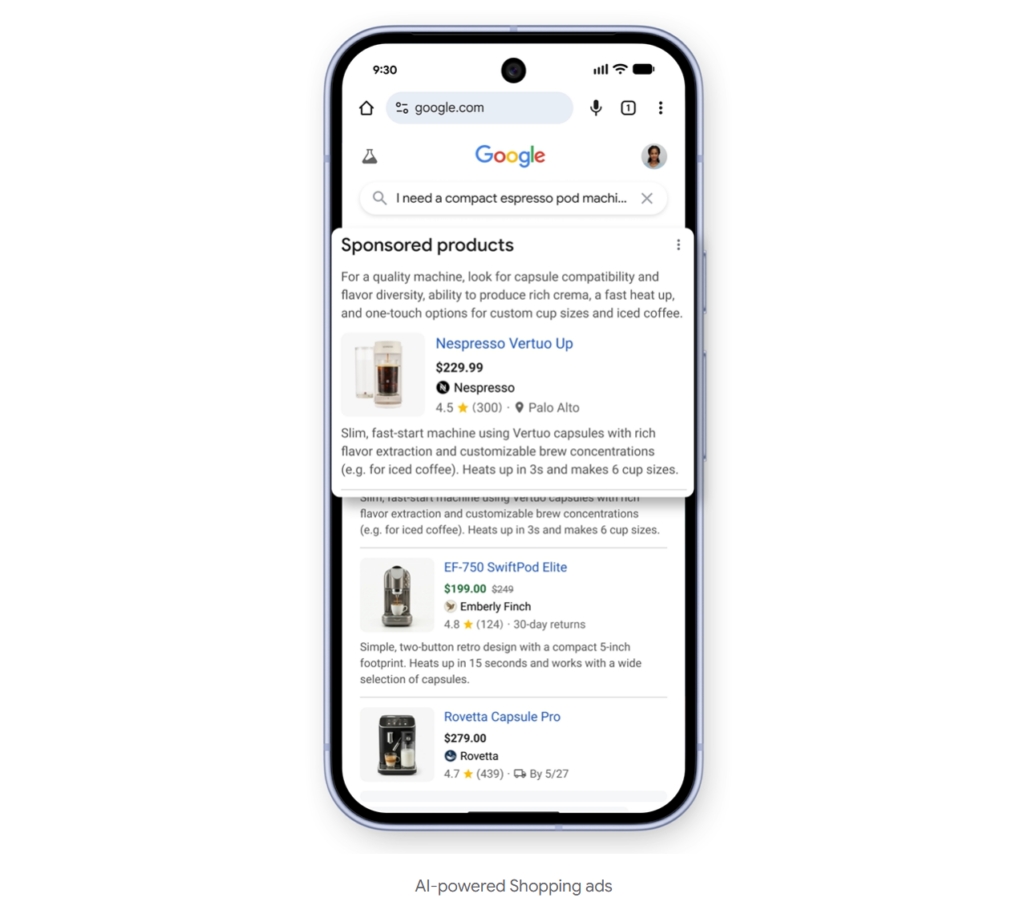
It introduced new Gemini-built ad formats in Search and AI Mode, including Conversational Discovery ads, Highlighted Answers and AI-powered Shopping ads. It also expanded Direct Offers for shoppers and introduced Business Agent for Leads, which allows users to chat with an AI agent inside an ad, based on information from an advertiser’s website.
The direction is not subtle. Search advertising is moving further into the answer layer.
For advertisers, the challenge is that AI-shaped ads cannot be managed only through bids, budgets and copy variants. If Google is using AI to interpret queries, generate context, pull from business information and support lead interactions, the quality of the advertiser’s underlying content starts to matter much more.
Two Formats Point To Different Behaviours
Conversational Discovery ads are designed for the question-and-answer side of AI search. The user has a specific need, but may not yet know exactly what product, service or provider fits. Google’s system can generate ad creative in response to the query and place the advertiser inside that exploratory exchange.
Highlighted Answers work differently. They are closer to sponsored recommendations inside AI-generated answer sets. If Google’s AI response is helping a user compare options or narrow a choice, a relevant advertiser can appear within that recommendation environment.
Conversational Discovery is closer to assisted exploration. Highlighted Answers is closer to commercial placement inside an AI-generated shortlist.
Both formats move the ad away from a separate unit beside the search result and towards something embedded in the answer experience. That puts more pressure on the material Google can understand about the advertiser: products, services, claims, offers, suitability, reviews and landing page content.
Ads Are Becoming Part Of The Answer
Traditional search advertising was built around intent, keywords, landing pages and auction mechanics. Someone searched. Google showed results and ads. The advertiser tried to win the click and continue the journey on its own site.
That model is not disappearing, but it is being stretched.
Google’s newer AI ad formats are designed to appear inside more conversational and assisted search experiences. A user may ask a detailed question, compare options, refine a need, request suggestions or move towards a purchase inside a guided interface.
Google wants ads to feel like useful additions to that journey rather than interruptions around it. From Google’s perspective, it also keeps commercial intent inside its own environment for longer.
For brands, the ad is no longer only a gateway to a landing page. It may become part of the answer, part of the comparison and part of the first sales interaction.
The Website Becomes Source Material
Business Agent for Leads is the clearest example.
Google says the agent can be built with Gemini and grounded in an advertiser’s website, allowing users to ask questions and receive responses before becoming a lead. The promise is obvious: fewer dead-end forms, more useful interactions and a smoother path from interest to enquiry.
The risk is just as obvious.
If the agent relies on the advertiser’s website, vague service pages, outdated FAQs, inconsistent product information and thin landing pages become a bigger problem. Poor content does not just hurt conversion after the click. It may weaken the AI interaction before the lead is even created.
Website copy, product feeds, service descriptions, reviews, pricing guidance, location data, eligibility information and customer support material all become part of the advertising system’s raw material.
Paid media teams can optimise campaigns. They cannot, by themselves, fix a poor information layer.
Shopping Ads Are Becoming More Assisted
Google’s AI-powered Shopping ads and Direct Offers pilot point in the same direction.
Shopping behaviour is becoming more guided, especially when users are comparing products, looking for offers, seeking recommendations or trying to narrow a decision. AI-assisted shopping formats give Google more room to interpret intent, personalise suggestions and place offers closer to the moment of decision.
For retailers and ecommerce teams, feed quality, product attributes, imagery, availability, pricing and promotional structure become more important. Product feeds can no longer be treated as technical plumbing.
The feed is part of how AI systems understand the product, decide when it is relevant and present it to a shopper. Brands with messy data, weak product taxonomy or inconsistent promotional logic may find that automation exposes those issues rather than solves them.
Media Teams Cannot Own The Whole System
AI advertising is often sold as a way to simplify campaign management. In some ways, it does. Machines can handle more matching, bidding, creative assembly and intent interpretation.
But the operating model becomes more complex.
An AI-shaped ad system depends on paid media, content, SEO, web, ecommerce, analytics, CRM, sales and customer experience working with more shared discipline. The ad account is only one part of the system.
A lead agent needs accurate source material and a sensible sales handover. A shopping ad needs clean product data and clear offers. A conversational ad needs landing pages and service content that can support more specific user questions. Measurement needs to show whether assisted journeys are improving business outcomes, not just generating more interactions.
The organisational chart will not matter to the system. Google will not care whether the missing product attribute belongs to ecommerce, media, web or merchandising. It will simply have weaker material to work with.
Governance Moves Closer To The Ad
Marketers have long reviewed ad copy, landing pages and claims. AI-assisted ad formats add more moving parts.
If an agent answers questions on behalf of a business, someone needs to understand what it is grounded in, what it should avoid saying, how it handles uncertainty and when a user should be handed to a human or sales process.
The risk is not only brand safety in the old sense. It is operational accuracy.
A brand does not want an AI-assisted ad interaction overstating availability, misunderstanding eligibility, giving unclear pricing guidance or qualifying leads against outdated information. Even if the model is working as designed, weak source material can still create a poor customer experience.
These formats should not be treated as plug-and-play media features. They need content governance, data ownership and testing rules.
The Practical Test Is Readiness
Marketing teams should use the direction of travel to assess readiness.
Useful questions include:
- Are our service pages clear enough to support AI-assisted answers?
- Are product feeds accurate, complete and actively managed?
- Do FAQs, reviews, pricing and location details reflect current reality?
- Who owns the content an AI lead agent would rely on?
- How would a lead from an AI-assisted conversation be qualified and handed over?
- What claims should AI-assisted ad experiences avoid making?
- How will performance be measured beyond clicks and form fills?
Some AI ad formats will work. Some will not. Performance will depend heavily on the business systems sitting around them.
AI Ads Are A Workflow Problem
Google’s AI ad announcements are easy to read as another step in media automation. That would be too narrow.
The deeper shift is that ads are moving closer to answers, recommendations and conversations. As that happens, advertising becomes more dependent on the quality of the organisation behind the campaign.
Good campaign managers will still matter. So will creative, bidding strategy and measurement. But the foundations are widening.
Product data, web content, structured information, reviews, CRM handover, sales workflows and governance are all becoming part of the paid media system.
Google is pushing ads into AI answers. Marketers now need to decide whether their businesses are ready to be used as source material.






RECOMMENDED FOR YOU
Google Gives Advertisers More AI Max Visibility
Google is introducing new AI Max reporting capabilities, giving…
Google is introducing new AI Max reporting capabilities, giving…
[STUDY] AI Content Production Keeps Accelerating
93% of marketers now use AI to support content…
93% of marketers now use AI to support content…
Meta Launches AI Agent For Businesses
Meta is extending its AI capabilities beyond Facebook, Instagram…
Meta is extending its AI capabilities beyond Facebook, Instagram…