
93% of marketers now use AI to support content creation, according to new research from Ahrefs, up from 87% in its previous study.
The findings suggest AI is becoming more deeply embedded in content production, with 69% of respondents publishing a greater proportion of AI-assisted content than a year earlier and 85% of AI users reporting faster production.
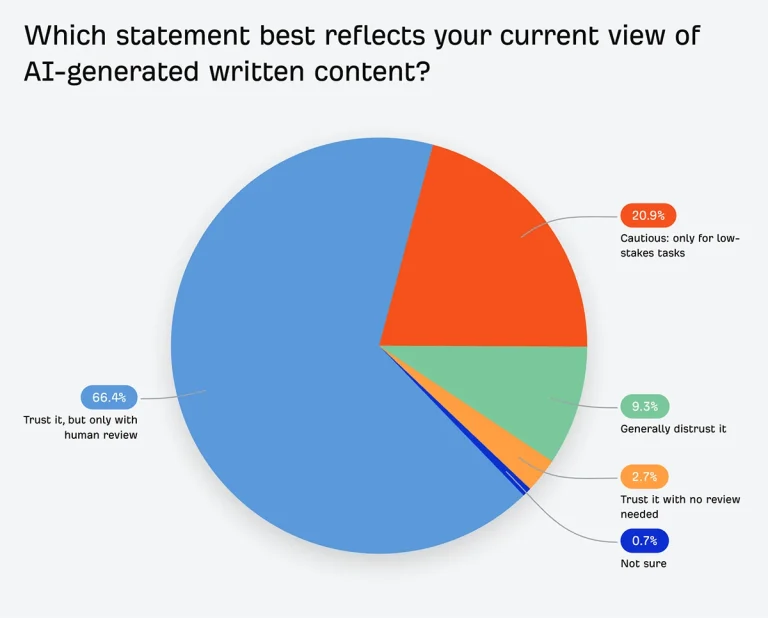
However, growing adoption is accompanied by continued concerns about quality. More than half of respondents still consider human-written content superior, while only 2.7% trust AI-generated material without human review.
Ahrefs also identifies growing use of AI beyond copywriting, particularly for data analysis, keyword research, image generation and editorial quality checks.
The findings provide a useful picture of changing content marketing practices, although adoption patterns can differ considerably between independent marketers, agencies and larger corporate or government teams.
AI Content Marketing Expands Beyond Copywriting
Some of the largest reported increases in AI usage involve activities extending beyond generating written content.
According to Ahrefs:
- Data analysis: Usage increased from 28% to 60%.
- Keyword clustering: Usage increased from 23% to 45%.
- Image creation: Usage increased from 19% to 43%.
The findings suggest AI is becoming involved in more stages of content marketing, including research, planning, analysis and creative development.
For example, keyword clustering can support editorial planning and website architecture, while data analysis can help interpret content performance and search visibility.
More sophisticated workflows may involve multiple AI applications, reusable instructions and automated processes connecting different stages of production.
Ahrefs found that 68% of AI users reported using reusable skill files, with 55% creating their own.
These allow teams to establish consistent instructions for recurring activities, including research, content development and editorial standards.
However, the research measures reported usage rather than effectiveness. Greater adoption does not necessarily establish better analysis, creative quality or commercial outcomes.
Claude Leads ChatGPT Among Surveyed Content Marketers
Ahrefs identified an interesting pattern in the AI tools respondents use.
Among marketers using AI for content creation:
- 83% use Claude.
- 76% use ChatGPT.
- 58% use Gemini.
- 42% use Claude Cowork.
Claude Code was used by 37%, while 13% reported using OpenAI’s Codex.
The figures are striking given ChatGPT’s much larger overall audience and Microsoft’s extensive corporate and government footprint.
However, the results describe usage among Ahrefs’ respondents, rather than the wider marketing profession.
Ahrefs operates primarily within SEO and digital marketing, where independent practitioners, agencies and technically experienced marketers may be more inclined to experiment with specialist AI applications.
The survey, involving 301 respondents, provides limited insight into how adoption differs across organisation sizes and industries.
AI Adoption Differs Between Large And Small Organisations
Smaller businesses and independent marketing professionals often adopt AI from the bottom up, choosing applications according to individual preferences and requirements.
A freelance content marketer might subscribe to ChatGPT, Claude and specialist AI products, switching between them depending on the task.
Larger organisations frequently operate differently.
Corporate and government teams often work within centrally managed technology environments, where IT, procurement and security functions influence which AI platforms employees can access.
Microsoft has a substantial advantage through its established enterprise software footprint.
In July, Microsoft reported that Microsoft 365 Copilot had surpassed 30 million paid seats, supported by its integration with Word, PowerPoint, Excel, Outlook, Teams and SharePoint.
Microsoft also maintains extensive government relationships, including major procurement agreements in Australia and the United States, alongside substantial deployments across UK government departments.
However, purchased licences and organisational deployments should be distinguished from active usage.
A large organisation may provide Copilot to employees while some teams continue using ChatGPT or Claude through separate subscriptions, where permitted.
Individual subscriptions and centrally managed team or enterprise plans can therefore produce very different adoption patterns.
Bottom-up adoption tends to encourage experimentation and rapid changes in tool preferences. Top-down deployments provide broader organisational access, consistent governance and integration with existing workflows.
The Ahrefs findings offer a useful snapshot of individual tool preferences, although they cannot establish which AI platforms are most widely used across corporate marketing and government communications teams.
Human-Written Content Still Leads On Perceived Quality
Despite widespread adoption, confidence in AI-generated content remains qualified.
Ahrefs found that 56% of AI users consider human-written content better than their AI-generated material, with 23% describing human writing as substantially better.
Only 2.7% said they trusted AI-generated content without human review, while 66% trusted it after a person had checked it.
Attitudes also varied between respondents.
Among founders and business owners, 43% believed their AI-generated content was better than human writing. Among junior and mid-level marketers, the figure was 17%.
Differences in content requirements, expectations and familiarity with AI tools may help explain the divide, although the research does not establish the reasons.
A product description or straightforward FAQ presents different editorial requirements from a thought leadership article, executive speech or complex public communication.
Content quality also involves originality, credibility, judgement and relevance to the intended audience.
The findings measure perceptions rather than independently assessing the editorial quality of published material.
AI Is Increasingly Used To Review AI Content
Almost 29% of AI users reported using AI to review AI-assisted content, compared with 14% in the previous survey.
Manual checking remained the most common approach.
AI review can help identify missing information, check consistency against editorial guidelines and assess whether content follows a specified structure.
However, AI-generated checks can repeat factual errors, accept unsupported claims or overlook problems requiring specialist knowledge.
Human oversight remains particularly important for material involving technical information, regulatory requirements, reputational risks and factual claims.
For content teams, the practical challenge is deciding which checks can be standardised and where specialist editorial judgement remains necessary.
Faster AI Content Production Has Yet To Deliver Clear Cost Savings
Although 85% of AI users reported producing content faster, 41% said AI had not reduced their spending on writers or freelancers.
Another 26% did not know whether AI had generated savings.
Only 28% of AI users surveyed worked with external writers, limiting the usefulness of freelance expenditure as a measure of overall financial return.
Among respondents reporting savings, the typical monthly reduction was between US$1,001 and US$2,000.
However, reduced spending on external writers captures only part of the economics of AI content production.
Some organisations may retain existing teams while increasing the volume or range of content they produce. Others may redirect time towards research, creative development, localisation and distribution.
Additional editing, verification, governance and software costs can also offset productivity gains.
The financial implications will vary between businesses purchasing individual subscriptions and larger organisations investing in enterprise licensing, integration and training.
AI Content Growth Puts Greater Pressure On Editorial Quality
Ahrefs also examined how much published content is generated with minimal human involvement.
Among AI users, 7% reported that more than three-quarters of their published material was produced entirely by AI, without editing or additional input. The equivalent figure was 4% in 2025.
Meanwhile, 40% reported publishing no completely unedited AI content, compared with 50% last year.
The findings suggest growing acceptance of AI-generated material, although most respondents still retain some human involvement.
Greater production capacity also raises broader questions about content marketing strategy.
As organisations become capable of producing more articles, social posts, videos and other materials with fewer production constraints, publishing volume becomes a less distinctive capability.
Competition for audience attention remains considerable, while search engines, social platforms and AI discovery systems continue determining which content receives visibility.
Increasing output without improving the relevance, originality or usefulness of material may simply add to the volume of content competing for attention.
For marketing and communications teams, greater AI capacity creates opportunities to redirect resources towards original research, subject matter expertise, creative development and distribution.
The commercial contribution of AI content workflows will depend on whether faster production translates into more useful content, stronger audience engagement and measurable marketing outcomes.

























RECOMMENDED FOR YOU
Google Gives Advertisers More AI Max Visibility
Google is introducing new AI Max reporting capabilities, giving…
Google is introducing new AI Max reporting capabilities, giving…
Meta Launches AI Agent For Businesses
Meta is extending its AI capabilities beyond Facebook, Instagram…
Meta is extending its AI capabilities beyond Facebook, Instagram…
ChatGPT Introduces Visual Advertising
OpenAI is expanding ChatGPT advertising with new visual formats,…
OpenAI is expanding ChatGPT advertising with new visual formats,…