Meta is evolving its ad ecosystem around three areas: culture, creators, and AI.
Recent updates across Reels, partnership ads, and generative tools show how these elements are becoming more tightly integrated, with implications for how brands plan, produce, and optimise social campaigns.
Culture Is Now A Planning Input
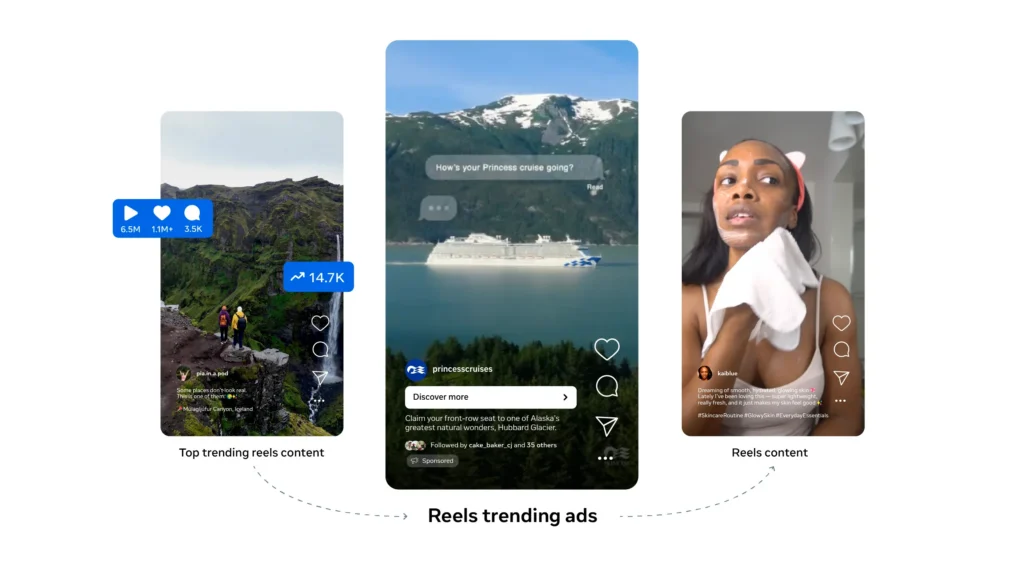
One of the more notable developments, highlighted at IAB NewFronts, is the expansion of Reels trending ads. Brands can now place ads alongside trending content tied to major cultural moments, including Fashion Week, F1, Black Friday, and NFL games, as well as broader category environments such as entertainment, travel, and finance.
Reels already functions as a discovery surface where trends emerge and spread quickly. Aligning paid placements with that content shifts social advertising closer to those moments of heightened attention.
Meta is also testing reserved buying for these placements, allowing brands to secure visibility during short windows of peak engagement. That introduces a more structured approach to moment-based media planning.
For brands, this suggests a need to treat cultural moments less as reactive opportunities and more as planned inputs. That has knock-on effects for budgeting, creative readiness, and approval timelines.
Creative Volume Is Becoming More Important
Alongside this, Meta continues to expand its AI-driven creative tools.
New features include AI-generated voiceovers, translation across video and image overlays, avatar-led video formats, and the ability to generate video assets from product catalogues. There are also updates to how product videos are assembled and displayed within Reels placements.
These tools are designed to address a growing demand for creative variation. Campaigns increasingly require multiple versions across formats, audiences, and markets, which can be difficult to scale through manual production alone.
Meta’s own data suggests that campaigns with a broader mix of creative assets tend to perform better, as they provide more inputs for optimisation.
For social ad strategies, this points towards a shift in how creative is developed. Rather than focusing solely on a small number of finished assets, there is increasing emphasis on building adaptable inputs, such as templates, product feeds, and modular content.
At the same time, greater reliance on automated tools raises questions around differentiation. As more brands use similar systems, maintaining a distinct creative identity may become more challenging.
Creator Content Moves Closer To Paid Media
Meta is also continuing to develop its creator ecosystem.
The Creator Marketplace now includes more than 1.5 million creators, with improved filtering tools to help brands identify partners based on audience characteristics. Updates to the Partnership Ads Hub aim to make it easier to discover and deploy creator content within paid campaigns.
These changes are intended to simplify what has traditionally been a complex process, from sourcing creators to scaling their content.
Creator content tends to perform well in social environments because it aligns with platform-native formats and user expectations. Integrating it more directly into paid media allows brands to extend that reach.
For brands, this suggests a more integrated approach. Creator content is less likely to sit in isolation and more likely to form part of the core media mix alongside brand and AI-generated assets.
From Campaigns To More Continuous Models
Taken together, these updates reflect a broader move towards more continuous, adaptive campaign models.
Tools such as trending ad placements, AI-generated creative, and automated product video support a more dynamic approach, where content and media can be adjusted in response to performance and context.
For existing strategies, this may require a shift away from fixed campaign cycles towards more flexible, always-on frameworks.
That has implications for how budgets are allocated, how content is produced, and how performance is measured over time.
What It Means For In-House Teams
In-house teams may need to adjust how they operate to support this shift.
Closer alignment between creative, media, and data functions becomes more important, particularly where AI-driven tools rely on consistent inputs and ongoing optimisation.
Content production is also likely to evolve. Modular assets and reusable formats may become more common as teams look to scale output efficiently.
Operationally, faster turnaround times may be required, particularly when working around cultural moments or testing multiple creative variations.
There is also a capability consideration. Teams need to understand how to work with platform tools, interpret performance data across multiple assets, and maintain creative consistency at scale.
What It Means For Agencies
For agencies, these changes affect where value is delivered.
As platforms take on more of the executional workload through automation, there is greater emphasis on strategy, planning, and integration.
Agencies may play a larger role in helping brands structure their approach, from identifying relevant cultural moments to building scalable creative systems and managing creator partnerships.
There is also a need to navigate increasing complexity. While tools are becoming more accessible, using them effectively requires coordination across multiple areas.
Where This Leaves Brands
The changes do not require a complete reset, but they do expose the limitations of many current approaches.
Campaign cycles that rely on long lead times, limited creative variation, and loosely connected creator activity will find it harder to keep pace. In contrast, strategies built around flexibility, scalable creative, and integrated content sources are better aligned with how the platform is evolving.
The gap between those two approaches is likely to widen. Not because of access to tools, but because of how teams are structured to use them.












RECOMMENDED FOR YOU
[STUDY] AI Search Shapes Brand Decisions
AI search is starting to influence purchase decisions well…
AI search is starting to influence purchase decisions well…
LinkedIn Lets AI Multiply Ad Creative
LinkedIn is giving advertisers far more freedom to vary…
LinkedIn is giving advertisers far more freedom to vary…
Copilot Lets Marketers Build Apps By Chatting
Microsoft is giving Copilot users the ability to build…
Microsoft is giving Copilot users the ability to build…