
LinkedIn is becoming a far more strategic platform in an AI-driven discovery landscape. Recent updates highlight two converging shifts. Long-form articles are driving stronger engagement, while also playing a growing role in how AI chatbots source and cite information.
Taken together, these trends signal a change in how marketers should approach content creation, distribution, and visibility.
Understanding LinkedIn Content Formats
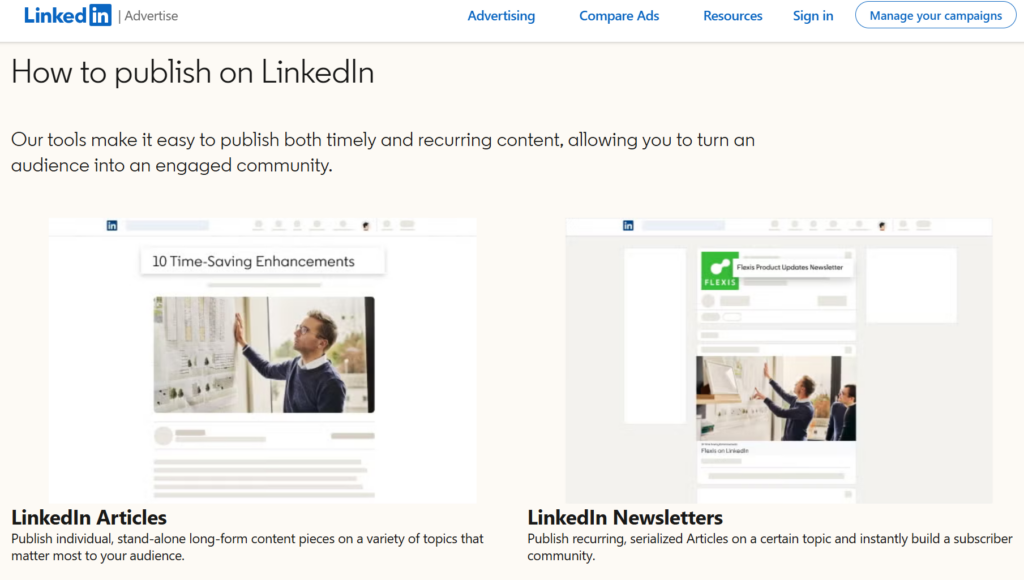
LinkedIn offers three primary publishing formats, available to both individual users and business pages, each serving a distinct role within a content strategy.
Standard posts are short-form updates that appear in the feed. Designed for reach and immediate engagement, they generate conversation through comments and shares. For most brands, posts remain the primary driver of consistent visibility.
Articles are LinkedIn’s long-form format, previously known as Pulse. They enable deeper analysis and more structured thinking, with a longer shelf life than posts. Articles are increasingly surfaced beyond LinkedIn itself, including in AI-generated responses.
Newsletters build on the article format by adding a subscription layer. Users receive notifications and emails when new editions are published, turning one-off readers into a retained audience.
Each format plays a clear role. Posts drive reach, articles build authority, and newsletters create ongoing engagement.
LinkedIn Articles Gain Strategic Importance
LinkedIn has confirmed that long-form content can significantly improve reach and engagement. More notably, posts and articles on the platform are now a leading reference source for AI chatbots.
Content is no longer limited to human audiences. It is also feeding into AI systems that shape how information is discovered and summarised.
Supporting data reinforces this shift. LinkedIn is now among the most cited sources in AI-generated responses, with citation rates rising sharply. LinkedIn Articles account for the majority of these references.
LinkedIn is evolving from a distribution channel into a visibility layer within AI ecosystems.
Declining Referral Traffic Changes The Model
That growing role in AI visibility comes at a time when traditional referral traffic is becoming less reliable. Data shows that Google search referrals have declined significantly, with drops of between 20% and 60% reported across publishers last year.
AI-generated answers are accelerating that shift. Users are increasingly finding what they need without leaving search environments, reducing the need to click through to external sites.
As a result, content performance is being reframed. Traffic alone is no longer a sufficient measure of value.
Visibility is moving towards influence within closed ecosystems, particularly within AI-generated outputs. Being cited or referenced in these environments can now deliver brand exposure without requiring a site visit.
That is where LinkedIn’s model becomes more relevant. Articles are not only performing within the platform, they are also feeding into the systems shaping this new discovery layer, placing them at the intersection of engagement, authority, and AI visibility.
Newsletters And The Rise Of Owned Audiences
LinkedIn reports growing interest in newsletters as a way to build a consistent, engaged audience. That reflects a broader shift across the market.
Platforms like Substack have accelerated the resurgence of newsletter-led publishing. Brands and individual experts are investing in direct-to-inbox relationships as organic reach becomes less predictable.
LinkedIn brings those dynamics into a professional network, combining subscription-based engagement with built-in distribution and discovery.
Why Adoption Still Lags
Despite clear advantages, LinkedIn articles and newsletters remain underutilised.
Effort is a key barrier. Long-form content demands more resource and expertise than standard posts, making it harder to sustain.
Distribution also plays a role. Posts benefit from immediate visibility and rapid engagement, while articles and newsletters often require more deliberate amplification.
Perception has yet to catch up with reality. LinkedIn is still widely seen as a feed-first platform, with long-form content viewed as secondary.
Measurement adds complexity. The impact of articles, particularly in areas like authority, evergreen visibility, and AI citation, is less immediate than clicks and impressions.
That gap between effort and measurable return continues to limit adoption, though it is likely to narrow as discovery evolves.
What Drives Performance On LinkedIn
LinkedIn’s guidance on article performance aligns with broader content best practice, with several factors standing out.
Original insight is critical. Content that offers unique perspectives is more likely to engage audiences and be referenced elsewhere.
Consistency builds authority. Publishing regularly within a defined topic area strengthens both audience trust and platform signals.
Structure improves performance. Clear formatting, skimmable sections, and concise summaries increase engagement and make content easier to extract and reuse.
Evergreen value is a key advantage. Long-form articles can remain relevant over time, continuing to attract engagement, resurface in search, and appear in AI-generated responses well beyond publication.
Credibility strengthens impact. Recognised experts and executive voices increase trust and authority.
Distribution remains essential. Cross-channel promotion, creator partnerships, and paid support all help drive reach and early traction.
A Shift Worth Acting On
LinkedIn’s growing role in engagement and AI discovery reflects a broader shift in how content delivers value.
Search is no longer just about rankings. Presence within the answers themselves is becoming just as important.
Long-form articles and newsletters offer a practical response. They build authority, support evergreen visibility, and create owned audience relationships.
For marketers willing to invest in depth and consistency, LinkedIn is no longer just a social platform. It is a key channel for visibility in an AI-first landscape.







RECOMMENDED FOR YOU
[STUDY] AI Search Shapes Brand Decisions
AI search is starting to influence purchase decisions well…
AI search is starting to influence purchase decisions well…
LinkedIn Lets AI Multiply Ad Creative
LinkedIn is giving advertisers far more freedom to vary…
LinkedIn is giving advertisers far more freedom to vary…
Copilot Lets Marketers Build Apps By Chatting
Microsoft is giving Copilot users the ability to build…
Microsoft is giving Copilot users the ability to build…