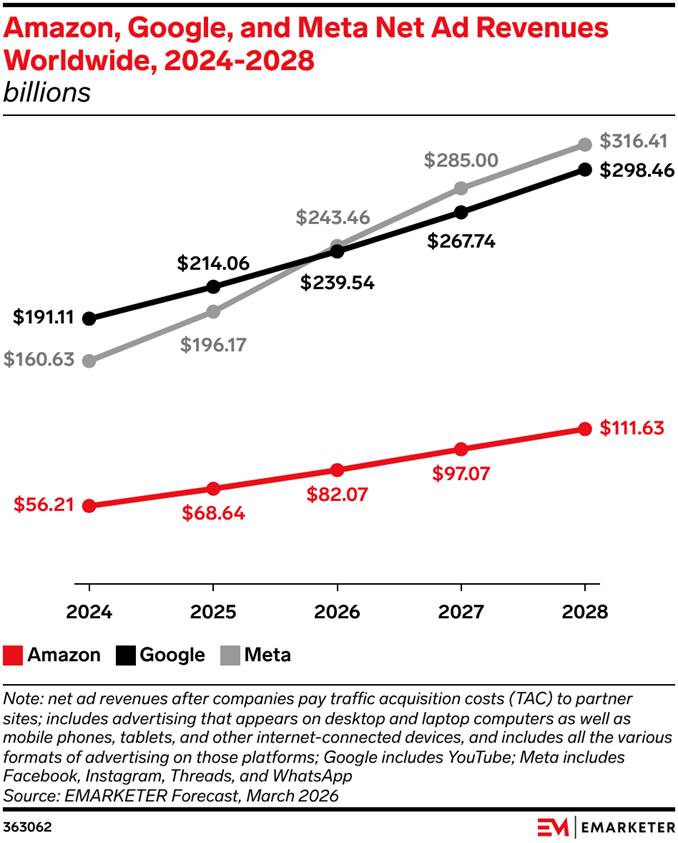
Meta is set to overtake Google in global ad revenue for the first time in 2026, marking a significant shift in how digital advertising value is being created and captured.
According to Emarketer, Meta is projected to generate $243.46 billion in ad revenue this year, narrowly ahead of Google’s $239.54 billion. That would give Meta a 26.8% share of global ad spend, just ahead of Google’s 26.4%.
The milestone is symbolic, but the underlying trend is more important. Rather than a simple change in rankings, it reflects a broader shift towards platforms built for automation, performance, and measurable return.
Performance Is Driving Budget Allocation
For years, Google has dominated digital advertising through Search, Display, and YouTube, capturing demand at the point of intent and monetising it efficiently.
That advantage still holds, but growth is slowing.
Meta, by contrast, has positioned itself around performance at scale. Its strength lies in combining reach with increasingly automated optimisation, allowing advertisers to drive measurable outcomes without the same level of manual control.
That distinction is becoming more important in the current market. As budgets tighten and scrutiny increases, advertisers are prioritising platforms that can demonstrate clear return on ad spend. Meta is benefitting directly from that shift, as more budget flows towards environments where performance can be both delivered and proven.
Automation Is Becoming The Differentiator
That shift towards performance is being accelerated by automation.
Meta’s investment across its ad stack is reducing the need for manual input at every stage of campaign delivery. Products like Advantage+ simplify setup, while AI-driven targeting and optimisation reduce reliance on granular audience management. At the same time, automated creative tools are increasing the volume and variation of ads that can be tested.
The result is a system that not only performs well, but is easier to scale.
From a commercial perspective, this matters. Lower operational complexity allows advertisers to increase spend without increasing overhead, while faster optimisation shortens the time between launch and results. In a market where efficiency is under constant pressure, that combination is highly attractive.
Brand Budgets Are Moving Into Digital
At the same time, a parallel shift is reinforcing Meta’s position.
As above-the-line budgets continue to move out of traditional channels such as TV, they are not simply being redirected into search. Instead, they are concentrating around platforms that can deliver both scale and sustained attention.
Meta is structurally well positioned to capture that spend. Facebook, Instagram, and Reels operate in high-frequency, high-attention environments, making them effective not just for direct response but for brand building at scale.
As those budgets move, expectations are changing.
Brand investment is becoming more accountable. Advertisers are no longer treating brand and performance as separate disciplines with separate success metrics. Increasingly, brand activity is expected to demonstrate a clearer link to business outcomes, whether through direct conversion, assisted impact, or measurable lift.
Meta’s advantage is that it collapses that divide.
Within a single system, advertisers can reach large audiences, optimise delivery in real time, and measure downstream impact. Brand activity can feed directly into performance through retargeting, signal generation, and conversion optimisation.
That makes brand spend easier to justify, and easier to scale.
Google, by comparison, remains strongest at the point of intent. Search captures demand efficiently, but it does not create it in the same way. As a result, its ability to absorb these upstream budgets is more limited, particularly as advertisers prioritise platforms that can both generate and convert demand within one ecosystem.
Better Performance Is Pulling Spend
These dynamics are already visible in how spend is shifting.
Meta’s growth is not being driven by a single product or format. Instead, it is improving performance across its entire ecosystem. Facebook and Instagram remain central, while formats like Reels are becoming increasingly important as monetisation improves.
At the same time, advances in measurement have made it easier for advertisers to prove ROI. Stronger performance, combined with clearer attribution, is pulling more budget onto the platform.
Google’s position remains strong, but more exposed to structural pressure. Search continues to be highly profitable, but faces increasing competition from AI-driven discovery and changing user behaviour. Growth in traditional search advertising is slowing, even as YouTube continues to attract brand budgets.
The gap is not about scale. It is about momentum.
Consolidation Around The Largest Platforms
Meta overtaking Google also reflects a wider consolidation of spend.
Meta, Google, and Amazon are expected to account for over 60% of global digital ad spend in 2026 , reinforcing the growing dominance of platforms with strong first-party data, advanced AI capabilities, and global reach.
These advantages are compounding. Larger platforms can improve performance faster, attract more advertiser spend, and reinvest into further optimisation.
Smaller platforms and traditional media cannot replicate this cycle at the same speed or scale. As a result, incremental budgets continue to consolidate around the largest players.
What This Means For Marketers
For advertisers, the shift is less about choosing between platforms and more about understanding how each creates value.
Meta’s rise highlights the growing importance of automation and performance-driven buying. Campaign success is becoming less dependent on manual optimisation and more reliant on the quality of inputs, particularly creative and data.
At the same time, Google remains critical for capturing high-intent demand. Search continues to be one of the most efficient ways to convert existing demand, even if its growth is slowing.
The opportunity lies in how budgets are balanced. Meta is increasingly acting as the engine for scalable, performance-driven growth, while Google continues to play a key role in demand capture.
A Structural Shift, Not A One-Off Moment
Meta overtaking Google in ad revenue is a headline moment, but it is also the result of longer-term structural change.
Advertisers are moving towards platforms that make it easier to automate campaigns, measure outcomes, and scale efficiently. Meta has aligned closely with those priorities and is now seeing the benefit.
Google remains one of the most powerful advertising businesses in the world, but the balance of power is shifting.
























RECOMMENDED FOR YOU
LinkedIn Lets AI Multiply Ad Creative
LinkedIn is giving advertisers far more freedom to vary…
LinkedIn is giving advertisers far more freedom to vary…
“Meta One” Adds Paid Business Tools
Meta is bundling more AI, business and creator tools…
Meta is bundling more AI, business and creator tools…
Google Expands Search Ads Into AI Mode
Google is testing a more controlled route into AI…
Google is testing a more controlled route into AI…