Google Search was supposed to be one of generative AI’s first major casualties.
As ChatGPT, Gemini, Claude and Perplexity attracted hundreds of millions of users, a seemingly straightforward assumption took hold. Every question directed to an AI assistant represented one fewer search for Google.
Recent data suggests the market is behaving rather differently.
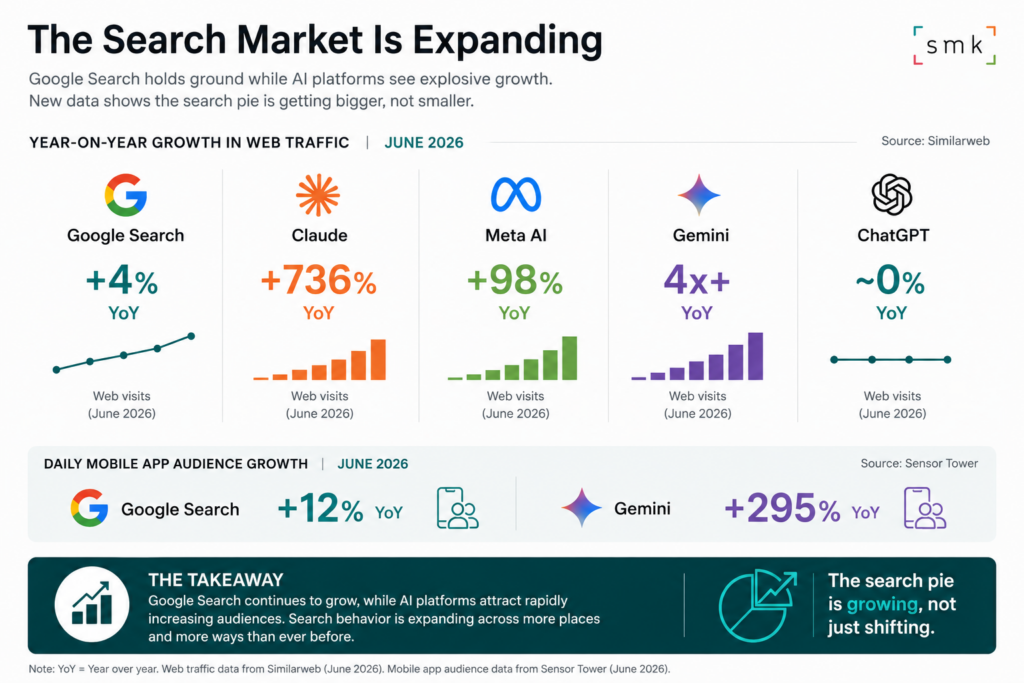
According to Similarweb’s latest traffic analysis, Google Search web visits increased 4% year on year during June 2026. At the same time, Claude’s web traffic surged 736%, Meta AI grew 98% and Gemini’s web traffic more than quadrupled. Separate mobile app data from Sensor Tower also showed Google’s daily mobile audience increasing by 12%, while Gemini’s grew 295%. ChatGPT traffic remained broadly stable over the same period.
Those numbers create an interesting paradox. If AI search is replacing Google, why are both continuing to grow?
The evidence points towards a different conclusion.
Rather than simply taking searches away from Google, AI appears to be expanding the overall search market.
AI Is Creating More Search Behaviour
Much of the debate assumes search is a fixed market.
If someone asks ChatGPT a question, the logic goes, that must represent one fewer Google search.
People do not necessarily behave that way.
Google remains exceptionally strong for navigation, shopping, local discovery, breaking news and everyday information retrieval. AI assistants are increasingly used for entirely different tasks, such as comparing options, interrogating documents, exploring unfamiliar topics, brainstorming ideas and refining responses through multiple follow-up questions.
Many of those interactions would never previously have become a sequence of Google searches.
Similarweb’s longer-term figures reinforce the scale of the shift. Between September 2024 and March 2026, ChatGPT web traffic increased around 84%, Gemini grew almost ninefold and Claude expanded roughly 770%.
Those gains have occurred without the dramatic collapse in Google usage that many predicted.
The search pie appears to be getting bigger.
Social Search Started The Trend
AI search is not the first force to expand what marketers mean by search.
TikTok, YouTube, Reddit, Instagram and LinkedIn have all become important discovery platforms over recent years. Users increasingly turn to them for demonstrations, professional advice, reviews, recommendations and lived experience that traditional search engines cannot always provide.
Those platforms did not replace Google.
They created new search occasions around it.
Someone researching marketing software might begin with ChatGPT to understand the market, search Google for individual vendors, watch product demonstrations on YouTube, read Reddit discussions from existing customers and review LinkedIn commentary from industry practitioners.
Trying to describe that journey as either “Google search” or “AI search” no longer reflects how people discover information.
Discovery has become fragmented across multiple environments.
Search Strategy Needs To Expand Too
If AI search is largely additive rather than purely substitutive, marketing strategy needs to evolve accordingly.
For years, search strategy was largely synonymous with SEO.
Today, SEO remains fundamental, but it has become one discipline within a much broader discovery strategy.
Marketing teams increasingly need to think about visibility across:
- Google Search and Bing
- AI assistants such as ChatGPT, Gemini and Claude
- Google AI Overviews and AI Mode
- YouTube search
- TikTok search
- Creator content and earned media
Each environment surfaces information differently. Each draws upon different signals. Each influences buying decisions in different ways.
Search is becoming an ecosystem rather than a channel.
Visibility Is Becoming More Complex
Traditional SEO continues to matter enormously.
Google’s own growth demonstrates that technical optimisation, useful content and authority remain critical.
However, appearing prominently in Google does not automatically mean appearing prominently in AI-generated answers.
Recent academic research comparing Google Search, AI Overviews and Gemini found surprisingly little overlap between the sources each system surfaces. Strong organic rankings alone are no longer a guarantee of visibility across emerging discovery platforms.
At the same time, social search follows another set of rules altogether, where engagement, creators, comments, video and community signals all influence discoverability.
Optimising for one environment does not necessarily optimise for another.
Measurement Is Becoming Harder
An expanding search market also creates a measurement problem.
Someone may first discover your organisation through ChatGPT, later search for your brand on Google, watch a YouTube review, read Reddit discussions and finally visit your website directly.
Traditional analytics will often attribute only the final interaction.
Social search creates similar challenges. Many buying decisions are influenced long before someone clicks a measurable link.
Marketing teams therefore need a broader understanding of discovery itself, rather than relying exclusively on website traffic or last-click attribution.
Branded search demand, AI citations, referral trends, social engagement and share of search all become increasingly valuable indicators.
Google Is Adapting Rather Than Standing Still
Predictions of Google’s rapid decline also overlook how aggressively Google is reshaping Search around AI.
AI Overviews now appear across a growing proportion of searches, while AI Mode introduces a far more conversational experience directly within Google’s own products.
Rather than defending the traditional list of blue links, Google is attempting to capture the same behavioural shifts driving the adoption of standalone AI assistants.
The market is becoming more competitive.
Google is evolving with it.
Discovery Is Becoming The New Competitive Battleground
Perhaps the biggest implication is that marketers need to stop thinking about Google, AI search and social search as separate conversations.
They increasingly form part of the same discovery ecosystem.
Google remains the world’s dominant search engine. AI assistants are creating entirely new ways for people to research, compare and learn. Social platforms continue to influence buying decisions long before a customer reaches a website.
Winning visibility now requires organisations to think beyond traditional SEO and build a coherent presence wherever people seek answers.
The search market is not disappearing.
It is expanding. The organisations that recognise that shift earliest will be better placed to earn visibility across an increasingly fragmented discovery landscape.

















RECOMMENDED FOR YOU
[STUDY] AI Search Shapes Brand Decisions
AI search is starting to influence purchase decisions well…
AI search is starting to influence purchase decisions well…
LinkedIn Lets AI Multiply Ad Creative
LinkedIn is giving advertisers far more freedom to vary…
LinkedIn is giving advertisers far more freedom to vary…
Copilot Lets Marketers Build Apps By Chatting
Microsoft is giving Copilot users the ability to build…
Microsoft is giving Copilot users the ability to build…