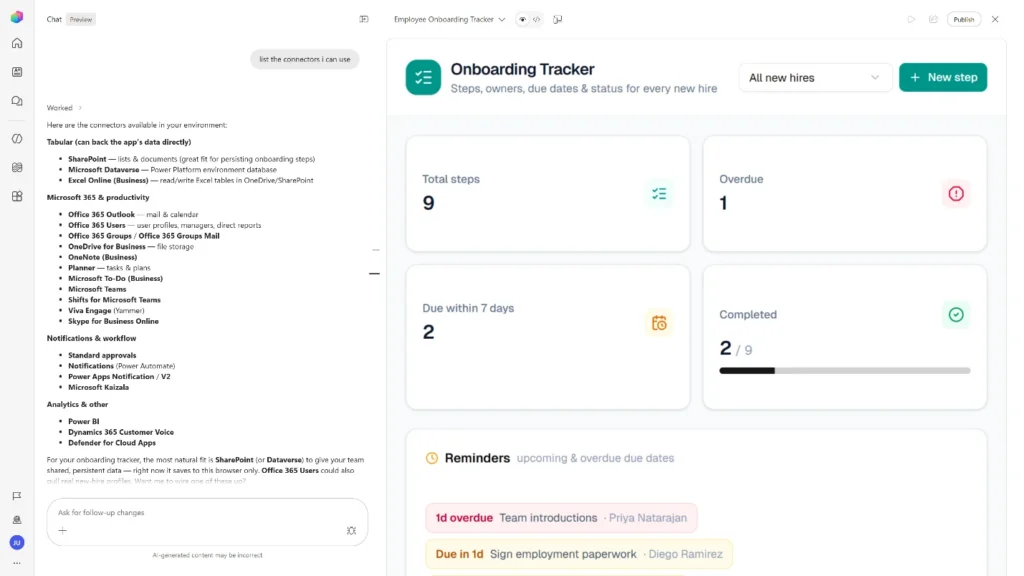
Microsoft is giving Copilot users the ability to build lightweight internal apps simply by describing what they need.
The new App skill inside Copilot Cowork can turn a natural-language brief into a working application, then let the user refine it through chat, connect it to Microsoft 365 data, preview it, publish it and share it internally. Microsoft says the capability is aimed at people who need to solve business problems without having to write code.
The idea itself is not new.
Claude Code and OpenAI Codex have already pushed AI-assisted software creation well beyond conventional coding. Anthropic has documented non-technical teams using Claude Code to build internal tools and automate workflows, while OpenAI positions Codex as an agent for creating, maintaining and operating software through natural-language instructions.
Microsoft is now bringing a more accessible version of that behaviour into the environment where many corporate teams already work.
For marketing leaders, that could be considerably more relevant than learning how to code.
AI Coding Is Escaping The IT Department
Claude Code provides one of the clearest examples of how quickly the audience for coding agents is widening.
Anthropic’s 2026 Agentic Coding Trends Report argues that sales, marketing, legal and operations teams are increasingly using coding agents to create their own tools and automate processes without waiting for engineering support.
One of Anthropic’s examples comes from its own legal team, where a lawyer with no coding experience used Claude Code to create self-service tools for contract and content review. Anthropic has also documented growth marketing, product design and other non-engineering teams using Claude Code internally.
Claude itself is also spreading further into everyday team workflows. Anthropic recently described Claude Tag, which allows teams to bring Claude into Slack channels and delegate work involving data, internal systems and codebases. The company says usage inside Anthropic has spread beyond engineering into areas such as product analytics and support.
Codex comes from a similar starting point.
OpenAI still positions it primarily as a coding agent, with capabilities spanning feature development, refactoring, migrations, parallel agent workflows and ongoing software maintenance. The broader direction is the same: users increasingly describe what they want built and supervise the result rather than manually writing every line themselves.
Copilot Cowork approaches the problem from the opposite direction.
Copilot Starts With The Business User
Cowork is already designed around everyday work rather than software development.
It can work across files, prepare summaries and briefings, draft and send communications, search organisational information, schedule tasks and interact with Microsoft 365 content. App building now sits alongside those capabilities.
A marketer does not have to open a coding environment and decide to build software.
They can stay inside Copilot and describe the business problem.
Microsoft’s own example is deliberately mundane: build an app to run a daily scrum. The user describes the problem, the required information and the actions the app should support. Cowork creates the app, can generate a data structure and can connect it to supported Microsoft 365 sources such as documents, spreadsheets, meetings and messages.
Marketing teams have no shortage of similar problems.
A campaign intake process could become an app. So could a content approval tracker, event planning tool, customer feedback viewer, briefing system or internal reporting interface.
Many of those jobs currently live in spreadsheets, email chains or a combination of systems held together by somebody who knows where everything is.
Excel May Finally Get Some Competition
Marketing teams have spent decades asking Excel to perform jobs it was never really designed to do.
Campaign trackers, project management systems, media plans, approval processes, content calendars and customer databases have all found their way into spreadsheets because somebody could build one immediately.
No developer was required. No procurement process was required. The team had a problem on Monday and by Tuesday there was a spreadsheet.
AI-generated apps preserve some of that accessibility while offering an interface designed around the task.
Someone can describe the process, generate something usable and continue changing it conversationally as the workflow develops.
Plenty of spreadsheets should remain spreadsheets. Converting every tracker into an app would simply create another form of organisational clutter.
The threshold for building something more suitable has nevertheless dropped sharply.
Microsoft Has A Different Advantage
Claude Code and Codex can create considerably more sophisticated software than a lightweight Cowork app.
Microsoft does not necessarily need to beat them at that game.
Its advantage is proximity to corporate data and workflows.
Many businesses already operate across Outlook, Teams, SharePoint, OneDrive, Excel, Dynamics and Power Platform. An app created through Cowork can draw directly on information sitting inside that environment and can be published within the organisation.
Microsoft is also putting governance around the process. Apps created through Copilot Studio can appear in the Microsoft 365 admin centre, giving administrators visibility and control over what is being built and shared.
That may prove more important to large organisations than raw coding capability.
A marketing team might be able to build something more ambitious using Claude Code or Codex, but doing so can introduce questions around hosting, permissions, security, data access and long-term ownership.
Cowork is trying to make those decisions less visible to the person creating the tool.
Smaller Problems Suddenly Become Worth Fixing
Traditional software development has an economic threshold.
A major customer platform is worth a large implementation project. A slightly irritating internal approval process usually is not.
So teams live with the irritation.
Natural-language app building lowers that threshold.
A process that wastes 20 minutes every week across ten people may never justify an IT project. It may justify spending an hour describing an app to Copilot and seeing whether it works.
That changes which operational problems teams can realistically address.
Some of the most valuable use cases may therefore look extremely boring.
A better briefing tool.
A cleaner campaign handover.
A central view of event activity.
A simple interface for pulling together customer feedback.
A tool that stops four people maintaining four versions of the same spreadsheet.
Boring software can still save a lot of time.
Easier Building Creates A New Kind Of Mess
There is an obvious downside.
Once everyone can build apps, everyone can build bad apps.
A confusing process can quickly become a confusing app. Duplicated systems can multiply. Teams can create tools that depend on data they should not access or that nobody understands six months later.
Microsoft is clearly aware of that problem, which helps explain why the App skill is being tied into Copilot Studio, Microsoft 365 administration and enterprise controls.
Marketing leaders still need basic discipline around ownership, permissions and purpose.
Someone should know why an app exists, what data it uses, who maintains it and whether another system already solves the same problem.
IT will still have a role, particularly once tools become business-critical or start touching sensitive systems.
The balance simply moves.
Business teams can create more of the first version themselves, while technical teams increasingly provide the environment, guardrails and deeper integration.
Internal Software Becomes Part Of AI Adoption
Most marketing AI adoption still focuses on individual tasks.
Someone drafts copy with Copilot, analyses a spreadsheet, summarises research or prepares a meeting brief.
Useful work happens, but much of it remains inside one person’s interaction with an AI assistant.
App building creates a route towards turning some of those behaviours into shared systems.
A useful prompt becomes part of a tool.
A reporting process becomes something colleagues can use repeatedly.
A workflow that previously lived in one employee’s head can become an internal application.
Claude Code and Codex have already demonstrated how far natural-language software creation can go. Microsoft is now bringing a deliberately simpler version into mainstream business software.
The opportunity for marketing teams is not to turn everybody into a developer.
It is to give the people who understand the workflow problem a much shorter route to fixing it.

















RECOMMENDED FOR YOU
[STUDY] AI Search Shapes Brand Decisions
AI search is starting to influence purchase decisions well…
AI search is starting to influence purchase decisions well…
LinkedIn Lets AI Multiply Ad Creative
LinkedIn is giving advertisers far more freedom to vary…
LinkedIn is giving advertisers far more freedom to vary…
Apple Intelligence Pushes Into Brand Discovery
Apple’s long-promised Siri overhaul is finally arriving, after years…
Apple’s long-promised Siri overhaul is finally arriving, after years…