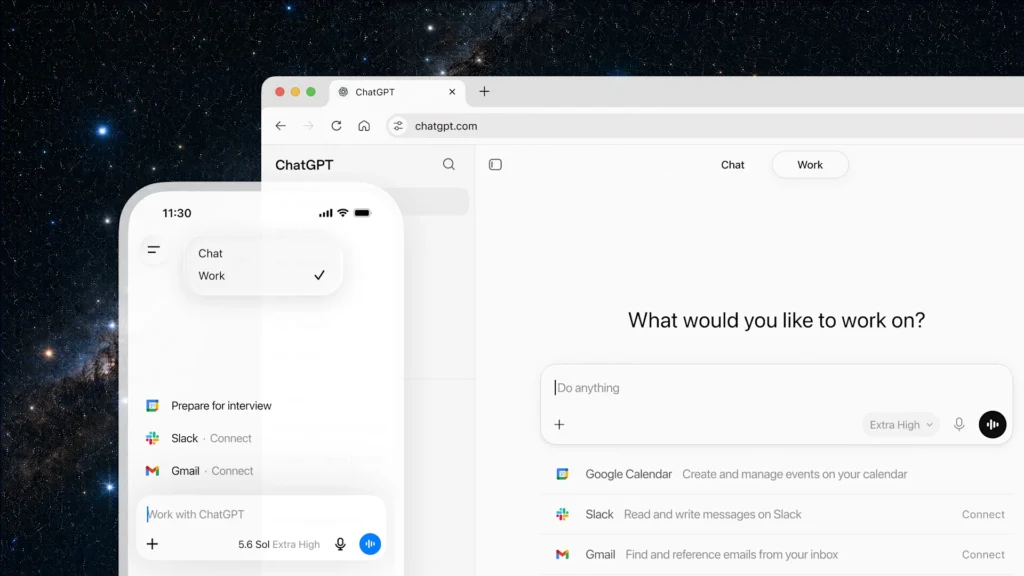
OpenAI has launched ChatGPT Work, a new agent designed to take on substantial projects across workplace apps, files and systems.
Work can gather information from connected tools, break a larger objective into smaller steps and remain with a project for hours. It can produce editable documents, spreadsheets, presentations and web applications while users monitor progress, answer questions and approve important actions.
For many business users, the product makes OpenAI’s recent advances far easier to relate to their working day.
The company has placed considerable emphasis on Codex, its agent for software development. Codex is strategically important and points towards a major change in how technical work is completed, but coding remains specialised territory for much of the workforce. Marketing, communications, sales, finance, customer experience and operations teams need to see how agentic AI fits into projects they already recognise.
ChatGPT Work provides that bridge.
A marketer could ask it to review research, compare campaign performance, develop a brief and turn the findings into an editable presentation. A communications team could bring together background material, stakeholder input and previous messaging before producing a first set of documents for review.
The appeal is not simply stronger content generation. ChatGPT is moving from answering individual requests towards carrying work across several stages and applications.
OpenAI Already Has A Large Business Footprint
ChatGPT is not starting from the margins of the workplace.
OpenAI reported more than nine million paying business users in February 2026. It had previously announced that more than one million organisations were paying for OpenAI through workplace ChatGPT plans or direct use of its developer platform.
Microsoft remains ahead on directly comparable paid workplace seats. It reported more than 20 million paid Microsoft 365 Copilot seats in April 2026, up from 15 million three months earlier.
Google does not publish an equivalent paid Gemini workplace seat figure. Its advantage comes from distribution through Google Workspace, where Gemini capabilities are increasingly bundled into software that organisations already use.
Anthropic also does not disclose a comparable Claude for Work seat total, but its enterprise growth is substantial. In April 2026, the company said more than 1,000 business customers were each spending over US$1 million annually, twice the number reported less than two months earlier. Anthropic’s run-rate revenue had also exceeded US$30 billion.
Claude has established a strong position across coding, research, analysis and demanding knowledge work. Microsoft has distribution through Microsoft 365, Google has Workspace, Anthropic has built credibility among technical and enterprise users, and OpenAI has the strongest consumer recognition of the group.
OpenAI’s challenge is therefore not a lack of business interest. It is turning broad familiarity and individual usage into more structured organisational adoption.
Many employees already use ChatGPT competently for research, writing, analysis and ideation. Work often remains fragmented across individual accounts, copied prompts, disconnected files and informal practices.
ChatGPT Work gives OpenAI a clearer way to show what a more integrated workplace deployment could look like.
Work Turns Prompts Into Delegation
A more integrated workplace deployment requires ChatGPT to do more than answer a sequence of questions.
Most current use of generative AI still consists of separate exchanges. A user requests research, asks for an outline, copies the result into another application and begins again when they need a spreadsheet, presentation or campaign asset.
ChatGPT Work is designed to compress that sequence.
Users can describe the required outcome while the agent determines intermediate steps, gathers context and creates the necessary materials. People remain able to follow the work, redirect it and approve consequential actions.
The shift changes where the effort sits.
Prompt-writing becomes less central than briefing the project properly, giving the agent appropriate access and defining what satisfactory completion looks like.
Someone still needs to explain the purpose of the work, identify the authoritative sources and decide where human judgement is essential. The agent can remove some of the coordination between tasks, but it cannot remove the need to understand the job.
Meaningful delegation therefore depends on the context the agent can access.
Connected Context Makes Longer Work Possible
Longer projects become more useful when ChatGPT can work with company information rather than relying on whatever an employee remembers to include.
OpenAI positions Work as an agent that can gather context across a team’s tools, apps and files, then use that material to produce finished outputs. On desktop, it can also work across local files, browser activity and computer applications.
For marketing and communications teams, that continuity could remove a meaningful amount of manual effort.
Campaign planning may require customer research, previous results, brand guidance, product information, budgets and stakeholder feedback. Much of the work sits in finding the material, resolving different versions and transferring information between systems.
An agent that can gather those inputs and retain context throughout the project offers more value than a chatbot producing a quicker first draft.
Greater access, however, also makes the quality of the underlying information more important. The agent can only work with the systems and material it is given.
Agents Will Expose Messy Workflows
A project may contain contradictory briefs, outdated files, uncertain ownership and several versions of the truth spread across email, chat platforms and shared drives.
ChatGPT Work can retrieve that material. It may still struggle to determine which document carries authority or whether an inconsistency represents an error, a later change or an unresolved disagreement.
Recurring processes create similar problems.
Asking an agent to maintain a weekly campaign report sounds straightforward until it encounters inconsistent naming, missing data and several teams using different definitions of success.
Employees often compensate for those weaknesses through experience, relationships and informal knowledge. An agent does not automatically inherit that context.
Reliable deployment will require teams to clarify inputs, owners, decision rules, exceptions and approval points. ChatGPT Work may help automate processes, but it may first reveal how poorly some of those processes have been defined.
Clearer workflows improve the agent’s chances of producing a useful result. They do not remove the need to judge the result properly.
Finished Files Are Not Finished Thinking
OpenAI presents Work as capable of producing finished, editable materials.
A completed file is useful, but it should not be confused with a resolved business decision.
A polished presentation may contain a weak recommendation. A complete spreadsheet may rely on questionable assumptions. A well-structured campaign brief may overlook an important customer, legal or commercial consideration.
Visual polish can make those problems harder to notice.
Review should concentrate on the points where judgement carries the greatest consequence: interpretation of the brief, source selection, assumptions, recommendations and any action affecting customers, budgets or public communications.
Checking every sentence or formula could remove much of the efficiency. Approving an entire project because the files look professional creates the opposite risk.
Useful oversight sits at meaningful decision points, rather than requiring a person to shadow every step.
The need for that oversight becomes more important when the agent can move beyond producing files and begin acting across workplace systems.
Computer Access Raises The Stakes
ChatGPT Work becomes more capable when it can act across desktop software, local files and websites.
Moving from reading information to taking action increases both its value and its risk. An inaccurate summary may waste time. Editing the wrong file, moving sensitive information or changing a live system can create a more serious problem.
Access should therefore expand gradually.
Early testing should use bounded workflows, limited permissions and clear approval gates. Teams need to decide what the agent may read, what it may change and which actions always require confirmation.
Broad access should be earned through evidence rather than granted because a product demonstration appeared convincing.
Such controls matter partly because OpenAI is not trying to replace the wider workplace software environment. It is trying to make ChatGPT useful across it.
OpenAI Is Building Across Other Work Environments
Microsoft and Google have a natural workplace advantage because they own the productivity suites where much organisational work already happens.
OpenAI needs ChatGPT to operate across those systems rather than replace them.
ChatGPT Work strengthens that position by acting as a work layer over files, applications and connected tools. OpenAI has also confirmed that GPT-5.6 will become the preferred model in Microsoft 365 Copilot, placing its technology inside Word, Excel, PowerPoint, Chat and Cowork even as the two companies compete at the product level.
The competitive lines are becoming less tidy.
Microsoft can distribute Copilot through Microsoft 365 while using OpenAI models. Anthropic can supply Claude through enterprise products and partner platforms. Google can combine Gemini with Workspace and its wider cloud infrastructure.
Organisations may end up using several frontier models through different interfaces, even when they believe they have standardised on one workplace platform.
ChatGPT Work gives OpenAI a stronger direct relationship with non-technical business users within that mixed environment. Turning that relationship into sustained value will depend less on the model alone and more on how the organisation chooses to use it.
Adoption Is Becoming An Operating Question
The product makes OpenAI’s workplace proposition easier to understand.
Rather than promising slightly faster writing or research, OpenAI can show an agent completing a recognisable business process and producing tangible deliverables.
OpenAI’s published examples include customer journey analysis, sales preparation, finance reporting and project coordination. Such cases are selected by the vendor and should not be treated as universal evidence, but they illustrate the category of cross-application work the company is targeting.
The adoption barrier now extends well beyond whether employees can write good prompts.
Teams need trusted information, agreed workflows, appropriate permissions, review standards and people who understand both the job and the system carrying it out.
Individual experimentation can identify valuable applications. It cannot establish how agents should operate consistently across a department or organisation.
Without coordination, several employees may automate overlapping processes, consult different sources and apply different standards without knowing what others have built.
A sensible rollout therefore starts with work the organisation already understands well.
Start With Familiar Work
Familiar projects give teams a basis for judging whether the output is accurate, whether the process saves time and where human expertise remains essential.
Research synthesis, campaign preparation, recurring reporting and structured document production offer sensible starting points. Each can be substantial enough to demonstrate the value of delegation while remaining bounded enough to inspect properly.
The first deployment should not involve the organisation’s most sensitive customer communications or an unsupervised workflow with broad system permissions.
ChatGPT Work is a welcome development in OpenAI’s workplace offer.
Codex has given developers a strong reason to rethink how software work gets done. Work brings the same broader shift into research, analysis, planning, communication and document production.
OpenAI can now offer more than a secure place for employees to chat. It can offer an agent capable of carrying a project across several stages and applications.
The quality of the model will matter. The quality of the brief, information, workflow and governance around it will determine whether the product becomes a useful organisational system or another impressive tool used differently by every employee.






RECOMMENDED FOR YOU
[STUDY] Only 6% Of Marketing Teams See Major AI Returns
AI adoption is almost universal across marketing departments, yet…
AI adoption is almost universal across marketing departments, yet…
Canva’s New AI Model Targets Everyday Design Work
Canva has launched its own AI image generation model,…
Canva has launched its own AI image generation model,…
Instagram Edits Gets A Major AI Upgrade
Instagram is bringing AI-powered content analysis and planning into…
Instagram is bringing AI-powered content analysis and planning into…