
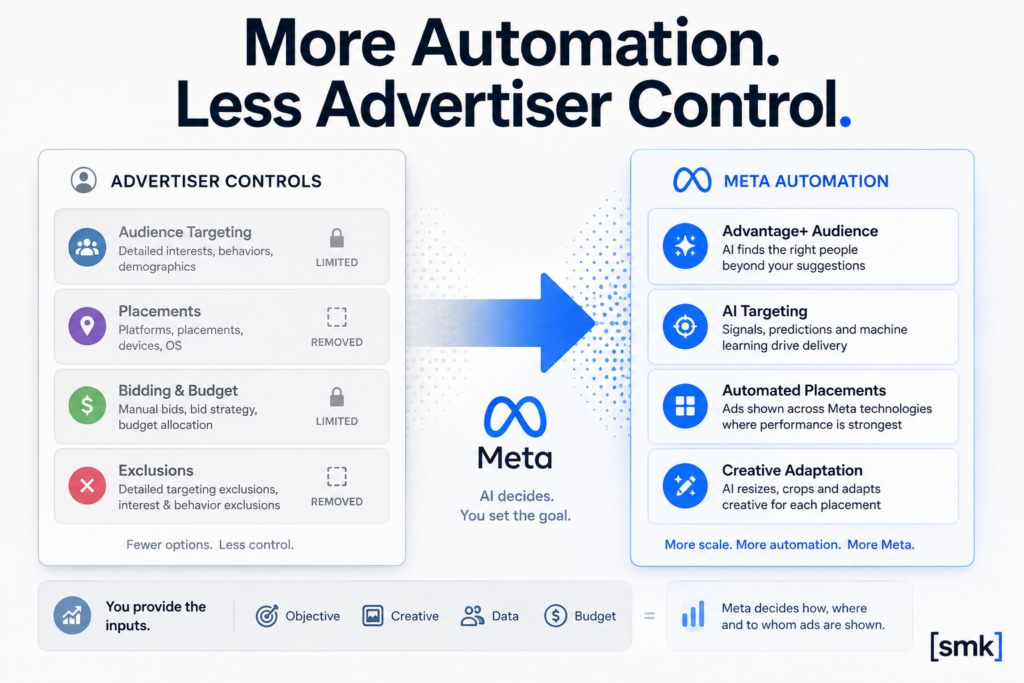
Meta advertisers may soon lose another familiar control inside Ads Manager, with the company beginning to alert some users that placement options could be removed from ad sets, potentially limiting their ability to decide where campaigns appear across Meta’s advertising ecosystem.
Taken on its own, the change could look like another fairly minor Ads Manager tweak. Viewed alongside the changes Meta has made over the past few years, however, it forms part of a much broader shift in how the company wants advertising to operate.
Meta has progressively removed detailed targeting options, eliminated interest and behaviour exclusions, consolidated granular audiences, turned many targeting selections into suggestions rather than instructions and pushed advertisers further towards automated Advantage+ campaign structures. Placements now appear to be the latest area where manual decision making is being reduced.
The direction is increasingly clear. Meta wants advertisers to define the commercial objective, provide creative, supply customer data and set the budget, while its systems make more of the decisions around who sees the advertising, where it appears and how spend is distributed.
For many advertisers, that may ultimately improve performance. It also changes quite significantly what paid social expertise looks like.
Meta Has Been Reducing Manual Control For Years
The latest placement change sits at the end of a fairly long sequence.
In January 2022, Meta removed thousands of detailed targeting options relating to areas such as health, race or ethnicity, religion, political affiliation and sexual orientation. Further targeting options disappeared in early 2024, particularly those Meta considered sensitive, overly granular or rarely used.
A more significant change followed in July 2024 when Meta removed Detailed Targeting Exclusions from new campaigns. Advertisers could no longer exclude people based on selected interests, behaviours or demographic characteristics, with the change later becoming more widely enforced across existing activity.
Around the same period, Meta also removed Audience Types from Advantage+ catalogue campaigns, reducing another layer of manual control over prospecting and retargeting.
Through 2025 and into 2026, the shift became more pronounced. Granular interests were increasingly consolidated into broader categories, while Advantage+ Audience made more inputs, including interests, lookalikes, age and gender parameters, recommendations rather than hard restrictions. Meta could expand beyond those selections whenever its system predicted better performance.
Placement controls now appear to be following the same path. Some advertisers are being told they may lose the ability to exclude specific placements, platforms, devices and operating systems from ad sets.
No firm rollout timetable has been confirmed, and some manual placement options remain visible in current documentation, so the extent of the change still needs to be watched carefully. Even so, the broader direction is hard to miss. Meta is steadily reducing the number of campaign decisions advertisers are expected to make themselves.
Meta Is Keeping Controls Where They Matter Most
The story is not simply that every advertiser safeguard is disappearing.
Meta recently introduced exclusion-only custom audiences, giving advertisers a clearer way to permanently prevent certain groups from receiving advertising. That matters for legal restrictions, opt-outs, customer suppression and other situations where a business genuinely needs to ensure that a campaign does not reach a particular audience.
The distinction is revealing because it suggests Meta is becoming more selective about which controls it considers necessary.
Advertisers may still be able to specify what absolutely must not happen, particularly where regulation, consent or customer experience is involved. They appear to have less freedom when the restriction reflects media strategy or advertiser preference rather than a hard business requirement.
In practical terms, a business may still be able to say that a particular group must not receive an advertisement, while having less say over whether the campaign appears in a specific placement or environment.
That represents a meaningful shift in the balance between advertiser judgement and platform automation.
Meta Has A Strong Performance Case
Meta is making these changes from a position of considerable strength.
Its advertising business continues to grow rapidly, with second-quarter 2026 revenue reaching US$60.8 billion, up 28% year on year. Across its family of apps, ad impressions increased 14% while the average price per ad rose 12%.
The company also continues to report improvements from its AI advertising systems. Meta says recent ranking developments increased Facebook ad clicks by 3.5% and lifted Instagram conversions by more than 1%, while another model spanning Instagram Feed, Stories and Reels reportedly increased conversion rates by 3%.
Those are Meta’s own measurements and should be treated accordingly, but they still help explain why the company is confident enough to keep removing manual controls.
If broader audiences, automated placements and machine-led optimisation consistently produce cheaper conversions, many advertisers will accept having less direct involvement in the buying process. The harder question emerges when platform efficiency and advertiser judgement start pulling in different directions.
Paid Social Expertise Is Shifting
The obvious conclusion from greater automation is that paid social expertise becomes less important. A more accurate interpretation is that the expertise moves into different parts of the system.
A large share of Meta advertising skill once sat inside campaign construction. Advertisers chose audiences, built exclusions, selected placements, set bids, split ad sets and continually moved budgets between them.
Meta is progressively absorbing more of that work, which means human advantage is increasingly concentrated around the quality of the inputs and the interpretation of the outputs.
Creative strategy, first-party data, experimentation and measurement all become more important because they shape what Meta has to work with and how advertisers judge the results it produces.
Creative Now Carries More Of The Load
Creative may be the area where the trade-off is most obvious.
As advertisers lose audience and placement controls, creative increasingly acts as a targeting signal. The asset itself needs to communicate who the product is for, what problem it solves and what kind of customer should respond, particularly when Meta has more freedom to distribute it across Feed, Stories, Reels, Messenger and other eligible inventory.
Meta’s response to that complexity has been to invest heavily in automated creative adaptation, including image expansion, resizing, copy changes, overlays and other Advantage+ creative features.
Advertisers have not always had a great experience with those tools.
In recent times, many have reported frustration when Meta has expanded images poorly, altered copy, introduced awkward overlays or made generative changes that were technically acceptable but creatively weak or inconsistent with brand intent.
That becomes more important if placement controls continue to disappear.
An asset created for Instagram Stories may be technically resized for another environment, but that does not mean the idea, framing or visual hierarchy works equally well there. Meta can make a creative fit a placement without necessarily making it appropriate for the placement.
Advertisers are therefore being asked to surrender more control over where creative appears while also placing greater trust in Meta’s AI systems to adapt that creative for environments they may not have chosen themselves.
For stronger advertisers, the answer is unlikely to be fewer assets and more blind reliance on automation. It is more likely to involve broader creative systems, greater format variation and tighter review processes so the platform has appropriate material to work with in the first place.
Better Data Replaces Some Lost Targeting Control
The same logic applies to data.
Meta is giving advertisers fewer opportunities to specify exactly who they want through granular targeting controls, while simultaneously increasing the importance of the first-party signals advertisers provide.
Customer lists, CRM data, website behaviour, conversion events and purchase data effectively tell Meta what a valuable customer looks like, allowing the system to find others who exhibit similar patterns.
The relationship is therefore changing. Advertisers once spent considerable time telling Meta who they wanted to reach. Increasingly, they are expected to provide evidence of what a valuable customer looks like and allow Meta to decide who else fits that profile.
For organisations with strong data infrastructure, that may work extremely well. For businesses with weak conversion tracking, fragmented CRM systems or poor-quality first-party data, greater automation can just as easily amplify existing weaknesses.
Measurement Becomes More Important As Control Declines
The most important consequence of Meta taking over more of the buying process may ultimately sit in measurement.
Meta increasingly wants to influence audience selection, placement, budget allocation and aspects of creative optimisation, while also supplying much of the reporting used to judge whether those decisions worked.
That creates an obvious tension.
A platform can optimise very effectively towards the outcomes it can see while still missing broader commercial effects such as incrementality, profit, customer quality or cannibalisation.
As advertisers lose some of the controls they once used to manage campaign delivery directly, they need stronger ways to evaluate the result independently.
Incrementality testing, downstream CRM performance, conversion quality and broader commercial KPIs become more important because they provide a check on whether platform efficiency is translating into genuine business value.
If Meta is going to make more of the buying decisions, advertisers need to become better at judging those decisions rather than simply operating the interface.
Meta Is Redefining The Advertiser’s Role
For years, digital advertising platforms sold increasingly granular control as one of their main benefits. Meta is now moving in almost the opposite direction.
The company increasingly wants advertisers to define the business outcome and provide the strongest possible inputs, while its systems determine how that outcome should be achieved.
The latest placement changes are another step in that process rather than an isolated product update.
Advertisers still choose the objective, supply the budget, provide the creative, feed the data and define the commercial constraints. They also remain responsible for determining whether the result is genuinely valuable.
More of what happens between those two points increasingly belongs to Meta.
Paid social expertise is not disappearing as a result. It is becoming less about manipulating campaign settings and more about building stronger creative systems, supplying better data, designing better experiments and knowing when platform performance should be trusted and when it should be challenged.

























RECOMMENDED FOR YOU
ChatGPT Work Expands Business Automation
For most organisations, generative AI still begins with someone…
For most organisations, generative AI still begins with someone…
[STUDY] ChatGPT Ads Defy An Easy Verdict
ChatGPT Ads have been live for six months. That…
ChatGPT Ads have been live for six months. That…
ChatGPT Work Starts Doing The Work
ChatGPT Work is only six weeks old, but OpenAI…
ChatGPT Work is only six weeks old, but OpenAI…