ChatGPT Work is only six weeks old, but OpenAI is already pushing it deeper into everyday workplace activity.
Since its July launch, Work has added voice control and tighter desktop integration, while its core proposition remains much bigger than another chatbot upgrade. It can work across connected apps and files, carry out multi-step tasks, create finished documents, spreadsheets, presentations and reports, and keep recurring activity moving through scheduled tasks.
For marketing and communications teams, that starts to move ChatGPT from something employees consult into something they increasingly delegate work to.
Instead of asking ChatGPT to help write a report, a team can increasingly give Work the source material, ask it to analyse what happened, create the finished report and repeat parts of the process next week.
That is a much more consequential shift than better prompting.
OpenAI’s latest enterprise data suggests some organisations are already moving quickly in that direction.
Work Is Different From Chat
The distinction between ChatGPT Chat and ChatGPT Work is easy to miss because both sit inside the same product.
Chat remains the familiar conversational experience. It is where users ask questions, brainstorm, research, analyse information or get help producing something.
Work is designed for longer, more involved jobs.
Rather than producing a response and handing the next step back to the user, Work can continue through multiple stages towards a finished deliverable. It can research, work with files, use connected applications and create outputs such as documents, spreadsheets, presentations and reports.
Users can still supervise the process, answer questions, redirect it and approve important actions along the way.
The operational difference is significant.
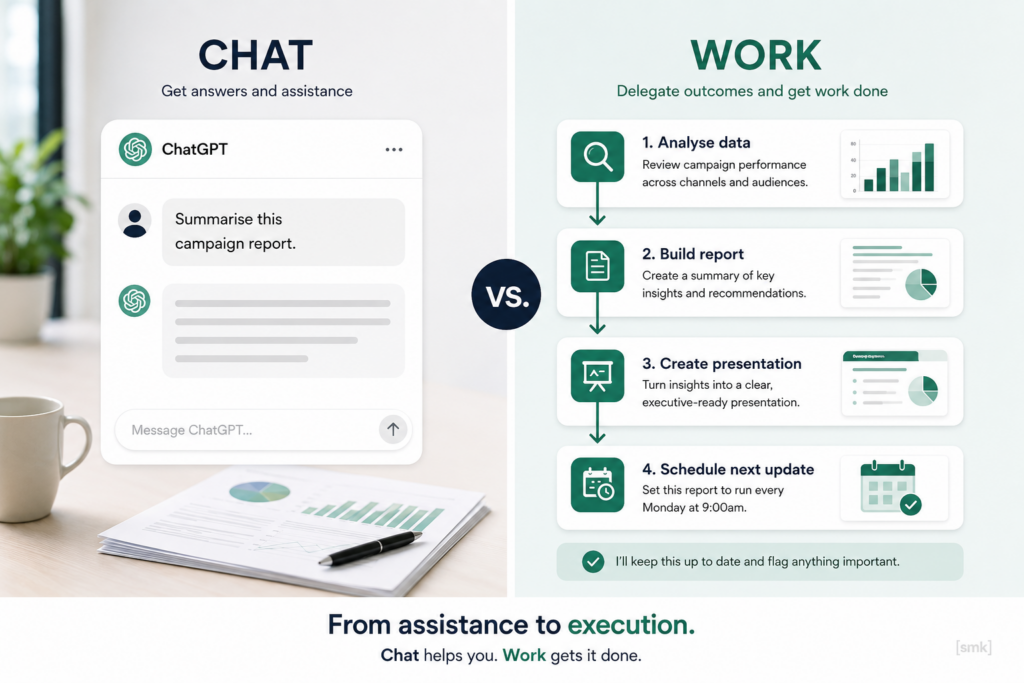
In Chat, a marketer might ask for an analysis of campaign data, then take the response into PowerPoint and build the presentation themselves.
In Work, the instruction could be closer to: analyse the campaign data, identify the important movements, compare them with the previous period, build the presentation and flag anything that needs my attention.
The human still sets the objective and retains judgement, but more of the work between the instruction and the finished output can be delegated.
Work Is Not A Separate Subscription
There is no separate ChatGPT Work subscription.
Work is included within eligible paid ChatGPT plans, although usage limits vary.
For individual users, ChatGPT Plus currently costs US$20 a month.
For organisations, ChatGPT Business costs US$20 per user per month when billed annually, or US$25 on monthly billing, with a minimum of two seats. Enterprise pricing is negotiated separately.
For many organisations already paying for ChatGPT, Work is therefore less a new procurement decision than a new capability inside something they already have.
That lowers the barrier to experimenting with it.
Setting It Up Is Relatively Straightforward
At its simplest, a user opens ChatGPT and chooses Work rather than Chat.
They can start with an existing project or create a new one, add files and relevant context, then describe the job or finished deliverable they want.
The more useful version begins when Work is connected to the systems and information a team already uses.
That might mean access to shared documents, internal files, campaign material or collaboration tools.
From there, recurring tasks can be scheduled to run again or monitor for changes.
A marketing team might use that setup to prepare a weekly campaign report, refresh a presentation when new data arrives or produce an updated briefing from agreed sources.
The mechanics are relatively simple.
The bigger decisions are what information Work should be able to use, what parts of the process it should handle and where human review still needs to sit.
Most Workplace Use Is Still Likely Informal
That question becomes more important when looking at how ChatGPT is currently used at work.
ChatGPT has around 900 million weekly active users, while OpenAI says around nine million paying business users access the product through managed organisational plans.
Those figures measure different things and should not be compared directly, but the difference in scale is still striking.
A large amount of workplace ChatGPT usage is therefore likely happening through individual Free, Plus or Pro accounts rather than centrally managed company environments.
OpenAI’s own research supports that picture. Its Signals data separately tracks work-related activity taking place on individually managed accounts, suggesting workplace adoption has often happened from the bottom up.
Employees started using ChatGPT before many organisations had made a formal decision about it. Some upgraded themselves. Others continued using free accounts. Business and Enterprise deployments came later.
That approach matters much more once AI moves from answering questions to accessing company information and completing parts of business workflows.
Using an individual account to draft an email or brainstorm campaign ideas is one thing.
Connecting AI to internal files and recurring operational processes is another.
As the level of delegation grows, organisations need to become clearer about access, oversight and what should remain under human control.
For OpenAI, that also creates a substantial commercial opportunity.
The company already has enormous reach among individual users. The next challenge is converting more informal workplace adoption into managed organisational use.
ChatGPT Work gives it a stronger reason to do so.
The Usage Gap Is Getting Wider
The organisations already operating in that more advanced mode appear to be pulling further ahead.
Earlier this year, OpenAI found that its heaviest enterprise users were consuming around 3.5x more AI intelligence per worker than typical firms, up from around 2x a year earlier.
More prompts explained only 36% of the difference.
Most of the gap came from richer context, more complex tasks and employees expecting AI to produce more substantial pieces of work.
The organisations pulling ahead were not simply asking ChatGPT more questions.
They were using it more deeply.
Newer data suggests that pattern is spreading beyond technical teams.
One signal comes from Codex, OpenAI’s more agentic work environment. Since February, weekly active use has grown 26x in marketing, 41x in sales, 41x in recruiting and 108x in legal.
The marketing figure should not be mistaken for evidence that agentic marketing has suddenly gone mainstream. OpenAI also does not disclose enough information to show the absolute number of marketers behind that 26x growth.
Even so, the direction is notable.
More advanced forms of AI use are moving beyond engineering into functions that rely heavily on research, documents, presentations, analysis and communication.
The Difference Is Depth, Not Access
For most organisations, access to AI is becoming the easy part.
Many businesses already have ChatGPT, Copilot, Gemini or Claude somewhere in the organisation. They may also have run training, created guidelines and identified common use cases.
None of that necessarily means the underlying work has changed.
A marketing team using AI to rewrite an email has adopted AI.
A marketing team connecting AI to its information, defining how campaign reporting should work and allowing an AI assistant to produce the first version every Monday has changed the workflow.
That is a much bigger organisational step.
Marketing and communications contain plenty of work suited to that model.
Reporting is an obvious candidate. Campaign analysis, research, briefing, monitoring, content adaptation and recurring stakeholder updates contain similar chains of repeatable activity.
The productivity opportunity increasingly sits in redesigning those chains rather than making every individual task slightly faster.
More Automation Exposes Weak Processes
Greater delegation also exposes problems that conversational AI can hide.
A chatbot can help an employee work around an unclear process.
An AI system expected to complete that process needs much more certainty.
- Which data source is authoritative?
- What should a finished report contain?
- Who approves an external communication?
- When should the system stop and ask for review?
- What happens when information conflicts?
If teams cannot answer those questions themselves, giving AI access to more information does not resolve the problem.
In some cases, it simply automates the confusion.
That is why the move from Chat to Work matters beyond OpenAI’s product strategy.
The first phase of generative AI encouraged organisations to improve prompting and individual capability.
The next phase forces them to examine how the work itself is organised.
The Leadership Question Is What To Delegate
OpenAI’s numbers still need some caution.
The company is analysing customers using its own products and has an obvious commercial interest in demonstrating that deeper AI use creates value. Growth rates can also look spectacular when they begin from a small base.
The data does not prove that marketing and communications teams are suddenly handing their functions over to autonomous systems.
It does suggest that more advanced users are moving beyond isolated AI tasks towards richer context, connected information and delegated work.
ChatGPT Work makes that transition considerably more accessible.
For marketing and communications leaders, the useful question is therefore shifting.
It is no longer simply whether the team uses ChatGPT.
It is which parts of the team’s recurring work should move from Chat to Work, what information Work needs to do the job properly, and where human judgement still needs to sit.
The next divide in workplace AI may have relatively little to do with who has access to the smartest model.
It may be between organisations still using AI one prompt at a time and those beginning to redesign how the work gets done.




RECOMMENDED FOR YOU
Google Gives Advertisers More AI Max Visibility
Google is introducing new AI Max reporting capabilities, giving…
Google is introducing new AI Max reporting capabilities, giving…
[STUDY] AI Content Production Keeps Accelerating
93% of marketers now use AI to support content…
93% of marketers now use AI to support content…
Meta Launches AI Agent For Businesses
Meta is extending its AI capabilities beyond Facebook, Instagram…
Meta is extending its AI capabilities beyond Facebook, Instagram…