For most organisations, generative AI still begins with someone deciding to use it. A marketer opens ChatGPT, asks for an analysis, uploads a document or gives an agent a task. Even increasingly sophisticated AI systems usually wait for a person to initiate the process.
ChatGPT Work is beginning to change that.
Last week, OpenAI added event-triggered tasks that can respond automatically when something happens inside Gmail, Slack or GitHub. A new email can arrive, client feedback can appear in a Slack channel or a pull request can change, and ChatGPT can begin a predefined task in response.
For marketing and communications teams, Gmail and Slack are probably the more immediately useful examples. An email from a particular stakeholder could trigger a summary and recommended actions, while feedback appearing in a campaign channel could automatically be consolidated into next steps.
The update moves ChatGPT Work further into business automation, where AI is not simply answering questions or completing work on demand, but becoming part of the process through which work arrives and moves around an organisation.
ChatGPT Work Adds Another Starting Point
ChatGPT Work launched in July as OpenAI’s environment for longer, multi-step tasks. It can gather information across connected apps and files, complete sequences of activities and create outputs such as documents, spreadsheets, presentations and reports.
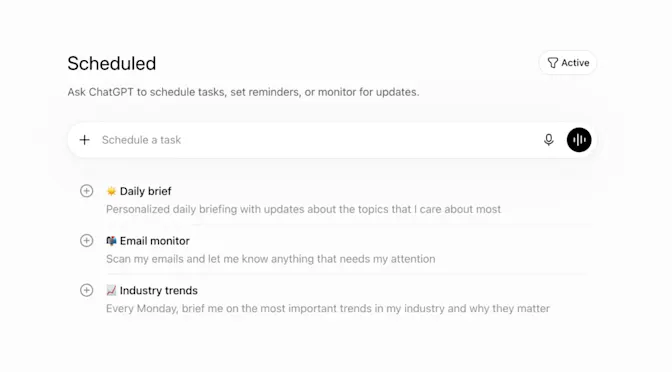
Scheduled tasks already allowed some of that work to run later or recur at a particular time. Event-triggered tasks extend the model by allowing users to define what ChatGPT should do when a particular event occurs.
Until now, a fairly typical AI workflow involved someone noticing that something needed attention, deciding AI could help and then initiating the task. Event triggers remove part of that manual hand-off.
Someone still needs to design the task, define the conditions and determine what ChatGPT should do, but the same workflow no longer needs to be manually restarted every time the underlying event occurs.
That distinction becomes more useful when applied to the everyday work of marketing and communications teams, much of which already begins with an identifiable trigger.
Marketing Work Is Full Of Repeatable Events
A client responds to a proposal, a journalist requests information, a stakeholder provides feedback, a campaign brief lands, a customer complaint appears or sales receives a new enquiry. The work that follows often has a recognisable pattern, even when the content itself varies considerably.
Gmail tasks can respond to new messages and be filtered by sender or subject, while Slack triggers can react to new channel messages and be narrowed by channel, sender or thread. GitHub activity is also supported, giving OpenAI an initial spread across email, collaboration and development workflows.
A communications team could use an incoming media enquiry to trigger a summary and draft response points for review. A marketing team could have stakeholder feedback from a campaign channel consolidated ahead of the next meeting, while sales and marketing teams could use incoming messages to prepare account context or suggested follow-up activity.
None of those outputs is especially remarkable on its own. The value comes from taking repeatable pieces of work that previously depended on somebody noticing, moving and initiating them, then making more of that process automatic.
OpenAI has also made scheduled and event-triggered tasks shareable, which starts extending the same idea from individual productivity into team practice.
Within ChatGPT Business, a team member can distribute a task across the workspace, while recipients can customise the instructions, connect their own apps and run an independent copy using their permissions.
A useful prompt might save one person time. A useful workflow that can be replicated across a team begins to codify how a piece of work should be done.
AI Capability Starts Looking More Operational
Shared workflows also challenge one of the more common ways organisations think about AI adoption.
Much of the enterprise discussion still revolves around usage. Organisations measure who has access to ChatGPT, Copilot or Claude, how often employees use them and how sophisticated their prompting has become.
Those measures matter, but they become less revealing once AI starts sitting inside repeatable processes.
The more useful questions shift towards which workflows have been identified, where AI can reliably take responsibility, which steps still require human judgement and whether the resulting process is actually better than what came before.
Prompting remains part of that work, but workflow design becomes increasingly important. Teams need to determine which events genuinely require action, what information the AI should gather, what output it should create and where permissions or review points need to sit.
Poor processes will not improve simply because AI can execute them faster. Confusing approvals, unclear ownership and weak data can just as easily become automated problems.
OpenAI’s current implementation recognises some of that risk. Connected-app permissions continue to apply, actions requiring approval can pause for review, and Enterprise and Edu administrators can control whether event-triggered tasks are enabled.
The more AI moves from answering questions towards acting inside business processes, the more important those operational disciplines become.
ChatGPT Joins A Much Bigger Automation Shift
Event-triggered automation itself is hardly new. Platforms such as Microsoft Power Automate and Zapier have spent years connecting events in one application with actions in another, while many larger organisations already operate substantial workflow automation systems.
Generative AI changes what can happen after the trigger.
Traditional automation works particularly well when the rules are clear and predictable. An event occurs and a predefined action follows. AI can work with much messier inputs, interpreting an email, conversation or document before determining what information matters and what should happen next.
An incoming message does not need to follow a particular template for an AI system to recognise that it contains campaign feedback, a customer complaint or a media request. It can interpret the context and prepare work around it rather than simply moving information from one application to another.
That creates more opportunities for automation, while also introducing more judgement and therefore more room for error.
ChatGPT Work is one expression of a much wider movement across workplace AI. Microsoft is pushing Copilot more deeply into Microsoft 365 and its broader agent ecosystem, while Anthropic is developing Claude around increasingly sophisticated work and agentic use cases.
For marketing teams, the choice of platform may ultimately be less important than learning to operate in this way.
Marketing Teams Need The Productivity Gain
The commercial pressure behind that shift is becoming difficult to ignore.
According to Gartner’s 2026 CMO Spend Survey, marketing budgets have barely moved, rising from 7.7% to 7.8% of company revenue. They have effectively been sitting on the same plateau for several years and remain well below earlier peaks.
Expectations have not declined with them.
Gartner found that 56% of CMOs believe they lack the budget required to deliver their 2026 strategy, while 54% say they do not have sufficient resources. Organisations are already allocating an average 15.3% of marketing budgets to AI, yet only 30% say they have sufficiently mature capabilities to scale it effectively.
There is little evidence that materially larger marketing budgets or significantly bigger teams are about to solve the problem.
That makes productivity more than an efficiency exercise.
Marketing teams increasingly need to create additional capacity from the resources they already have, which means AI adoption has to progress beyond individual employees occasionally saving time on a draft, analysis or piece of research.
Whether those workflows are built through ChatGPT, Microsoft Copilot, Claude or another environment matters less than whether AI becomes embedded in the underlying operating model.
The opportunity lies in removing repeated hand-offs, absorbing administrative work, accelerating analysis and supporting decisions across the everyday processes through which marketing and communications teams operate.
Buying access to AI is relatively straightforward. Redesigning work so AI consistently increases the capacity of the team is considerably harder.
AI Is Moving Into The Operating Layer
Event-triggered tasks are an early but useful illustration of what that transition can look like.
ChatGPT began as somewhere people went to ask questions. Work expanded the model by allowing people to delegate larger jobs. Event triggers now allow some of those jobs to begin because something has happened elsewhere in the business.
OpenAI is starting with Gmail, Slack and GitHub, giving Work an immediate foothold across several common workplace environments. As the capability develops, its usefulness will grow with the range of business systems and events that can initiate work.
The broader opportunity extends well beyond OpenAI. Marketing teams are being asked to deliver against ambitious plans without any obvious budget or resource windfall on the horizon, while AI systems are becoming increasingly capable of taking responsibility for parts of the workflow rather than merely assisting individual employees.
The organisations that get the most from that shift are unlikely to be those with the cleverest prompts. They will be the ones that work out where AI belongs inside their operating model, which processes should change and where human judgement still creates the most value.










RECOMMENDED FOR YOU
[STUDY] AI Search Shapes Brand Decisions
AI search is starting to influence purchase decisions well…
AI search is starting to influence purchase decisions well…
LinkedIn Lets AI Multiply Ad Creative
LinkedIn is giving advertisers far more freedom to vary…
LinkedIn is giving advertisers far more freedom to vary…
Copilot Lets Marketers Build Apps By Chatting
Microsoft is giving Copilot users the ability to build…
Microsoft is giving Copilot users the ability to build…