
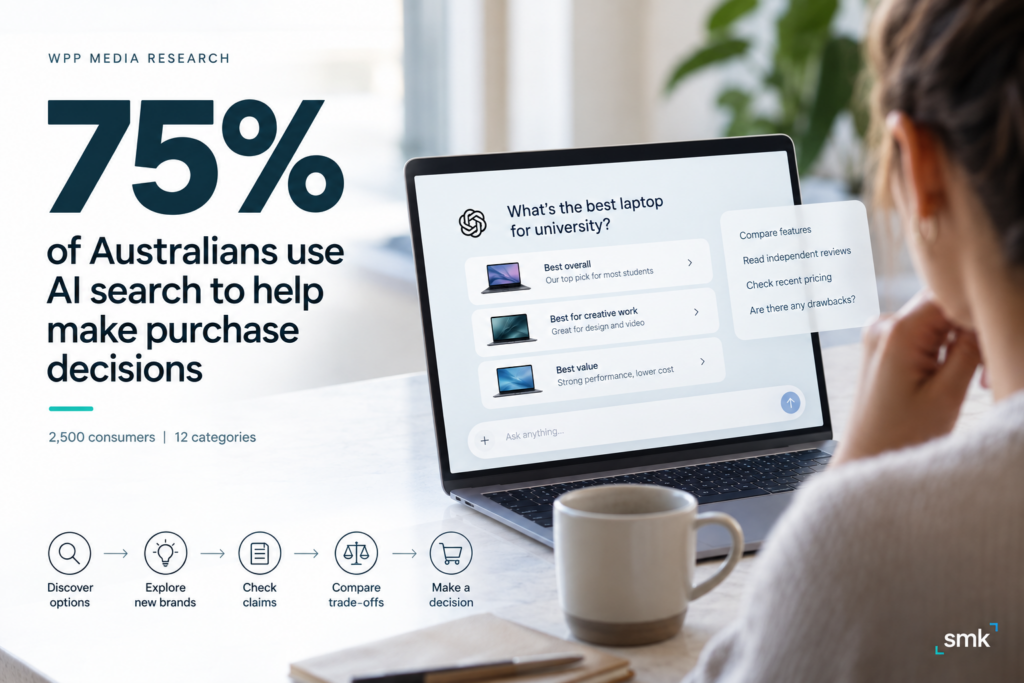
AI search is starting to influence purchase decisions well before many brands can see that a customer is in the market.
New Australian research from WPP Media, covering 2,500 consumers across 12 categories, found that three in four respondents use AI-assisted search when making purchase decisions. That includes 58% using AI summaries within conventional search results and 40% using large language models such as ChatGPT, Gemini or Claude directly. Almost a third use both.
The research goes beyond whether brands appear in AI-generated answers. It looks at what consumers do with those answers, how much they trust them and whether AI changes what they eventually buy.
Some of the more useful findings sit towards the beginning of the customer journey. WPP found buyers complete an average of 18 AI actions around a purchase decision, with 94% of that activity occurring early in the process.
AI is helping consumers discover options, interrogate claims and narrow choices before they necessarily visit a brand website, click an ad or generate another signal a marketing team can readily measure.
AI Is Moving Earlier Into The Decision
WPP found AI-assisted search being used across every category included in the research, although adoption varied considerably.
Usage ranged from 36% in pet care to 87% in financial services, covering categories including travel, automotive, fashion, insurance, consumer electronics and health.
Consumers are also doing more than asking for straightforward product information.
Sixty-one per cent said AI had introduced them to brands they had not previously considered, while 66% had used AI to check whether a claim they encountered in advertising was true.
A brand can therefore enter, or leave, consideration inside the same AI interaction.
Someone might begin by asking for options, discover several unfamiliar brands and then ask the AI to compare reviews, investigate a product claim or identify potential drawbacks. The process that previously required several searches, websites and comparison sources can increasingly happen inside one conversation.
WPP describes that activity as a largely hidden pathway through the customer journey because much of it takes place before conventional measurement systems see anything.
AI Can Widen The Consideration Set
One of the more interesting findings is that AI appears capable of introducing consumers to options they had not initially intended to explore.
WPP found that 84% of buyers said AI surfaced a product or service they had not originally planned to buy, while 61% discovered brands they had not previously considered.
That suggests AI discovery can be broader than simply answering more detailed versions of traditional search queries.
A customer may begin with an outcome rather than a category.
Someone planning a family weekend could describe the type of experience they want without naming an attraction, hotel or restaurant category. A business buyer might explain an operational problem without knowing which software category solves it.
The AI can then assemble a set of possible products, services and brands around the need.
Brands can therefore become relevant through the situations they solve, not only through the category terms marketers already track.
That pushes AI discovery closer to broader brand strategy, category entry points and content planning rather than leaving it solely within SEO.
AI Can Also Change A Decision
WPP found that 26% of respondents completely changed an intended purchase decision following an AI recommendation.
A customer may already have a preferred brand based on advertising, previous experience, word of mouth or conventional search, then use AI to challenge that preference before buying.
Reviews, pricing, product limitations, independent reporting and inconsistencies between brand claims and external information can all become part of that interrogation.
The result can work in the brand’s favour. AI might provide additional reassurance, surface useful evidence or confirm that a company is well suited to the customer’s needs.
It can also introduce an alternative.
Marketing teams have traditionally concentrated heavily on getting into the consideration set. AI creates another challenge around what happens when consumers start interrogating that shortlist.
Consumers Are Using AI To Check Marketing Claims
The finding that 66% of respondents had used AI to check an advertising claim is particularly relevant for brand and communications teams.
Consumers have always had the ability to verify what companies tell them. AI reduces the effort required.
A claim about price, performance, sustainability, customer satisfaction or product quality can be questioned immediately, with an AI system drawing information from sources well beyond the advertiser’s own website.
Corporate communications, reviews, product information, media coverage, customer experience and owned content can all influence what an AI system finds when it investigates a brand.
A polished advertising claim may carry less weight if the information surrounding it tells a different story.
The implication is broader than search visibility. Brand claims increasingly sit inside a wider information environment that customers can interrogate almost instantly.
Referral Traffic Only Shows Part Of The Influence
AI search has often been discussed through the traffic it sends to websites.
WPP’s findings suggest that view is too narrow.
An AI assistant can introduce a brand, reinforce it, reduce confidence in it or remove it from consideration without generating a direct referral visit.
The customer might later search the brand on Google, visit a retailer directly, use an app or make an offline purchase. Conventional analytics may capture the final interaction while missing the AI conversation that helped shape it.
AI visibility measurement therefore needs to stretch beyond referral traffic.
Tools that track brand mentions, recommendations and citations across AI systems can provide useful signals, particularly when organisations want to understand where they are appearing and which sources are influencing the answers.
Those measures are still proxies.
A high share of AI answers becomes commercially meaningful when those appearances contribute to consideration, preference or sales.
AI Appears To Be Compressing Research
WPP also found that 91% of buyers believed AI accelerated their decision-making, with 51% saying it reduced the time required to reach a decision by between 1.5 and two times.
AI can bring several stages of research together.
Consumers can discover options, compare them, investigate objections and ask follow-up questions without repeatedly moving between search results and websites.
Brands excluded from those early conversations may therefore have fewer opportunities to recover later in the journey.
AI is not replacing every other source of information, however.
Separate Australian research from IAB Australia found that shoppers continue to use a mix of search engines, retailers, social media, reviews and AI tools. Among consumers using AI for shopping, 74% said they use it alongside other information sources, while 78% still click through to websites for more information.
The customer journey is becoming more fragmented rather than neatly transferring from Google to AI.
A person might discover a category through social media, explore options through ChatGPT, verify claims through Google, read reviews and then buy through a retailer.
AI increasingly sits somewhere inside that journey, even when it does not own the final interaction.
AI Visibility Creates An Ownership Problem
WPP’s findings broaden the AI visibility conversation considerably.
Brands need to understand where they appear in AI answers, the questions customers are asking, the situations that bring them into the category, the evidence AI systems encounter and how accurately the brand is represented when consumers begin comparing options.
Some of that work clearly overlaps with SEO. Technical accessibility, structured information, search visibility and content quality all influence what AI systems can find and interpret.
The overlap only goes so far.
AI answers also draw on earned media, reviews, customer sentiment, product information, social content and other third-party sources. Questions around reputation, positioning, claims and customer experience quickly bring communications, brand, content and CX into the picture.
That raises a harder question around ownership.
Inside organisations, AI visibility is likely to cut across several functions. SEO teams bring deep expertise in discovery and technical optimisation. Communications teams understand earned influence and reputation. Brand teams own positioning and meaning, while digital and analytics teams are likely to play a major role in measurement.
Agency land could be considerably messier.
SEO agencies can make a credible claim because much of the underlying work builds on search and content optimisation. PR agencies can argue that earned coverage, reputation and third-party authority increasingly shape what AI systems say. Media agencies are already building AI visibility products around discovery and measurement, while creative and brand agencies will increasingly see a role in shaping the signals and narratives that models encounter.
No single discipline has an obvious claim to the whole problem.
That makes an ownership bun fight fairly likely as agencies look to turn AI visibility into a new service line.
For clients, the more useful question will be less about which agency category gets to own it and more about who can actually connect the different signals, diagnose the gaps and coordinate action across search, content, communications, brand and customer experience.
By the time a customer reaches a website, clicks an ad or approaches a retailer, an AI assistant may already have influenced which brands are being considered.
WPP’s research suggests that influence is becoming a customer journey issue, not simply a search issue.
















RECOMMENDED FOR YOU
LinkedIn Lets AI Multiply Ad Creative
LinkedIn is giving advertisers far more freedom to vary…
LinkedIn is giving advertisers far more freedom to vary…
Copilot Lets Marketers Build Apps By Chatting
Microsoft is giving Copilot users the ability to build…
Microsoft is giving Copilot users the ability to build…
Apple Intelligence Pushes Into Brand Discovery
Apple’s long-promised Siri overhaul is finally arriving, after years…
Apple’s long-promised Siri overhaul is finally arriving, after years…