Canva has launched its own AI image generation model, Craft, designed to produce more accurate layouts, typography and graphics for everyday creative work.
Available through Canva’s Dream Lab, Craft is aimed at one of the persistent frustrations with AI image generation: producing attractive visuals is relatively easy, but getting the text, composition and individual design elements right can still require considerable manual correction.
The launch is particularly relevant for marketing and communications teams already using Canva to produce social graphics, presentations, promotional materials and other branded content.
Craft also arrives alongside improvements to Canva’s AI design and editing tools, bringing the platform closer to a workflow where teams can generate creative assets, make changes and prepare finished materials within the same environment.
Craft Puts Design Ahead Of Image Generation
Developed by Canva’s internal AI research team, Craft has been trained with an emphasis on graphic design, drawing on millions of human-designed templates covering posters, presentations, social content and other visual formats.
Its approach differs from image generators primarily designed to produce photographic or illustrative content.
Canva says Craft first develops a plan for the composition, including the placement of objects, text and other elements, before generating the finished image.
The model supports more than 30 aspect ratios and images up to 2K resolution, with particular emphasis on typography, layout accuracy and the relationships between elements.
For example, a marketing team could request a promotional graphic featuring a headline, supporting copy, product imagery and a specified visual hierarchy.
The challenge for conventional image generators is often maintaining that structure while rendering text accurately. Craft is designed to improve those outcomes, potentially reducing the amount of editing needed before an asset can be used.
Canva says the model performed strongly in early design-focused benchmarks, although those results need to be considered alongside independent testing and the practical demands of marketing production.
AI Images Become Editable Marketing Assets
One of the more significant developments is how Canva is connecting image generation with editable design workflows.
Its Magic Layers technology can convert AI-generated images into designs containing separate elements that users can adjust within Canva.
Instead of treating an AI-generated graphic as a single flattened image, teams can potentially change copy, reposition elements and adapt layouts without recreating the entire asset.
The capability also extends to images created using other AI systems, including ChatGPT and Gemini, providing a route from general-purpose image generation into Canva’s editing environment.
For marketing teams, that addresses a familiar limitation of AI image tools.
An AI-generated promotional graphic may look convincing, but changing a price, correcting a headline or adapting the design for another market can be unnecessarily difficult when the entire composition exists as a single image.
Editable elements make the output more practical, particularly for organisations producing multiple versions of campaign assets.
However, converting a generated image into layers does not guarantee the same level of control as working with a professionally constructed design file. Teams will still need to assess how accurately elements are separated and whether the resulting layouts remain usable.
Canva AI Moves Beyond The Design Editor
Craft also fits into Canva’s wider efforts to make AI a more central part of everyday creative production.
Canva AI 2.0 has expanded the platform’s conversational design capabilities, allowing users to develop creative work through prompts and refine outputs within Canva.
The company has also been building connections with external AI assistants, including ChatGPT and Gemini, so creative tasks can begin outside Canva before moving into its design environment.
The implications extend beyond image generation.
A communications team could develop an initial campaign concept using an AI assistant, generate supporting visuals and then move the resulting assets into Canva for editing, brand adjustments and production.
For organisations already using Canva’s brand templates and shared design resources, the potential advantage is bringing more of that process into familiar tools.
Canva’s recently introduced ProSuite also extends its professional creative capabilities through Affinity, Cavalry, Flourish and Leonardo, although those tools serve different production requirements and are not all directly connected to Craft.
Together, the developments suggest Canva is positioning itself to handle a larger share of the creative production process, from initial concepts through to finished marketing materials.
Better Image Models Still Need Better Design Judgement
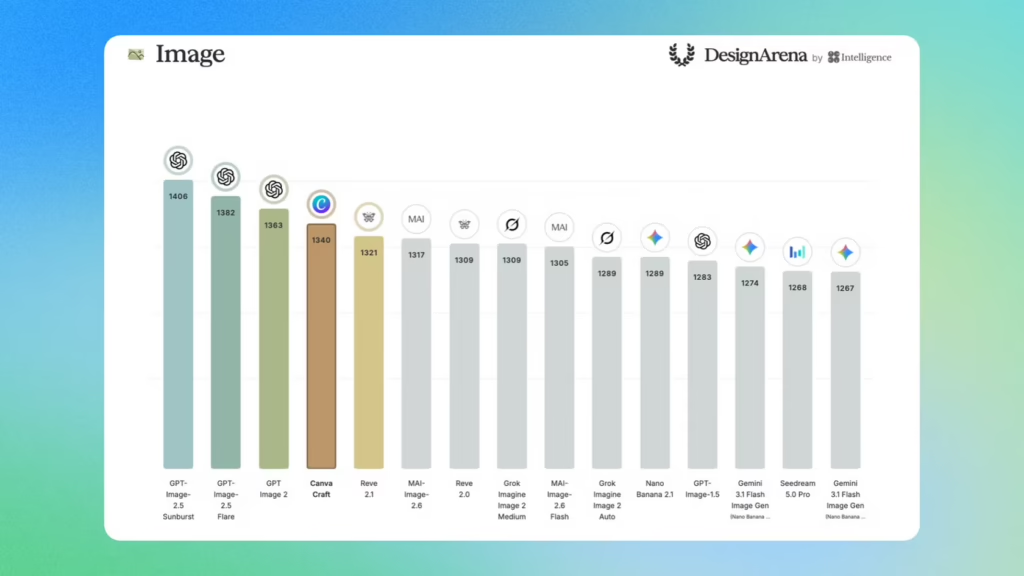
Canva reports that Craft debuted fourth overall on the DesignArena image generation leaderboard, with particularly strong results in categories including portraits, landscapes and product imagery.
The rankings suggest that Canva has developed a competitive image generation model, although performance on a crowdsourced benchmark is only one measure of its usefulness.
Marketing teams have more specific requirements. Promotional graphics need accurate text, consistent brand elements, appropriate image composition and sufficient control to make changes without rebuilding the design.
Craft’s emphasis on typography and composition addresses some of those challenges, but Canva acknowledges that fine print and technical drawings still need improvement. Its Magic Layers technology also remains dependent on accurately interpreting the structure of generated images. <Cite refs={[“turn913862search2″,”turn913862search1”]}/>
A useful test would be to produce a small set of familiar marketing assets using Craft, ChatGPT Images and Google’s image generation tools, then compare the results on accuracy, editing effort and final production quality.
Teams could test a promotional graphic containing multiple lines of copy, a branded social post, a presentation visual and a campaign asset requiring several size variations.
The most useful measure is the amount of work required to turn the generated output into something ready for publication.
Creative Production Becomes More Accessible
Canva now serves more than 250 million users, giving its new capabilities considerable reach across businesses that already rely on the platform for everyday design work.
The combination of Craft, Magic Layers and conversational design tools could make routine creative production more accessible to marketing and communications teams, particularly where professional design resources are limited.
There are also implications for how organisations manage their creative workflows. Designers may spend more time establishing brand systems, developing original concepts and overseeing quality, while other team members handle a greater share of routine asset production and adaptation.
Canva’s investment in professional tools through ProSuite suggests it also sees a continuing role for specialist creative work alongside increasingly automated production.
For existing Canva users, Craft is available globally through Dream Lab, making it relatively straightforward to evaluate against their current image generation tools.
The more consequential development is the growing connection between AI generation and editable design. If Canva can make that process consistently reliable, marketing teams may find themselves using AI for a much larger share of everyday creative production, with fewer steps between an initial brief and a finished asset.



















RECOMMENDED FOR YOU
[STUDY] Only 6% Of Marketing Teams See Major AI Returns
AI adoption is almost universal across marketing departments, yet…
AI adoption is almost universal across marketing departments, yet…
Instagram Edits Gets A Major AI Upgrade
Instagram is bringing AI-powered content analysis and planning into…
Instagram is bringing AI-powered content analysis and planning into…
Microsoft Pushes Copilot Into Marketing Automation
Microsoft is expanding Copilot’s automation capabilities, allowing organisations to…
Microsoft is expanding Copilot’s automation capabilities, allowing organisations to…