
Marketing leaders are raising their expectations of agencies as artificial intelligence changes how marketing work is produced, delivered and valued.
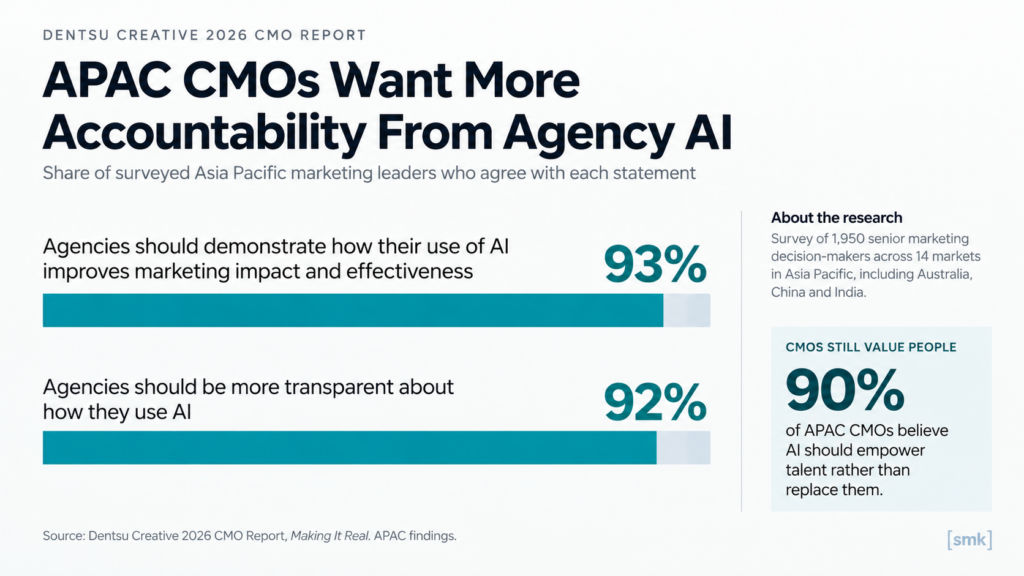
New research from Dentsu Creative finds that 93% of Asia Pacific CMOs expect agencies to demonstrate how AI improves marketing impact and effectiveness, while 92% want greater transparency about how their agency partners use the technology.
The findings come from Dentsu Creative’s Making It Real 2026 CMO Report, which surveyed 1,950 senior marketing decision-makers across 14 markets, including Australia, China and India.
The pressure extends beyond agency performance. AI is also changing the capabilities available to clients themselves, raising questions about which activities should be managed internally, what agencies should provide and how the two sides work together.
For agencies, the challenge is to demonstrate value as clients gain access to increasingly capable technology. For marketing leaders, the opportunity comes with decisions about internal investment, operating models and the expertise they will continue to need externally.
CMOs Want Evidence Of AI’s Value
Dentsu’s research suggests marketing leaders are becoming more demanding about the commercial contribution of AI.
Globally, 71% of CMOs report that AI is improving speed to market, yet 70% say they have not experienced major cost efficiencies. Meanwhile, 74% are considering replacing some of their existing technology tools.
The findings suggest that faster production and greater access to AI capabilities are not automatically translating into lower costs or better business outcomes.
Agency operating models are also attracting scrutiny. Some 77% of global CMOs believe the separation of media, data and production across agency structures is limiting the effectiveness of their content.
There is an important qualification. Dentsu is itself a major agency network, and its interpretation naturally emphasises the continuing value of integrated agency services. Nevertheless, the research provides a useful indication of how client expectations are evolving.
The commercial implications extend into agency scopes, staffing, pricing and the division of responsibilities between clients and their external partners.
The Client–Agency Division Of Labour Is Changing
Marketing teams now have access to AI capabilities that can support research, copywriting, creative production, reporting, analysis and campaign planning.
Increasingly, these capabilities are moving beyond individual productivity tools into automated workflows and AI agents that can undertake more complex activities across business systems.
Some work previously outsourced to agencies may consequently become practical for internal teams to manage, particularly routine production, content adaptation, reporting and administrative activities.
However, the extent of that shift will vary considerably.
A large organisation with an established marketing operations function, strong data infrastructure and dedicated AI resources has different options from a smaller business with a handful of marketing employees.
Nor does having access to AI automatically mean an internal team has the time, expertise or processes to produce work to the required standard.
Agencies continue to offer specialist capabilities, experienced talent, creative judgement, established production resources and perspectives developed across multiple clients and industries.
Those advantages remain commercially relevant. AI may also make agencies more capable by allowing their specialists to spend less time on repetitive execution and more time developing ideas, solving problems and improving outcomes.
The likely consequence is a more fluid division of work, with clients reassessing which activities they can manage effectively themselves and where external expertise continues to offer greater value.
Agency Pricing Faces New Questions
Changes in production efficiency are likely to place additional pressure on traditional agency commercial models.
Dentsu’s 2025 CMO research found that 88% of marketers expected AI to change agency pricing models, suggesting the issue has been developing for some time.
Consider a creative agency producing a substantial volume of campaign assets. If AI reduces the time required to develop variations, resize creative or adapt content for different channels, clients may reasonably expect some of those efficiencies to be reflected in their fees.
Agencies, meanwhile, are investing in software, specialist talent, training, governance and new production systems. Their commercial contribution may also extend well beyond the hours required to produce a particular deliverable.
The resulting tension is familiar, although AI makes it more pronounced. Clients want better value from increasingly efficient production processes, while agencies need viable commercial models that reward expertise, investment and quality.
Time-based billing may become harder to defend for some activities, particularly where automation substantially reduces manual effort. Project fees, retained access to specialist capabilities and other service-based models may become more attractive.
Outcome-based pricing could also gain ground in areas where agencies have sufficient influence over performance and results can be measured reliably.
Greater transparency will become important regardless of the pricing model. Clients will increasingly want to understand how AI contributes to the work they commission and what commercial benefits it provides.
What Lies Ahead For Agencies?
Agencies face decisions about which services they offer, how they deliver them and where they invest.
Routine production work may become more competitive as clients gain access to similar tools. Agencies whose business models depend heavily on labour-intensive execution could face pressure to reconsider their services and pricing.
At the same time, AI creates opportunities to expand what agencies can deliver.
Specialist expertise in brand strategy, creativity, media, communications, customer experience and technology remains valuable. Agencies that combine those capabilities with effective AI workflows may improve both their productivity and the sophistication of their services.
Smaller specialist agencies could also benefit. AI can reduce some of the production and operational resources historically required to service larger clients, potentially allowing smaller teams to compete for more substantial work.
Another opportunity lies in helping clients develop their own AI capabilities.
Agencies may increasingly support clients with workflow design, specialist agents, technology integration, governance and ongoing AI operations, extending their role beyond conventional marketing services.
Some will find that commercially attractive. Others may be reluctant to help clients become more self-sufficient when doing so could reduce demand for established services.
The strategic question for agency leaders is where their expertise can command a premium as AI makes more routine activities accessible and increasingly inexpensive to produce.
What Lies Ahead For Clients?
Marketing leaders face equally important decisions about their own operating models.
As AI capabilities expand, organisations will have more opportunities to undertake work internally. However, decisions about bringing activities in-house need to account for the investment required to operate them effectively.
AI tools require appropriate skills, reliable information, governance, quality assurance and ongoing management. More sophisticated automated workflows may also introduce integration, maintenance and consumption costs.
For some organisations, developing these capabilities internally will be commercially attractive. Others may achieve better results by continuing to work with specialist agencies or external technology partners.
The decisions should form part of a broader marketing and organisational AI strategy, with potential use cases evaluated against business value, implementation complexity and available resources.
Clients should also revisit their agency arrangements as internal capabilities develop.
Scopes of work, pricing, performance expectations and responsibilities for AI-generated assets may all require attention. Questions about data access, intellectual property and ownership of automated workflows become particularly relevant when agencies develop systems that clients depend upon.
There is also a risk of overestimating what internal AI capabilities can replace.
External agencies provide independent perspectives, specialist knowledge and creative challenge that may be difficult to replicate within an organisation. Reducing external support purely because production has become easier could weaken the quality of marketing decisions.
The objective should be to establish the most effective combination of internal capability and external expertise.
The Next Client–Agency Relationship
As both clients and agencies invest in AI, a further issue is emerging: the potential duplication of technology, workflows and capabilities.
A client might develop internal agents for campaign reporting, research and content production while its agencies invest in similar systems to support the same account.
Some duplication may be unavoidable, particularly where agencies need tools that operate across multiple clients. However, overlapping investment also creates opportunities for closer coordination.
Future agency relationships may involve more explicit decisions about which AI capabilities are developed internally, which are supplied by agencies and which should be built collaboratively.
Agencies could increasingly contribute to the design and operation of client marketing systems, while clients retain greater control over routine execution and the underlying business information.
Such arrangements will require clear commercial agreements, governance and decisions about ownership when relationships change.
Dentsu’s research also provides a useful reminder that marketing leaders continue to place considerable value on people. Some 90% of Asia Pacific CMOs believe AI should empower talent rather than replace it.
For agencies, the opportunity lies in combining specialist expertise with increasingly capable technology. For clients, the challenge is to make informed decisions about which capabilities to develop, which to buy and how to work effectively with external partners.
The traditional client–agency relationship has always evolved alongside changes in media, technology and marketing practice. AI is accelerating another period of adjustment, with both sides having a considerable stake in how the relationship develops.























RECOMMENDED FOR YOU
Google Gives Advertisers More AI Max Visibility
Google is introducing new AI Max reporting capabilities, giving…
Google is introducing new AI Max reporting capabilities, giving…
[STUDY] AI Content Production Keeps Accelerating
93% of marketers now use AI to support content…
93% of marketers now use AI to support content…
Meta Launches AI Agent For Businesses
Meta is extending its AI capabilities beyond Facebook, Instagram…
Meta is extending its AI capabilities beyond Facebook, Instagram…