Artificial intelligence adoption is accelerating across businesses worldwide, with marketing emerging as one of the earliest and most active areas of deployment.
New findings from the US Census Bureau’s 2026 AI supplement provide one of the clearest large-scale snapshots yet of how organisations are integrating AI across business functions, workflows, and employee tasks. While the dataset is US-focused, the patterns are broadly indicative of how enterprise AI adoption is evolving globally.
The study, The Microstructure of AI Diffusion: Evidence from Firms, Business Functions, and Worker Tasks, found that 18% of firms already use AI in at least one business function, rising to 32% when weighted by employment. Adoption is expected to increase further over the next six months.
Marketing Emerges As The Leading Use Case
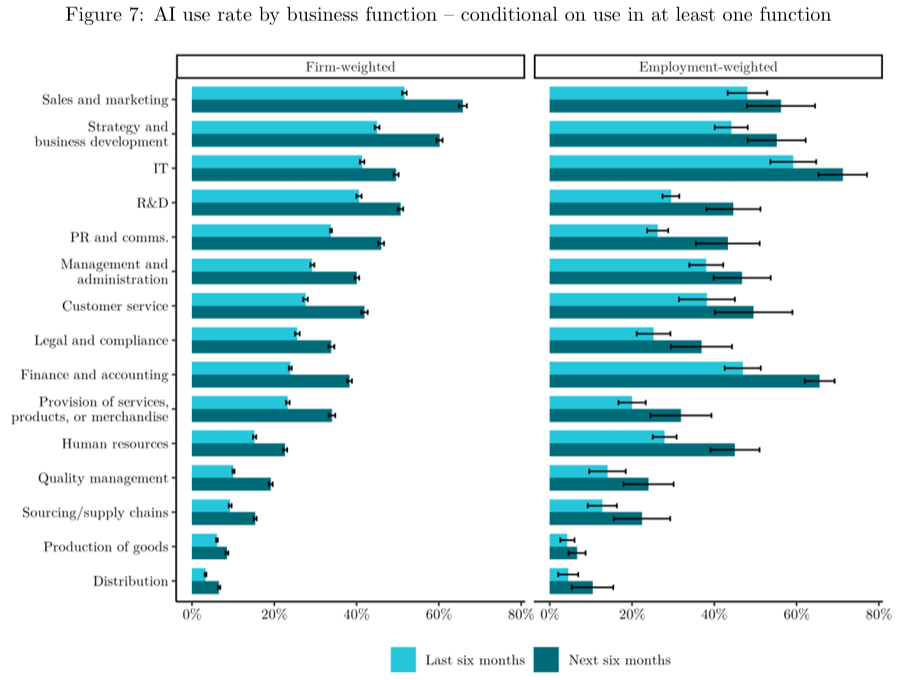
Among AI-adopting firms, sales and marketing emerged as the leading use case, with 52% reporting AI integration within those functions. Strategy and business development followed at 45%, while IT ranked third at 41%.
That hierarchy is significant because it highlights where organisations are currently finding the most immediate commercial value from AI adoption.
Marketing functions are uniquely positioned for rapid AI integration. Teams operate across high-volume content production, audience analysis, campaign optimisation, customer communications, and performance measurement. Generative AI tools are already capable of accelerating many of those workflows, from drafting campaign assets and summarising customer feedback to supporting research, reporting, and personalisation efforts.
Unlike operational or infrastructure-heavy business functions, marketing also offers a relatively low barrier to experimentation. Outputs can be tested quickly, performance can be measured in near real time, and teams can scale successful workflows rapidly.
AI Adoption Is Still Narrow
The research suggests many organisations are still approaching AI incrementally rather than pursuing enterprise-wide transformation from the outset. Around 57% of firms using AI reported deploying it across three or fewer business functions.
That pattern positions marketing as a common entry point for broader adoption.
Researchers identified a distinct category of businesses labelled “Marketing Specialists”, organisations concentrating AI use primarily within sales, outreach, customer service, and communications functions. Those firms represented 31% of all businesses using AI across functions.
The findings reinforce the idea that AI adoption is not unfolding evenly across organisations. Instead, many businesses are developing capability within specific departments first, with customer-facing functions leading the transition.
Larger Firms Continue To Lead
The study also highlights how uneven AI diffusion remains across industries and business types. Adoption rates are significantly higher among large organisations and knowledge-intensive sectors, particularly information services, finance, and professional services.
At the same time, smaller organisations appear to be adopting AI more cautiously, despite the increasing accessibility of generative AI tools.
That unevenness creates both opportunity and competitive pressure. Early adopters are gaining advantages through faster content production, more efficient campaign execution, and improved customer targeting. Organisations moving more slowly risk widening operational gaps as AI-enabled workflows become increasingly embedded within day-to-day marketing activity.
Yet the research also shows that most businesses remain early in the adoption cycle.
Comprehensive AI integration is still relatively uncommon. Only 4% of AI-using firms were classified as “Comprehensive Adopters”, meaning businesses deploying AI broadly across nearly every business function.
Bottom Up Adoption Is Accelerating
Another notable finding is the growing disconnect between formal organisational adoption and employee-level usage.
Researchers found that worker task use sometimes occurs without official firm-level adoption, while some organisations report formal AI implementation without widespread employee usage.
That dynamic points to two parallel adoption paths emerging inside organisations.
In some businesses, AI deployment is being driven through structured top-down initiatives involving procurement, governance, training, and operational redesign. In others, adoption is spreading organically through employee experimentation and individual workflow optimisation.
Marketing teams are particularly exposed to that bottom-up adoption model because the tools are accessible, inexpensive, and capable of delivering immediate productivity gains. Employees can begin using AI for ideation, content summaries, research, or campaign planning long before formal enterprise systems or governance frameworks are introduced.
AI Is Primarily Augmenting Work
The study also challenges some of the more extreme narratives surrounding AI-driven workforce replacement.
Most firms reported using AI to augment employee work rather than replace workers outright. Researchers found that 66% of firms using AI rely on it solely for task augmentation, while only 2% reported AI-related employment decreases.
Writing, document analysis, and information search emerged as the most common AI-supported tasks.
Those findings suggest AI is currently functioning more as a productivity layer than a direct replacement mechanism, particularly within knowledge and communication-heavy functions such as marketing.
For leadership teams, that distinction matters. Businesses focusing exclusively on labour reduction may overlook the more immediate commercial upside of AI adoption. The organisations reporting the strongest performance outcomes were those broadening AI integration while also investing in operational capability and workflow redesign.
AI Transformation Is Becoming Organisational
Taken together, the research points to a broader shift in how organisations are approaching AI adoption.
Rather than operating as a standalone technology initiative, AI is increasingly becoming embedded within business processes, decision-making structures, and day-to-day operational workflows. Marketing may be leading the transition today, but the longer-term competitive advantage is likely to come from organisations capable of scaling AI integration across functions while aligning people, processes, and governance around it.
The overall picture remains one of early but accelerating transformation. AI usage is still concentrated within a relatively small number of functions and tasks, governance structures continue to evolve, and most organisations are still experimenting with implementation models.
Even so, the direction of travel is becoming increasingly clear. Marketing is no longer simply testing AI tools at the edges of the organisation. In many businesses, it is becoming the first function where large-scale AI transformation is taking shape.





















RECOMMENDED FOR YOU
Google Gives Advertisers More AI Max Visibility
Google is introducing new AI Max reporting capabilities, giving…
Google is introducing new AI Max reporting capabilities, giving…
[STUDY] AI Content Production Keeps Accelerating
93% of marketers now use AI to support content…
93% of marketers now use AI to support content…
Meta Launches AI Agent For Businesses
Meta is extending its AI capabilities beyond Facebook, Instagram…
Meta is extending its AI capabilities beyond Facebook, Instagram…