Microsoft has announced a major expansion of Copilot Studio, introducing new governance controls, workflow automation features, and app integrations designed to help organisations scale AI agents more effectively. The updates reflect how enterprise AI platforms are evolving beyond standalone assistants into broader operational systems.
Microsoft’s broader AI strategy is built around Microsoft 365, the company’s workplace productivity platform used by more than 400 million commercial users globally.
For marketers, the announcement offers insight into the next phase of workplace AI. Rather than focusing solely on content generation or productivity prompts, Microsoft is positioning Copilot Studio as a platform for building, managing, and connecting AI-driven business processes across teams and systems.
What Is Copilot Studio?
Copilot Studio is Microsoft’s platform for creating and managing AI agents. Organisations can use it to build assistants that automate tasks, answer questions, retrieve business information, or support employees and customers across workflows.
Unlike consumer AI tools, Copilot Studio is designed for enterprise environments where governance, permissions, compliance, and integrations with existing business systems are essential.
Businesses can use these agents to handle repetitive internal tasks such as summarising meetings, routing customer queries, checking inventory levels, processing HR requests, reviewing contracts, or surfacing campaign performance data from multiple systems.
For marketers, that could mean creating an internal assistant that pulls live campaign metrics from analytics platforms, drafts stakeholder summaries, and flags unusual changes in spend or conversion rates automatically.
The latest updates focus heavily on oversight, workflow coordination, and system integration, particularly as organisations begin deploying larger numbers of AI agents across departments.
Microsoft Expands AI Governance Features
One of the biggest challenges with enterprise AI adoption is maintaining visibility and oversight as usage scales.
Microsoft’s latest updates introduce several governance-focused features designed to help organisations monitor how AI agents are performing, what data they access, and how they are managed.
A new Analytics Viewer role allows stakeholders to review agent performance data without being able to modify configurations or publishing settings. The feature creates a clearer separation between operational visibility and administrative control.
For example, marketing operations teams could monitor how a customer service AI assistant is performing without receiving broader editing access that might unintentionally alter workflows or permissions.
Microsoft has also expanded Agent 365, a centralised management layer that gives organisations oversight across AI agents built in Copilot Studio, Microsoft 365, and partner ecosystems. The platform brings together information on permissions, activity, inventory, and governance policies within a single environment.
For larger organisations running multiple AI projects, the update could simplify how IT and compliance teams manage access controls and monitor usage across departments.
The company has additionally updated its usage estimator tools to include Dynamics 365 AI agents, helping organisations forecast costs and model AI usage more accurately across deployments.
That matters because many enterprise AI systems operate on usage-based pricing. Better forecasting can help organisations avoid unexpected increases in operational costs as adoption grows.
Taken together, the updates highlight how governance is becoming a core part of enterprise AI infrastructure rather than a secondary consideration.
Workflow Automation Becomes More Flexible
Workflow automation is another major focus area in the latest release.
Copilot Studio now allows organisations to embed AI agents directly into structured workflows. Instead of relying entirely on fixed automation rules, workflows can delegate reasoning, classification, or content generation tasks to AI agents at selected stages.
The model combines traditional automation with more adaptive AI-driven decision making.
A retailer, for instance, could create a workflow where incoming customer complaints are automatically categorised by urgency, summarised for support teams, and escalated to managers when certain risk indicators are detected.
A marketing team could build workflows that generate campaign briefs, route approvals to legal teams, adapt messaging for different regions, and prepare launch summaries for stakeholders.
Microsoft has also introduced tools for testing individual workflow steps using sample inputs before deployment. The capability is intended to help teams validate behaviour earlier and identify issues before workflows go live.
The company highlighted a case study involving aviation services provider Unifi, which used coordinated AI agents and workflows to automate legal contract review processes. According to Microsoft, the system reduced processing times from days to minutes.
Business Apps Move Into AI Conversations
Microsoft is also expanding how AI agents interact with business applications.
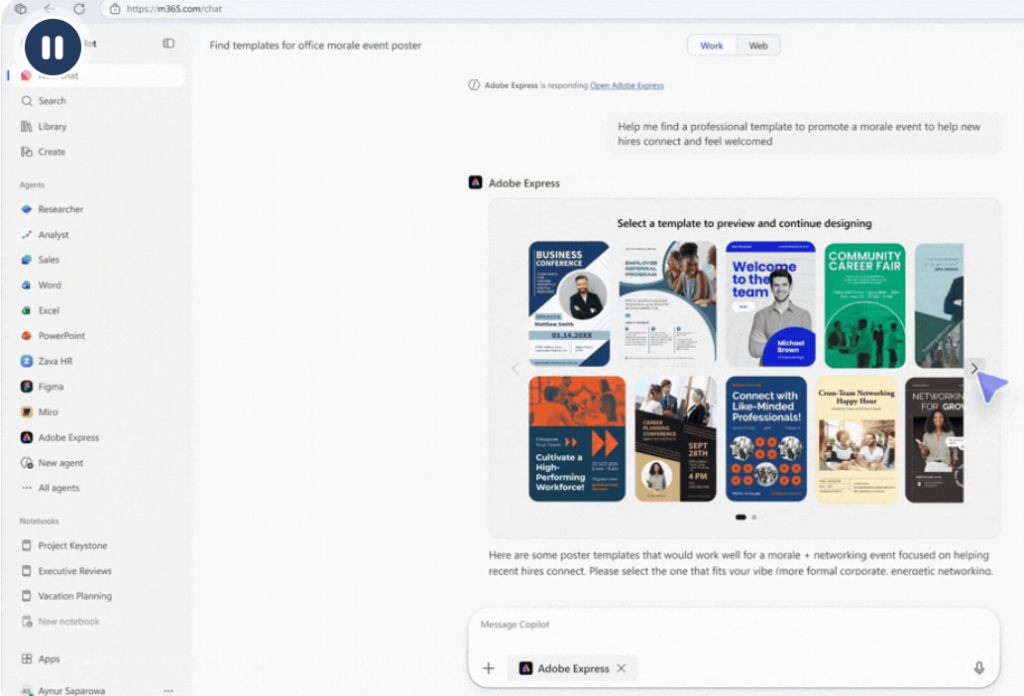
Copilot Studio agents can now surface interactive app experiences directly inside Copilot Chat. Users can review records, approve requests, edit assets, or complete tasks without switching between separate platforms.
The integrations include Microsoft tools alongside partner platforms such as Adobe Express, Figma, Monday.com, Wix, and Box.
A marketer, for example, could generate a campaign summary in Copilot Chat, open an Adobe Express template directly inside the conversation, edit creative assets, and send approval requests without moving between multiple applications.
A sales manager could ask an AI assistant for an account update, review CRM information, approve a proposal, and schedule follow-up actions from within the same interface.
For enterprise teams, the update reflects a broader trend toward conversational interfaces becoming a layer that connects multiple business systems and workflows.
Instead of functioning purely as chatbots, AI agents are increasingly being positioned as operational interfaces capable of triggering actions across connected applications.
Microsoft Advances Multi-Agent AI Systems
Several additional updates point toward Microsoft’s longer-term AI strategy.
The company introduced support for agent-to-agent communication through Work IQ, allowing AI agents to collaborate and delegate tasks while sharing organisational context.
One AI agent, for example, could manage customer interactions while another retrieves inventory data, with a third handling billing or approvals behind the scenes.
Microsoft also announced broader availability of GPT-5.5 Reasoning within Copilot Studio early release environments. The model is designed to support more advanced analysis and reasoning tasks across enterprise workflows.
While many of these capabilities remain at an early stage for most businesses, they indicate how enterprise AI platforms are evolving toward coordinated systems of specialised agents rather than isolated assistants.
Enterprise AI Moves Into Operational Infrastructure
The latest Copilot Studio updates illustrate how enterprise AI is entering a more operational phase.
Initial adoption often centred on experimentation and productivity improvements. Increasingly, organisations are evaluating how AI systems can integrate into existing workflows while remaining secure, manageable, and compliant.
Microsoft’s announcement reflects that shift. Governance, interoperability, workflow orchestration, and system integration are becoming just as important as the underlying AI models themselves.
For marketers and digital leaders, the broader takeaway is clear. AI platforms are rapidly moving closer to core business infrastructure as organisations look for ways to connect automation, collaboration, and operational processes at scale.















RECOMMENDED FOR YOU
[STUDY] AI Search Shapes Brand Decisions
AI search is starting to influence purchase decisions well…
AI search is starting to influence purchase decisions well…
LinkedIn Lets AI Multiply Ad Creative
LinkedIn is giving advertisers far more freedom to vary…
LinkedIn is giving advertisers far more freedom to vary…
Copilot Lets Marketers Build Apps By Chatting
Microsoft is giving Copilot users the ability to build…
Microsoft is giving Copilot users the ability to build…