OpenAI is rapidly adding the campaign controls, audience tools and creative formats required to turn ChatGPT advertising from a limited experiment into a functioning media platform.
Advertisers can now run conversion-optimised campaigns, use daily budgets, apply geographic controls, upload campaigns in bulk and connect customer lists through custom audiences. A refreshed static ad format gives creative more prominence, while suggested drafts can pull images, titles and descriptions from an advertiser’s website.
None of those features is especially novel by digital advertising standards. Google, Meta and other established platforms have offered comparable capabilities for years.
Their arrival is still significant. ChatGPT advertising is beginning to look less like a handful of sponsored placements and more like a channel that media teams could realistically plan, manage and scale.
ChatGPT Ads Moves Beyond Basic Reach
OpenAI initially sold ChatGPT advertising on a cost-per-thousand impressions basis, giving the company a relatively simple way to test advertiser demand and delivery.
It has since introduced cost-per-click bidding, expanded campaign controls and a beta self-serve Ads Manager. Advertisers can now set budgets and bids, upload creative, launch campaigns and review performance without buying directly through OpenAI’s sales operation.
Agency and technology partners including Dentsu, Omnicom, Publicis, WPP, Adobe, Criteo and StackAdapt are also supporting campaign purchasing and management.
The latest additions move the system further towards performance advertising.
Advertisers can use conversion-optimised cost-per-click campaigns, daily budgets, custom audiences, mobile measurement integrations and bulk campaign management. Product-feed campaigns have also appeared in OpenAI’s expanding set of advertiser tools.
Such developments matter less because they are new and more because they signal intent. OpenAI is not building a small sponsorship product around ChatGPT. It is recreating the infrastructure required to compete for serious media budgets.
The company still has a long way to go before it can match the scale, control and ecosystem maturity of Google or Meta. However, the foundations are arriving quickly.
Conversation Context Replaces The Keyword List
ChatGPT advertising is not simply search advertising placed inside a chatbot.
Traditional search campaigns are largely organised around keywords and queries. ChatGPT ads use the context and apparent intent of a conversation to determine whether a placement may be relevant.
Advertisers can provide context hints describing the conversations, topics or situations in which a product may be useful. Those hints are not exact-match keywords and do not guarantee that an advertisement will appear alongside a particular discussion.
OpenAI considers several relevance signals, including conversational intent, the advertiser’s landing page, the ad title and copy, and selected signals from a user’s wider ChatGPT activity when ad personalisation is enabled.
Potential value comes from the depth of the interaction.
Someone comparing business software, planning a holiday or researching a major purchase may reveal far more about their needs during a conversation than through an isolated search query. Several follow-up questions can clarify budget, priorities, concerns, preferred features and trade-offs.
An advertisement could therefore appear after the user has already worked through much of the consideration process.
Google has spent decades building an advertising business around search intent. ChatGPT is attempting to monetise something potentially richer: conversational intent shaped over several exchanges.
The distinction could become commercially important. Search often captures what someone is looking for at a particular moment. Conversation can reveal why they are looking, what they have already ruled out and what would influence the final decision.
Greater context does not automatically produce better advertising. ChatGPT still needs to interpret user intent accurately and avoid placing ads that feel irrelevant, intrusive or opportunistic.
The opportunity is still substantial. Advertisers may gain access to moments that sit between broad awareness and explicit search, where people are actively working through a problem but have not yet settled on a product, brand or supplier.
Creative Variety Becomes Part Of Targeting
OpenAI is also changing how advertisements appear and how advertisers are expected to develop them.
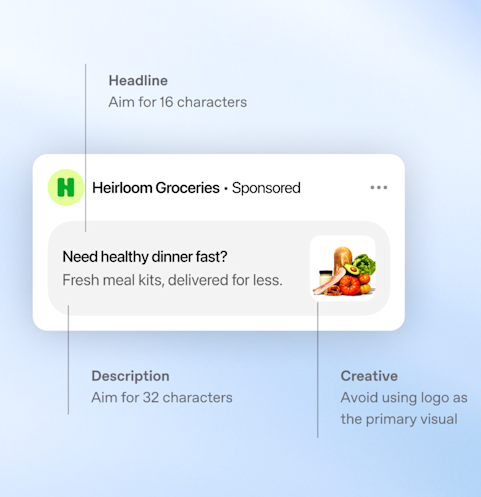
A refreshed static ad card uses larger visual elements within a more compact layout. The format combines an image, title, description and destination link, giving creative a more prominent role than a basic sponsored-link treatment.
Suggested ad drafts can use existing website metadata to prefill an image, title and description for advertisers to review and edit. OpenAI says the feature does not generate new copy or imagery with AI.
More consequentially, OpenAI is encouraging advertisers to submit multiple distinct titles, descriptions and images for each offering.
Each variation should present a different benefit, audience or use case rather than repeating the same general message.
Creative variety effectively becomes another targeting input.
Conversational intent can be expressed through a much wider range of situations than a conventional keyword list. A business software provider, for example, may need different creative for users concerned about integration, cost, security, ease of use or team adoption.
One generic advertisement is unlikely to speak convincingly to all of those contexts.
ChatGPT may determine who should see an ad, but advertisers still need to provide enough useful material for the platform to make a good match. Campaign performance may increasingly depend on the breadth and quality of the creative system behind it.
Search advertisers accustomed to working primarily with text may need production systems closer to social advertising. Multiple visual and copy variations will need to be created, approved and refreshed without creating a large volume of repetitive content.
OpenAI has indicated that further formats and campaign objectives will follow. The current static card remains fairly conventional, but the direction points towards richer commercial experiences built around recommendations, products and decisions.
Familiar Audience Controls Are Arriving
Custom audiences add another familiar layer to the platform.
Advertisers can upload lists using email addresses or phone numbers, then use them to include known customers or prospects, exclude selected groups or adjust bids for higher-value audiences.
The thresholds are substantial. Each custom audience requires at least 25,000 matched users before it can be used, while OpenAI recommends audiences of at least 100,000.
Such requirements make the capability more immediately relevant to large advertisers than smaller businesses.
They also complicate the early idea that ChatGPT advertising would rely mainly on conversational relevance.
OpenAI is building a hybrid system that combines conversation signals with customer matching, conversion optimisation, audience exclusions and bid adjustments. The surface may look new, but much of the advertising machinery underneath is becoming recognisable.
Bulk campaign management reinforces that direction.
Campaigns, ad groups and creative can be created or updated through spreadsheet uploads, allowing larger advertisers and agencies to manage activity at scale. Context hints, budgets, bids, landing pages and assets can all be structured through the same workflow.
OpenAI appears to understand that novelty alone will not unlock large media budgets. Advertisers need familiar controls, operational efficiency and enough flexibility to fit ChatGPT into existing planning and campaign processes.
OpenAI Is Forecasting A Huge Ad Business
The pace of development becomes easier to understand when viewed against OpenAI’s reported revenue ambitions.
Investor projections reported by Axios suggest OpenAI expects advertising to generate US$2.5 billion in 2026 and US$100 billion annually by 2030. An early pilot was also reported to have reached US$100 million in annualised advertising revenue within two months.
Those figures have not been publicly confirmed by OpenAI and should be treated as internal ambitions rather than dependable forecasts.
Reaching US$100 billion would place OpenAI among the world’s largest advertising companies. Achieving that scale would require far more than placing sponsored cards inside a popular chatbot.
OpenAI would need to expand across many more markets, dramatically increase available inventory and build a mature ecosystem for agencies, advertisers and creative production.
The forecast also assumes that ChatGPT can accommodate significantly more advertising without damaging the experience that made the product valuable in the first place.
Advertiser demand may not be the greatest constraint. ChatGPT offers a large audience and potentially valuable signals about what people are researching and considering.
Inventory is the harder issue.
Ads can only appear where the topic, user, market and conversation are eligible. OpenAI also needs to protect sensitive exchanges, maintain clear separation between answers and sponsorship, and avoid making conversations feel built around commercial interruption.
A conventional social feed can carry a large number of ads because users already expect an advertising-supported experience. ChatGPT occupies a more delicate position. Many users treat its answers as guidance, assistance or advice.
An ad appearing beside that guidance could feel exceptionally useful when the match is strong. A poor placement could feel more intrusive than an irrelevant banner or sponsored post.
OpenAI’s new campaign controls, creative formats and audience tools are therefore more than routine product updates. They are early components of a much larger attempt to build an advertising business around conversation.
ChatGPT now has enough infrastructure for advertisers to begin testing that proposition seriously.
The more important question is whether conversational intent can support an advertising market anywhere near the scale OpenAI appears to be forecasting.








RECOMMENDED FOR YOU
[STUDY] AI Search Shapes Brand Decisions
AI search is starting to influence purchase decisions well…
AI search is starting to influence purchase decisions well…
LinkedIn Lets AI Multiply Ad Creative
LinkedIn is giving advertisers far more freedom to vary…
LinkedIn is giving advertisers far more freedom to vary…
Copilot Lets Marketers Build Apps By Chatting
Microsoft is giving Copilot users the ability to build…
Microsoft is giving Copilot users the ability to build…