
LinkedIn advertising remains expensive by most conventional performance measures.
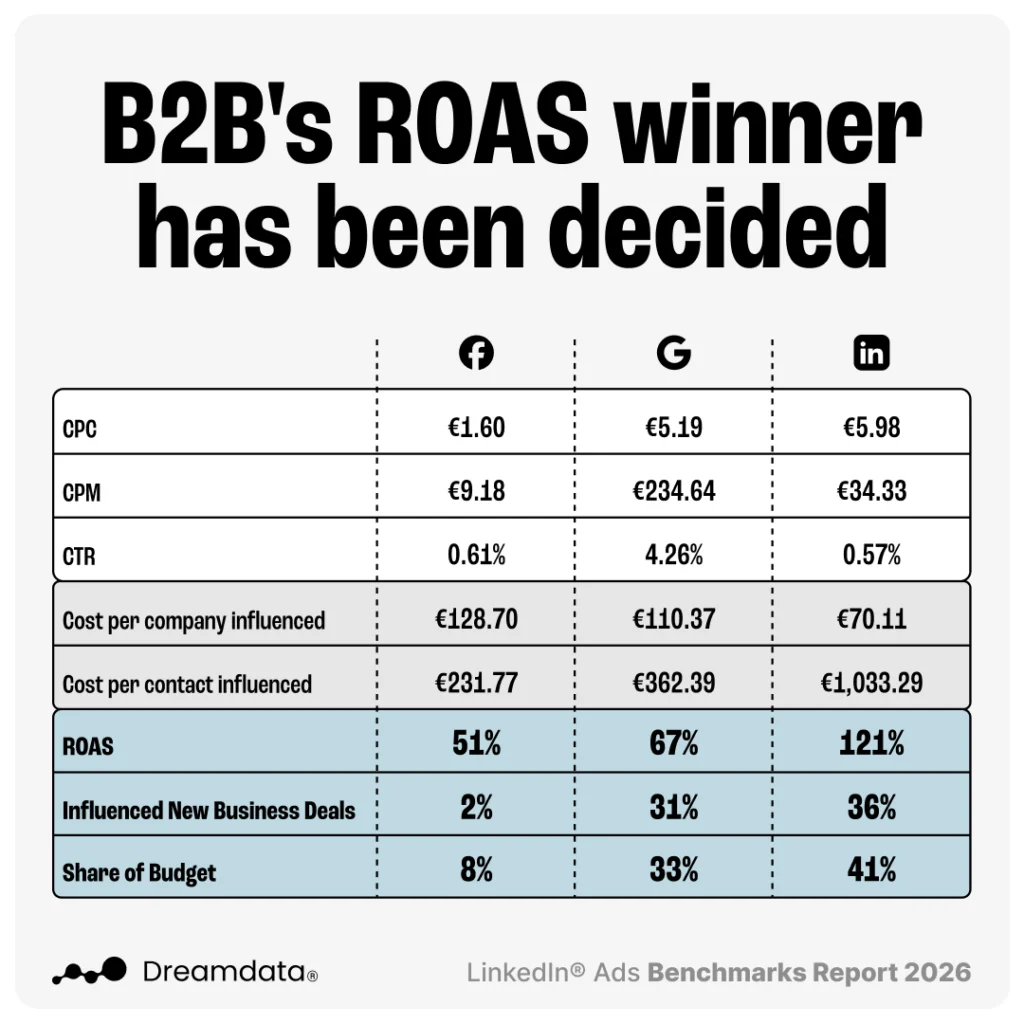
Dreamdata’s latest B2B advertising benchmarks put the average LinkedIn cost per click at €5.98, compared with €1.60 for Meta. LinkedIn’s average CPM reached €34.33, more than three times Meta’s €9.18.
Judged by clicks and short-term lead generation alone, the conclusion appears fairly simple. LinkedIn is a costly place to advertise.
The wider customer journey tells a different story.
Dreamdata found that LinkedIn generated a 121% attributed return on ad spend across its customer dataset, compared with 67% for Google Search and 51% for Meta. LinkedIn also represented 41% of measured B2B advertising budgets, up from 39% the previous year.
The findings do not prove that LinkedIn will outperform other channels for every B2B advertiser. They do expose the limitations of assessing complex buying journeys through cost per click, cost per lead and short attribution windows.
B2B Buying Now Takes Nearly Nine Months
Dreamdata’s report draws on more than 66 million website sessions and 3.5 million customer journeys across thousands of B2B companies.
The average journey from first marketing interaction to closed revenue reached 272 days, up from 211 days in the previous report. Buyers spent an average of 220 days researching and consuming content before entering the sales pipeline.
Around 81% of the measured journey therefore happened before sales became formally involved, up from 70% a year earlier.
The path was also becoming more complicated.
An average customer journey involved 88 touchpoints, four channels and ten stakeholders. Last year’s benchmarks recorded 76 touchpoints, 3.7 channels and 6.8 stakeholders.
Such findings do not sit comfortably with monthly campaign reports built around individual form submissions.
A lead can still be useful. However, it captures one action by one person at one moment. It does not show how several people from the same company encountered a brand, returned through different channels, reviewed content and influenced a purchasing decision over the following seven or eight months.
B2B marketing teams often operate with account-based strategies while reporting through person-based metrics. The operating model and the measurement model are pulling in different directions.
LinkedIn Looks Different At Company Level
LinkedIn’s expensive clicks become more defensible when the unit of measurement shifts from individual leads to companies influenced.
Dreamdata put LinkedIn’s average cost per company influenced at €70.11. Comparable figures were €110.37 for Google Search and €128.70 for Meta.
LinkedIn therefore looked expensive when judged by the cost of securing a click, but comparatively efficient when judged by the cost of reaching and influencing an organisation.
A company influenced is not the same as a new customer. Nor does appearing within a buying journey prove that an advertisement caused the eventual sale.
The comparison is still useful because B2B purchases are rarely made by an isolated lead.
A senior decision-maker may see a sponsored post without clicking. A technical specialist may later visit the website through Google. Another colleague may download a report, while a procurement manager arrives directly several months later.
A lead-based report may credit whichever person completed the most visible action. Company-level analysis tries to recognise that the commercial decision was shaped across a broader buying group.
LinkedIn is particularly well placed within that kind of journey. Its member data is organised around professional roles, employers, industries, seniority and business interests. Advertisers are often paying a premium for access to a narrower and more commercially relevant audience rather than cheap traffic at scale.
The cost of the click can therefore become a distraction when the click was never the real product.
LinkedIn Influence Strengthens Deeper In The Funnel
Dreamdata also found that LinkedIn’s presence did not disappear after a lead entered the pipeline.
LinkedIn Ads accounted for 24.2% of measured sessions at the marketing-qualified lead stage. Its share increased to 30.2% at the sales-qualified lead stage and remained at 28.3% among journeys that reached new business.
Last year’s analysis showed LinkedIn’s influence declining as prospects moved towards a sale. The 2026 report suggests that it now remains visible throughout evaluation and sales engagement.
Several interpretations are possible.
Advertisers may be using LinkedIn more deliberately for account nurturing and deal progression rather than limiting campaigns to initial lead acquisition. Buying committee members may also continue encountering content on LinkedIn while their organisation evaluates a supplier.
Organic activity appears to contribute as well. Dreamdata found that visits involving LinkedIn Company Pages increased further down the funnel, suggesting that prospects may return to review an organisation’s credibility, content and activity as decisions progress.
A company page is unlikely to close a major deal on its own. A neglected or unconvincing presence can still weaken confidence when several people are checking whether a potential supplier appears credible.
Paid and organic LinkedIn activity are often managed separately, sometimes by different teams and agencies. Buyers are less considerate of organisational charts. They experience the advertisements, executive posts, employee activity and company page as parts of the same brand.
Short Campaign Windows Can Punish The Right Activity
The report’s timing data creates an awkward problem for campaign management.
The average period between a first LinkedIn ad impression and revenue was 281 days. First ad engagement occurred an average of 212 days before revenue, while the first recorded conversion happened 214 days before the deal.
Waiting nine months before making any campaign decisions would be impractical. Expecting a channel to demonstrate its full commercial value within 30 days is equally unrealistic.
Short reporting windows tend to reward activity that produces an immediate and easily captured response. Lead-generation forms, downloadable reports and webinar registrations can therefore look more productive than campaigns that build recognition across a buying group.
Teams may then optimise towards the actions that are easiest to count rather than the influence that is most commercially valuable.
LinkedIn has an obvious interest in encouraging advertisers to look beyond expensive clicks and leads. Dreamdata is also a LinkedIn Marketing Partner and sells B2B attribution software, so both organisations benefit from wider adoption of company-level measurement.
Methodology deserves scrutiny as well. Dreamdata’s results come from its own customers rather than a representative sample of every B2B advertiser. Its attributed ROAS figures are produced through a data-driven model and should not be treated as experimental proof that LinkedIn caused the reported revenue.
The underlying buying-pattern data remains hard to dismiss. Long sales cycles, large buying committees and cross-channel research make simplistic lead attribution increasingly difficult to defend.
B2B Media Needs A Wider Scorecard
Cost per lead should not disappear from campaign reporting. It can help teams assess conversion efficiency, compare creative and identify friction in a response journey.
Problems begin when it becomes the primary measure of value.
B2B advertisers need a wider scorecard that considers account reach, the quality of companies engaging, buying-group coverage, progression through the pipeline and eventual revenue. Individual campaigns should also be assessed within the wider channel mix rather than treated as isolated lead-producing machines.
Such an approach requires stronger connections between advertising platforms, website analytics, CRM records and revenue data. It also depends on consistent company identification and agreement about how marketing influence should be interpreted.
The technology alone will not settle those questions. Attribution platforms can produce a more complete view of the journey, but they still apply models and assumptions to complex behaviour.
Marketing and sales teams need to decide which signals are useful, how long campaigns should be allowed to develop and what evidence is strong enough to justify continued investment.
LinkedIn may still be too expensive for organisations with broad audiences, low contract values or weak sales follow-up. No attribution framework can rescue poor targeting, generic creative or an offer that buyers do not want.
For B2B organisations pursuing complex, high-value accounts, expensive clicks may be an acceptable cost of reaching the right companies and remaining visible throughout a long decision.
The latest benchmarks suggest LinkedIn advertising is not becoming cheaper. Its value is becoming harder to understand through lead-based measurement alone.




RECOMMENDED FOR YOU
Google Gives Advertisers More AI Max Visibility
Google is introducing new AI Max reporting capabilities, giving…
Google is introducing new AI Max reporting capabilities, giving…
ChatGPT Introduces Visual Advertising
OpenAI is expanding ChatGPT advertising with new visual formats,…
OpenAI is expanding ChatGPT advertising with new visual formats,…
LinkedIn Lets AI Multiply Ad Creative
LinkedIn is giving advertisers far more freedom to vary…
LinkedIn is giving advertisers far more freedom to vary…