ChatGPT Ads have been live for six months. That is apparently long enough for people to start deciding whether they work.
The available evidence suggests the answer is considerably less satisfying.
Some early advertisers are reporting expensive clicks, limited engagement and virtually no conversions. Others claim ChatGPT is already generating qualified B2B leads at substantially lower costs than Google.
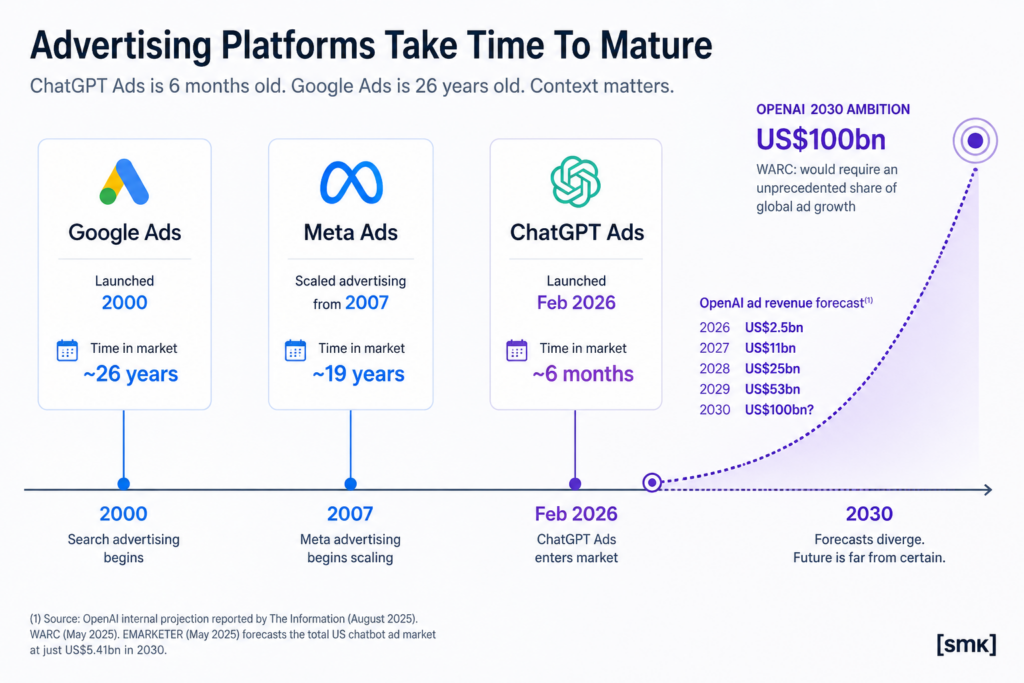
Meanwhile, expectations for where the channel is heading could hardly be higher. OpenAI reportedly expects advertising revenue to grow from US$2.5 billion in 2026 to US$11 billion next year, US$25 billion in 2028, US$53 billion in 2029 and US$100 billion by 2030.
WARC calculates that reaching US$100 billion would require OpenAI to capture as much as half of all incremental global advertising spend through 2030, growing faster than any major digital advertising platform before it.
EMARKETER is considerably more cautious. Its forecast puts the entire US chatbot advertising market at just US$5.41 billion in 2030 and suggests ChatGPT’s US advertising revenue could fall roughly 90% short of OpenAI’s global ambition.
Six months in, there is no particularly satisfying hot take.
Early Performance Is All Over The Place
Enough advertisers and agencies have now released campaign data to give an early indication of performance. The results vary considerably.
B2B agency InterTeam Marketing says campaigns across three SaaS clients have generated more than 150 qualified leads, with cost per lead less than half what those clients were paying through Google and average CPC around US$5. Its strongest activity has focused on specific conversational situations, including competitor comparisons, problem research, pricing and implementation.
Synter offers a very different picture. Across 129,663 impressions in five countries, its campaigns generated 448 clicks at a blended CTR of 0.35% and CPC of US$9.89. Results also varied sharply by market. UK CPC came in at US$5.10, compared with US$10.62 in the US and US$17.59 in Australia.
Australian agency JBE Digital recorded 9,263 impressions and 80 clicks during its first month. One of its clearest findings was creative related, with a real human face outperforming graphic-led alternatives.
B2B software business GravityKit sits at the other end of the spectrum. It stopped a three-week test early after generating relatively inexpensive clicks but almost no meaningful website engagement and no conversions or key events.
Individual tests are too small and too different to establish a reliable industry benchmark.
Collectively, however, they show a channel producing very different outcomes depending on the advertiser, market, campaign structure and probably the quality of execution.
ChatGPT Is Not Google With A Chat Box
Some inconsistency will inevitably sit with OpenAI. Some may also sit with advertisers.
Google Ads dates back to 2000. Meta’s advertising operation has had close to two decades to develop.
Both have accumulated enormous quantities of performance data while marketers, agencies and technology providers have spent years learning how to use them.
ChatGPT advertising only began testing in the US on 9 February 2026.
Expecting comparable sophistication after six months is unrealistic.
More importantly, advertisers may need to resist treating ChatGPT as another search engine.
OpenAI uses Context Hints to help determine where ads should appear. Advertisers describe the conversations, problems and situations where a product may be useful. OpenAI then considers those hints alongside the current conversation, landing page, ad creative and other signals.
They are deliberately not exact-match keywords.
InterTeam’s stronger results are interesting in that context. Its campaigns have attempted to align different offers with different conversational states, such as educational content when someone is researching a problem and more commercial landing pages when someone is comparing products or investigating pricing.
Simply transferring Google keyword structures, Meta creative or existing landing pages into ChatGPT may therefore miss much of what makes the environment different.
Advertiser capability is also likely to vary widely. Writing useful Context Hints is a new media skill. Poorly defined hints may contribute to poor targeting without necessarily proving that conversational advertising itself does not work.
The Right Person Can Still Be In The Wrong Conversation
SE Ranking recently analysed 50,006 commercially oriented prompts across 20 categories in the US.
Ads appeared against 25.94% of them, with 1,159 different advertisers identified. ChatGPT advertising has therefore already moved well beyond a tiny experimental inventory.
Relevance was less convincing.
SE Ranking’s analysis classified around one in seven placements as effectively off-target after comparing the relationship between prompts, ads and generated responses. It also found the advertiser appearing among ChatGPT’s organic sources in just 3.63% of ad placements.
OpenAI clearly still has work to do, although advertiser choices may contribute to what users see.
Context Hints depend on marketers accurately describing the conversations where their offer belongs. More recent targeting options add another dimension.
Custom audiences now allow advertisers to target or adjust bids for people contained within customer or prospect lists using email addresses or phone numbers.
That may improve audience quality while potentially creating a different relevance problem.
Someone could be a known customer, previous prospect or commercially attractive account while using ChatGPT to discuss something completely unrelated to the advertiser.
From an audience-targeting perspective, the placement could make perfect sense. From the user’s perspective, the advertisement could still feel strangely disconnected from the conversation.
ChatGPT’s potentially distinctive advantage is the richness of the conversational context surrounding a user. Lean too heavily on familiar CRM, retargeting and audience tactics and advertisers risk reaching the right person at the wrong moment.
Different combinations of Context Hints, first-party audiences, creative and optimisation could therefore produce substantially different results.
That makes comparisons between early advertiser tests particularly difficult.
ChatGPT Has Plenty Of People To Advertise To
ChatGPT Ads currently appear for users on Free and Go plans. Plus, Pro, Business, Enterprise and Edu accounts remain ad-free.
The limitation should not be confused with a lack of scale. The overwhelming majority of ChatGPT’s enormous user base remains outside those premium tiers.
Audience composition could still matter.
A consumer advertiser may have more than enough addressable reach among Free and Go users. B2B software, financial services or professional services advertisers could find some particularly valuable heavy professional users sitting inside paid individual or workplace accounts.
There is not enough evidence yet to quantify that effect, and weak B2B performance cannot simply be blamed on premium users being unavailable.
It is another variable behind results that are already difficult to compare directly.
Six Months Is Too Early For A Verdict
OpenAI is already changing the product quickly.
Ad volume has increased, more advertisers are joining and targeting and measurement options are expanding. EMARKETER, citing Sensor Tower, reported that ChatGPT showed mobile users roughly twice as many ads per hour in July as in April, while advertiser numbers had climbed from around 300 to more than 820.
Someone testing ChatGPT Ads now is not really testing the same advertising system that existed at launch.
That makes the temptation to establish definitive benchmarks after six months even less helpful.
Performance absolutely matters. Cheap traffic that does not generate customers remains poor advertising, regardless of how exciting the underlying technology may be.
But there is another return available to early advertisers: learning.
Organisations experimenting now are beginning to understand which conversational situations indicate commercial intent, how Context Hints should be structured, where first-party audiences help or hinder relevance, which creative works and how AI advertising differs from paid search and social.
For organisations with very limited media budgets, paying for that education may make little sense. Proven channels should probably continue doing most of the heavy lifting.
Larger advertisers with genuine experimentation budgets are in a different position.
Google Ads has had more than 25 years to mature. Meta has had close to 20. ChatGPT Ads has had six months.
For some businesses it may be many months, perhaps years, before ChatGPT delivers comparable performance. Some categories may never find it particularly effective.
OpenAI’s US$100 billion forecast could also prove wildly optimistic. WARC’s calculations certainly illustrate just how extraordinary that trajectory would need to be.
None of that is a strong argument for ignoring the channel.
Structured experimentation now can generate performance data, customer insight and AI advertising capability that organisations sitting on the sidelines simply will not have.
The sensible approach is neither to pile money into ChatGPT because AI advertising is fashionable nor abandon it because the first CPA looks ugly.
Test it deliberately. Give it its own budget. Experiment with conversational targeting rather than recreating Google or Meta campaigns. Assess commercial outcomes, but recognise that early learning has value as well.
Six months of ChatGPT Ads has given advertisers plenty of signals.
A verdict can wait.




RECOMMENDED FOR YOU
ChatGPT Work Expands Business Automation
For most organisations, generative AI still begins with someone…
For most organisations, generative AI still begins with someone…
Meta Removes More Advertiser Controls
Meta advertisers may soon lose another familiar control inside…
Meta advertisers may soon lose another familiar control inside…
ChatGPT Work Starts Doing The Work
ChatGPT Work is only six weeks old, but OpenAI…
ChatGPT Work is only six weeks old, but OpenAI…