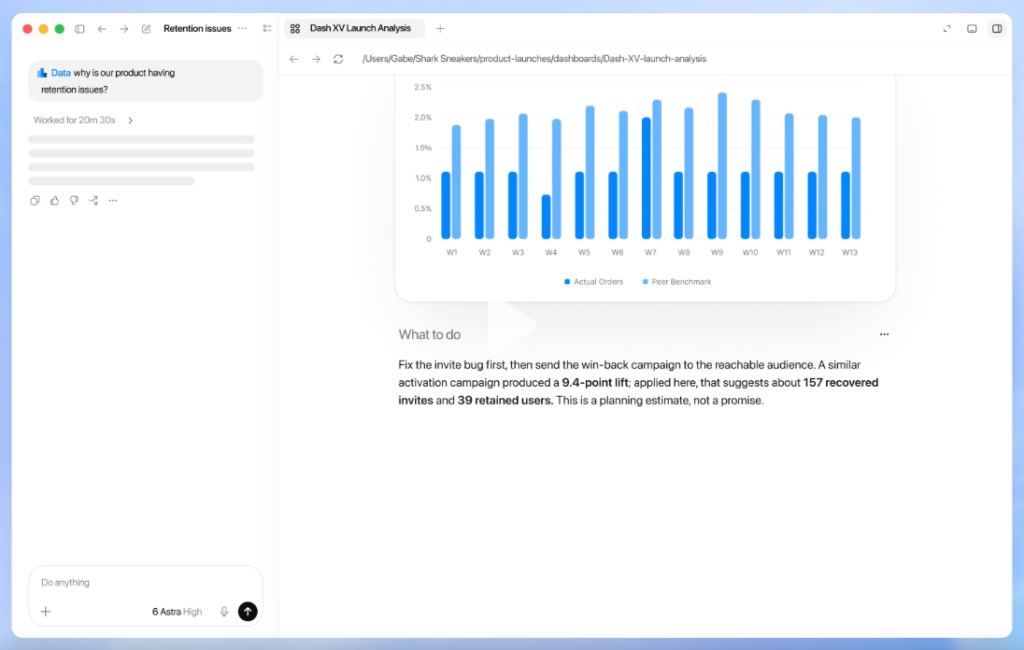
OpenAI is pushing ChatGPT further into business reporting and analysis with a new Data agent inside ChatGPT Work.
Launched on 10 September, Data can connect to company information, investigate performance questions, build interactive dashboards and produce reports through a conversational interface. It works with data platforms including Snowflake, BigQuery, Databricks and Redshift, as well as business information stored in services such as Google Drive and SharePoint. Existing BI tools including Power BI and Tableau can also sit within the workflow.
ChatGPT Work is OpenAI’s business-focused working environment, designed to move ChatGPT beyond one-off prompts and into longer, multi-step tasks using company files, connected apps and organisational data. Rather than simply answering a question, Work is intended to help users research, analyse information, operate across business systems and produce finished outputs.
Data takes that proposition further into reporting and business intelligence.
For marketing and communications teams, the more interesting development is not another way to make dashboards.
Reporting itself is beginning to change.
Most organisations have spent years building increasingly sophisticated reporting environments across analytics platforms, CRM systems, advertising accounts, spreadsheets and business intelligence tools. Yet finding an answer can still involve locating the right dashboard, applying the right filters, exporting several datasets or asking an analyst to investigate.
ChatGPT Data starts somewhere else entirely.
Instead of navigating the reporting environment, users can start with the business question.
Reporting Starts With The Business Question
That shift becomes more useful when applied to the kinds of questions marketing teams already struggle to answer quickly.
A marketing director might want to know why acquisition costs increased last month, which channels were responsible and whether lead quality changed at the same time.
A content team could investigate which themes are associated with stronger engagement or conversion, while a campaign manager might want to understand what changed after a new campaign went live and where performance started to deteriorate.
Data is designed to investigate those kinds of questions across connected information, compare segments, examine possible causes and continue the analysis through follow-up questions.
OpenAI also says users can turn the findings into dashboards, reports and leadership readouts.
The Dashboard Is No Longer The Starting Point
Traditional reporting often begins with a predefined view.
Someone has already decided which charts matter, which dimensions are available and how the dashboard should be structured.
Conversational analysis changes that sequence.
The user starts with the question. The system then identifies the relevant information, conducts the analysis and presents an answer that can be challenged or explored further.
For experienced marketers, that could be considerably more useful than simply automating the production of another monthly dashboard.
It also changes the role of the dashboard itself.
Rather than being the place where analysis starts, a dashboard can become one of the outputs generated after the right questions have been asked.
ChatGPT Moves Closer To The Data Stack
ChatGPT Work was already moving OpenAI beyond the standalone chatbot model by connecting AI with company files, applications and workflows.
Data makes that proposition more concrete.
OpenAI says ChatGPT Work can bring together data warehouses, BI tools, spreadsheets and business documents within the same analysis. Supported tools include Power BI, Tableau, Snowflake, Databricks, BigQuery, Mixpanel and Amplitude.
For organisations already heavily invested in Power BI or Tableau, that distinction matters.
The likely near-term development is not ChatGPT replacing established BI environments. More plausibly, ChatGPT becomes a conversational layer sitting across them.
Dashboards may continue to provide agreed reporting views, while ChatGPT handles more exploratory questions around why something happened, what changed and what deserves further investigation.
Marketing Reporting Becomes More Accessible
Most marketing teams already have access to far more data than they meaningfully use.
The constraint is often not availability. It is the ability to interrogate the information quickly enough to support a decision.
A senior marketer may understand exactly what they want to know without knowing where a particular field sits inside the data warehouse, how a Power BI model has been structured or which combination of reports will provide the answer.
Conversational data tools reduce some of that friction.
Someone could move from asking what happened, to why it happened, to which audience or channel was responsible, without repeatedly rebuilding reports.
That could be particularly useful across paid media, customer acquisition, retention, campaign performance and content reporting, where the first number often raises more questions than it answers.
Analysis Becomes More Exploratory
The ability to keep interrogating the data may prove more important than the initial answer.
Monthly reporting often presents a fixed selection of charts and commentary. Teams discuss whatever has already been chosen for inclusion.
Conversational analysis opens up a much more dynamic process.
If conversion falls, a marketer can ask where. If one audience segment stands out, they can investigate what changed. If a campaign appears to be driving more leads, they can ask whether those leads are converting further down the funnel.
Each answer creates another line of enquiry.
That should materially improve the quality of insight teams can generate because they are no longer restricted to the questions anticipated when a dashboard was built.
It should also make reporting more actionable. Instead of simply identifying that performance moved, teams can probe the causes, test assumptions and move more quickly towards a decision or next step.
Analysts Still Have Plenty To Do
Easier access to analysis does not automatically produce better analysis.
Someone still needs to decide which metrics matter, whether the underlying data is reliable and whether the conclusion being presented actually makes sense.
Poorly defined conversion goals remain poorly defined conversion goals.
Attribution models do not become objective because an AI explains them fluently.
Correlation does not suddenly become causation because ChatGPT found the pattern.
OpenAI’s Data system can incorporate an organisation’s existing metric definitions, calculations and relationships between datasets. Those definitions may come from internal documentation, trusted dashboards or established data models.
Organisations with mature measurement frameworks should therefore have an advantage.
Bad Data Does Not Become Good Data
Teams with agreed definitions, clean data and well-structured reporting environments can give the AI considerably better foundations on which to work.
Others may discover that AI simply exposes existing problems faster.
If Marketing has one definition of a qualified lead, Sales uses another and Finance measures something slightly different again, conversational analysis cannot resolve the disagreement on its own.
AI may remove the wait for a report. It cannot remove the argument about what the numbers actually mean.
The quality of the insight still depends heavily on the quality of the underlying data and measurement practices.
Reporting Could Become More Continuous
Monthly marketing reports are partly a product of how reporting systems have historically worked.
Data needs to be assembled. Reports need to be produced. Dashboards need to be interpreted. Meetings are scheduled around the resulting output.
Conversational analysis could compress that cycle considerably.
If campaign performance shifts on Tuesday, someone can investigate it on Tuesday.
They can ask which segment changed, compare it with previous periods, explore possible causes and create a shareable view of the findings without waiting for the next reporting cycle.
From Insight To Action
More importantly, the analysis does not have to stop at diagnosis.
A team can move from identifying a change, to understanding the likely cause, to defining the next action in the same workflow. That should make reporting considerably more useful as an operational tool rather than simply a record of what has already happened.
OpenAI is also positioning Data as a bridge between analysis and action, with ChatGPT Work able to recommend next steps and use connected tools to move findings into wider workflows.
Reporting therefore starts moving closer to the work itself rather than remaining a document produced after the work has happened.
The valuable skill does not disappear. It shifts.
Knowing where to click inside a reporting interface becomes less important. Knowing which questions to ask, whether the answer is credible and what decision should follow becomes more important.
ChatGPT can make company data considerably easier to interrogate.
It can also make the path from insight to action dramatically shorter.























RECOMMENDED FOR YOU
[STUDY] AI Puts Pressure On Client Agency Relationships
AI is starting to change the economics of media…
AI is starting to change the economics of media…
ChatGPT Ads Reach US$1bn In 200 Days
ChatGPT Ads has reached a US$1 billion annualised revenue…
ChatGPT Ads has reached a US$1 billion annualised revenue…
ChatGPT Work Expands Business Automation
For most organisations, generative AI still begins with someone…
For most organisations, generative AI still begins with someone…