
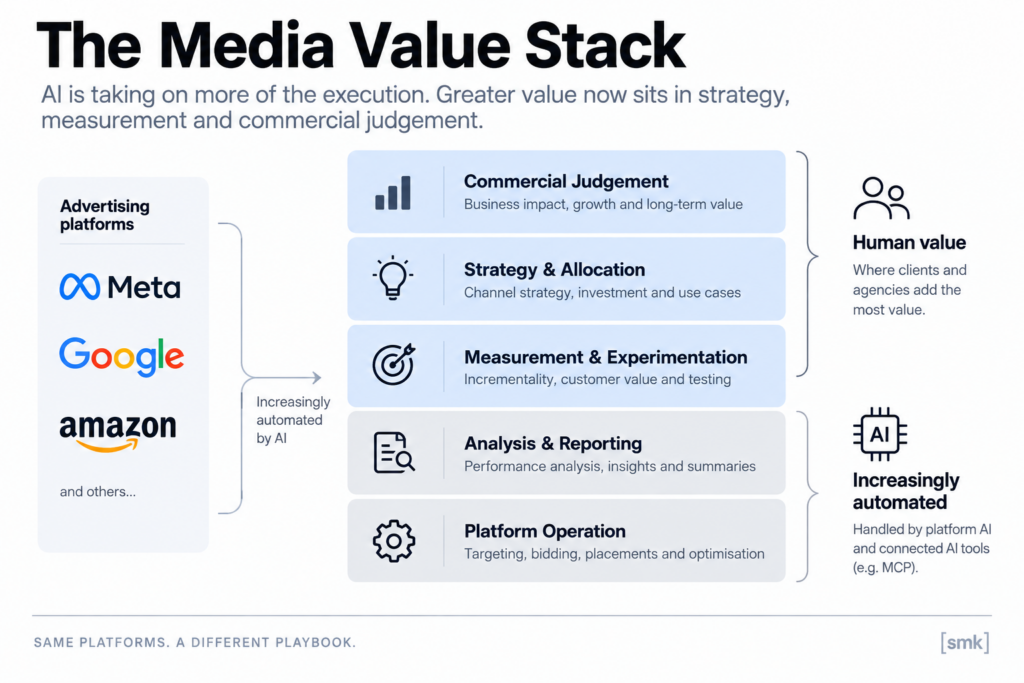
AI is starting to change the economics of media buying at the same time that CMOs are already under pressure to get more from flat budgets and leaner teams.
Gartner expects more than 70% of global advertising spend to flow through self-service platforms where AI materially influences how media is bought, priced and delivered by 2028. In the US, that figure is expected to reach around 80%.
In practical terms, Gartner is talking about the major advertising environments where most digital media already runs, particularly platforms such as Meta, Google and Amazon. Advertising platforms already account for more than half of global ad spend, representing at least US$600 billion annually.
The shift is already visible. Meta is giving Advantage+ more responsibility for targeting, placements and delivery, while Google is pushing more Search activity into AI Max and increasingly automated campaign structures.
For agencies, the issue is not simply that media buying is becoming more efficient. More of the operational work that once justified specialist teams, agency hours and platform expertise is being absorbed into the systems themselves.
For clients, that raises a harder question around what they should continue paying external partners to do.
Platform Operation Is Becoming Less Valuable On Its Own
Media agencies have traditionally benefited from complexity.
Clients paid for teams that understood how to structure accounts, manage bids, build audiences, select placements, optimise performance and navigate platforms that were difficult to operate well at scale.
That expertise still matters, but some of its value becomes less distinctive as the platforms take over more of the mechanics.
Meta’s recent direction illustrates the point clearly. Advertisers increasingly provide the objective, creative, customer signals and budget, while Meta decides more of what happens between those inputs and the final outcome.
Google is moving in the same broad direction across Search.
As a result, the value of simply knowing how to operate the interface starts to decline. Clients are still likely to value specialists who understand the platforms deeply, but they will increasingly expect more than campaign administration and routine optimisation for the agency premium.
The stronger agency role starts to move towards the decisions the platforms cannot make on the client’s behalf.
AI Connectors Change The Client Agency Boundary
Automation is also beginning to move beyond the platforms themselves.
Meta’s Ads AI connectors allow compatible AI assistants and agents to connect directly with advertising accounts and work with campaign information and functions.
In practical terms, that means reporting, account analysis, campaign interrogation and parts of the optimisation workflow can increasingly happen through an AI assistant rather than beginning manually inside Ads Manager.
The consequences for agencies and internal teams are fairly significant.
Meta is already automating more of what happens inside the campaign. Connected AI tools can now automate more of the work around the campaign.
A client team may increasingly be able to ask an AI assistant to analyse campaign performance, identify anomalies, summarise changes and prepare the next stage of work without relying on someone to manually move data between systems.
Meta is unlikely to remain an isolated example. As MCP and similar connection standards become more widely adopted, other advertising platforms will almost certainly expose more campaign data and functionality directly to AI assistants.
That could change the client-agency boundary faster than platform automation alone.
Some work that historically sat with agencies because it required specialist access or repeated manual effort may become easier for internal teams to handle themselves.
The question then becomes less about who has access to the platform and more about who brings the better judgement.
Agencies Need To Add Value Above The Platform
Meta can decide which audience it predicts is most likely to convert. Google can determine which search opportunities it wants to pursue. Neither platform can decide how a client should allocate its total marketing budget, how much confidence to place in each channel or how paid media should contribute to wider commercial growth.
Those decisions require a broader understanding of the business.
Agencies need to know more about customer economics, growth priorities, competitive conditions and the wider marketing plan if they are going to create value beyond execution.
They also need to be willing to challenge the platforms.
Automated systems are designed to improve the outcomes they can observe and optimise towards. Those outcomes do not always line up perfectly with what the client ultimately cares about.
A lower CPA may still produce weaker customers. Strong platform ROAS may include sales that would have happened anyway. Higher conversion volume does not automatically mean higher incremental profit.
As clients hand over more buying decisions to automated systems, independent judgement becomes more valuable.
That is where the agency has an opportunity to become more important rather than less.
Measurement Becomes A Much Bigger Part Of Agency Value
Gartner places particular emphasis on independent measurement as AI takes a greater role in media buying.
That recommendation is increasingly relevant because major platforms occupy several roles at once. They own the inventory, operate the buying environment, optimise the campaign and provide much of the reporting used to judge whether it worked.
Advertisers benefit from that integration, but platform reporting cannot be the only measure of success.
Clients need stronger ways to understand whether apparently efficient campaigns are generating genuinely incremental growth, better customers and stronger commercial outcomes.
That places more value on incrementality, downstream CRM performance, customer quality and broader business measures.
An agency that simply reproduces Google or Meta reporting is increasingly vulnerable.
An agency that can help a client establish whether the investment actually created additional value has a much stronger reason to remain involved.
Clients Need To Raise Their Own Capability
The pressure does not sit entirely with agencies.
Gartner says 70% of CMOs believe their internal marketing processes are not mature enough to scale AI effectively, while more than half say they lack the budget or resources required to deliver their current strategy.
Marketing budgets themselves remain largely flat, sitting at 7.8% of company revenue in 2026 compared with 7.7% last year.
There is therefore little reason to expect bigger teams or materially larger budgets to solve the problem.
Internal media teams need to become more capable of working with automation directly and more confident about where external expertise is genuinely useful.
They need to understand what should be left to the platform, what can move into connected AI workflows and which decisions still require experienced human judgement.
Without that capability, clients risk outsourcing the judgement along with the execution.
The strongest client-agency relationships may therefore become more demanding on both sides. Clients need to commission and challenge agencies more intelligently, while agencies need to demonstrate value in areas that automation cannot easily absorb.
Client Agency Relationships Will Need To Change
Gartner’s 2028 forecast gives the industry a relatively short window to adjust.
If more than 70% of global ad spend is flowing through AI-influenced self-service platforms within two years, automated media buying will no longer be an emerging trend. It will simply be how much of the market operates.
AI connectors add another layer by making more of the reporting, analysis and operational work surrounding those campaigns easier to automate as well.
That combination puts pressure on agency models built heavily around execution.
Clients will still need media expertise, but they will increasingly expect that expertise to help them decide where to invest, how to measure success, when to challenge automated recommendations and how paid media contributes to commercial growth.
Agencies, in turn, will need to show that their value sits in better decisions rather than simply more activity.
AI is unlikely to remove the need for client-agency relationships.
It is much more likely to change what both sides expect from them.








RECOMMENDED FOR YOU
Google Gives Advertisers More AI Max Visibility
Google is introducing new AI Max reporting capabilities, giving…
Google is introducing new AI Max reporting capabilities, giving…
[STUDY] AI Content Production Keeps Accelerating
93% of marketers now use AI to support content…
93% of marketers now use AI to support content…
Meta Launches AI Agent For Businesses
Meta is extending its AI capabilities beyond Facebook, Instagram…
Meta is extending its AI capabilities beyond Facebook, Instagram…