
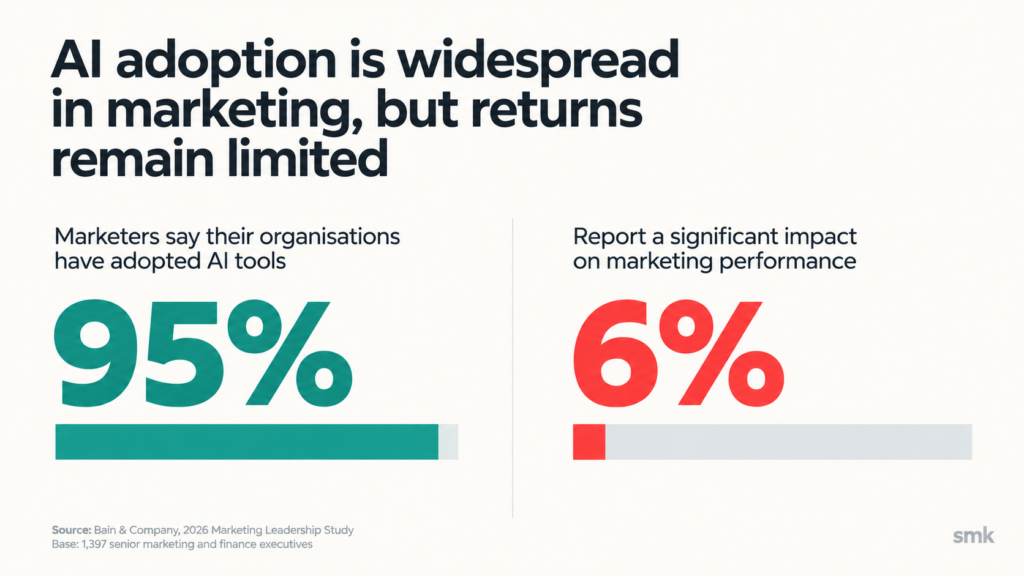
AI adoption is almost universal across marketing departments, yet remarkably few are reporting significant improvements in performance.
New research from Bain & Company finds that 95% of marketers say their organisations have adopted AI tools, but just 6% report a significant impact on marketing performance.
Bain’s tenth annual marketing leadership study, involving 1,397 senior marketing and finance executives, reveals substantial differences between the marketing functions of higher-performing businesses and their peers.
The findings suggest that while access to AI has become commonplace, the organisations generating greater commercial value are making more substantial changes to how their marketing teams operate.
AI Adoption Is High, Returns Remain Limited
Much of marketing’s early AI adoption has centred on individual productivity, from drafting content and summarising documents to research and campaign planning.
Such applications can save considerable time, although the benefits do not necessarily translate into measurable improvements in revenue, customer acquisition or marketing effectiveness.
Bain’s analysis compares marketing functions within higher-performing businesses, classified as leaders, against those of their less successful peers.
The research identifies leaders using business performance measures, including revenue growth and market share gains. While the differences in AI adoption and operating practices are substantial, the study does not establish that AI caused their stronger commercial results.
Leaders Are 3.7 Times More Likely To Redesign Workflows
One of the clearest distinctions concerns how AI is incorporated into everyday operations.
Higher-performing marketing functions are 3.7 times more likely to fundamentally redesign workflows around AI, rather than concentrating primarily on individual applications.
They are also:
- 1.8 times more likely to follow a centrally defined AI strategy.
- 2.4 times more likely to embed AI directly into their marketing tools.
- Twice as likely to restructure teams and job descriptions around AI.
Meanwhile, laggards are ten times more likely to have no defined marketing AI strategy.
Only 6% of leaders rely on general-purpose AI tools, compared with 16% of laggards.
For businesses investing in ChatGPT, Copilot and similar products, the findings raise questions about what happens after employees receive access.
Individual productivity gains are valuable, but more substantial improvements may require connecting AI to existing systems, automating recurring processes and changing how responsibilities are distributed.
For example, marketing reporting might involve collecting data, analysing performance, preparing presentations and developing recommendations. AI can accelerate each activity independently, while a redesigned process could connect the stages and substantially reduce manual work.
Such changes require investment in integration, governance and organisational capability, extending well beyond purchasing software licences.
Customer Applications Are 5.2 Times More Common Among Leaders
Bain also finds that higher-performing marketing functions are 5.2 times more likely to prioritise customer-centric AI applications.
Their investment is increasingly directed towards activities with a more immediate connection to commercial performance.
Leaders are:
- Twice as likely to use AI for demand forecasting and revenue modelling.
- Three times more likely to continuously reallocate channel spending using AI insights.
- 1.5 times more likely to apply AI to personalisation and customer experiences.
The emphasis on customer outcomes is significant. While internal productivity improvements can reduce costs and release capacity, applications affecting customer acquisition, retention and revenue offer a more direct route to measurable returns.
Leading Teams Are Running 100 Experiments A Month
Experimentation provides another striking distinction.
Bain finds that higher-performing marketing functions are 8.5 times more likely to conduct at least 100 marketing experiments each month.
AI can accelerate the development of creative variations, audience analysis and campaign optimisation, making more frequent experimentation practical.
However, the volume of testing only creates value when teams have the measurement capabilities and processes to act on the results.
Bain highlights Nestlé as an example of AI being applied across a broader commercial process. The company reportedly reduced product concept development cycles from six months to six weeks using a proprietary AI platform, while achieving nearly three times the return on investment.
The example illustrates the potential gains when AI supports an established business process with measurable outcomes.
AI Budgets Are Growing, Alongside Organisational Commitment
Higher-performing marketing functions are also making larger financial commitments.
More than 40% allocate at least 11% of their marketing budgets to AI, compared with approximately a quarter of laggards.
Leaders are twice as likely to allocate more than 25% of their budgets to AI-related activities.
Meanwhile, 47% of leaders now describe AI as a core marketing capability, compared with 30% of laggards. A year earlier, those figures were 35% and 8% respectively.
The increase across both groups suggests that AI is becoming more deeply embedded throughout marketing, although adoption maturity remains uneven.
The differences also extend to decision-making. Nearly 70% of leaders regularly or extensively adjust strategy and spending using AI, compared with 31% of laggards.
Higher investment alone does not guarantee better outcomes, but Bain’s findings suggest that leading businesses are committing resources to the organisational changes needed to support more sophisticated applications.
Measuring Returns Becomes The Next Priority
For CMOs, the research raises an increasingly important question: how much of their AI investment is producing demonstrable commercial value?
The number of AI licences, prompts or experiments provides limited evidence of business impact.
More useful measures include changes in production costs, campaign development time, conversion performance, customer acquisition costs and the speed at which teams can respond to market conditions.
Marketing leaders also need to distinguish between productivity improvements that release employee capacity and efficiencies that generate measurable financial returns.
Bain’s findings suggest the largest opportunities lie in identifying commercially valuable applications, redesigning processes around them and establishing reliable ways to measure the results.
With just 6% reporting significant performance improvements, much of that work remains ahead.























RECOMMENDED FOR YOU
Canva’s New AI Model Targets Everyday Design Work
Canva has launched its own AI image generation model,…
Canva has launched its own AI image generation model,…
Instagram Edits Gets A Major AI Upgrade
Instagram is bringing AI-powered content analysis and planning into…
Instagram is bringing AI-powered content analysis and planning into…
Microsoft Pushes Copilot Into Marketing Automation
Microsoft is expanding Copilot’s automation capabilities, allowing organisations to…
Microsoft is expanding Copilot’s automation capabilities, allowing organisations to…