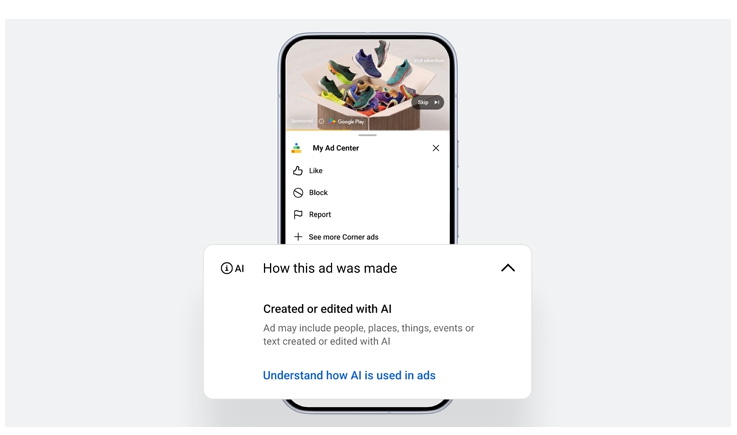
Google is introducing new disclosures showing when advertising has been created or edited using generative AI.
A “How this ad was made” section will appear inside My Ad Center, accessible through the three-dot menu or information icon attached to ads across Search, YouTube and Discover. The panel will indicate when generative AI has been used to produce or alter an ad.
Google will apply the disclosure automatically when content is created using its own generative AI tools. Advertisers will also be able to declare when assets were produced or materially changed using external platforms.
The update gives Google a more formal way to track and disclose AI use across its advertising ecosystem. It also creates a deceptively difficult question for marketing teams.
What exactly counts as an AI-made ad?
A campaign might include copy suggested by Gemini, an image expanded inside Google Ads, a synthetic background created in another platform and footage assembled by a human editor. The finished asset could be almost entirely generated, lightly adjusted or somewhere between the two.
A broad disclosure can show that AI was involved. It will not necessarily explain what changed, how significant those changes were or whether the finished advertisement accurately represents the product.
Google Is Adding Context Rather Than A Warning
The disclosure will not necessarily appear prominently across every advertisement.
People will generally need to open My Ad Center to view the “How this ad was made” information. More direct labels may appear where local laws or regulations require them.
Google is therefore treating generative AI use as additional context rather than automatically presenting it as a warning.
The distinction is sensible. AI involvement alone does not make an advertisement deceptive.
Extending a background, translating a voice-over or adapting an image for another placement may have little bearing on the truthfulness of the message. A fabricated testimonial, synthetic expert or altered product demonstration creates a very different level of risk.
One broad label could eventually cover all of those uses.
As AI becomes embedded in routine creative production, the disclosure may become so common that it communicates very little on its own. Its usefulness will depend partly on how accurately Google and advertisers can identify where AI has actually shaped the creative.
Google Can Track Its Own Tools More Easily
Google has an obvious advantage when an asset is produced inside its ecosystem.
The company can identify content created using its own generative tools and apply the disclosure automatically. Google has also expanded technologies for tracing and verifying AI-generated media across products including Search, Gemini, Chrome, Pixel and Cloud.
External production is harder to follow.
Advertisers will receive tools for declaring third-party AI use, but that part of the system depends more heavily on accurate self-reporting.
Some businesses will document AI involvement carefully. Others may not know which elements of agency-produced creative were generated. Teams may also reach different conclusions about whether minor edits warrant disclosure.
The result could be an uneven system in which work created through Google is identified consistently while externally produced content depends on advertiser knowledge and judgement.
Transparency is easiest where Google already controls the production process. The difficulty increases once AI is spread across several tools and stages of production.
AI Involvement Is Becoming Harder To Define
Generative AI is no longer confined to a separate copywriting or image platform.
Google Ads can create text and visual assets, adapt existing creative and assemble combinations dynamically. Products such as Performance Max and AI Max apply machine learning across campaign construction, matching, delivery and optimisation.
Consider an advertiser that uploads a human-designed image. Google expands the background, generates a headline, changes the layout and selects the final combination for an individual search.
Was the resulting ad created with AI, edited with AI or merely delivered through an AI-powered system?
The distinction affects how teams record production and explain it to regulators, clients and internal stakeholders.
Marketing organisations need workable definitions of AI-generated and AI-assisted creative before they can disclose either consistently. Regulators are now beginning to confront the same problem.
Regulation Is Moving Towards Disclosure
Google’s announcement arrives as governments begin formalising expectations around AI-generated and manipulated content.
The clearest near-term requirements are in Europe. Article 50 of the EU AI Act applies from 2 August 2026 and introduces transparency obligations for certain AI-generated or manipulated content, including deepfakes and machine-readable marking by system providers.
Advertising could fall within those rules when synthetic people, locations, products or events are presented in ways that appear authentic. Final guidance and enforcement practice will determine how broadly the obligations apply across specific ad formats and production techniques.
Elsewhere, the picture is less consistent.
Australia does not currently require every AI-assisted advertisement to carry a specific label, although existing consumer, privacy and online safety laws still apply. An AI disclosure would not excuse misleading claims or inaccurate product representation.
The United States is developing through state laws and narrower measures, particularly around synthetic performers, political communications and deceptive media. No single national standard currently governs all AI-generated commercial advertising.
Global advertisers are therefore likely to face a patchwork of requirements rather than one universal rule.
Google’s disclosure system may become a practical baseline across markets, but it will not remove the need to understand where an ad is running and which legal obligations apply. Nor does it mean most consumers will ever notice the label.
Most People Will Never See The Label
Google’s disclosure may improve transparency in principle, but its practical visibility is likely to be limited.
People will generally need to open My Ad Center through the information menu attached to an ad. Most users will not do that.
Advertising is already filtered out through habit. People scroll past social ads, skip video placements, ignore sponsored search results and mentally screen out banners throughout the day. A disclosure hidden behind an additional click is unlikely to change behaviour at scale.
Some audiences will care, particularly when an ad uses synthetic people, fabricated testimonials or imagery presented as documentary evidence. Journalists, regulators, campaigners and competitors may also inspect the disclosure more closely.
The vast majority of ordinary ad impressions will probably pass without anyone checking how the creative was produced.
The more immediate significance is operational and regulatory. Google is creating an audit trail, setting a platform standard and preparing for disclosure requirements that are becoming more formal across several markets.
Consumer awareness may be the public rationale. Compliance infrastructure may be the more consequential outcome.
A Label Does Not Verify The Claim
Even when someone does see the label, transparency about production should not be confused with verification.
An AI-labelled advertisement may be entirely accurate. An ad produced without generative AI may still be misleading or poorly substantiated.
Google’s disclosure tells people something about how the creative was made. It does not certify the truthfulness, safety or quality of the result.
Some people could interpret the label as a warning that the ad is unreliable. Others may assume Google has reviewed and approved the synthetic content.
Neither conclusion is necessarily correct.
Advertisers remain responsible for substantiating claims, protecting likeness rights and ensuring products are represented accurately, regardless of how clearly AI involvement is disclosed.
That responsibility becomes harder to manage when creative moves through several platforms, agencies and production systems before it reaches Google Ads.
Advertisers Need Their Own Rules
Google’s label cannot replace an organisation’s internal disclosure policy.
Teams need to decide when AI use must be recorded, who is responsible for declaring it and how agencies or production partners will supply that information.
The policy should distinguish between materially different uses.
Basic resizing, translation or background extension may justify a lighter process. Generated people, altered products, synthetic testimonials, fabricated events and realistic depictions of sensitive subjects require closer review.
Agencies and production partners will also need to provide better asset histories. A client cannot make an accurate disclosure when it does not know which tools were used or which parts of the creative were generated.
The operational challenge grows when assets pass through Google, Meta, Canva, Adobe, ChatGPT, specialist video tools and several external suppliers.
A platform checkbox cannot reconstruct that production history. Google can label what it knows, but advertisers still need a reliable record of how the work came together.
Transparency Will Need Greater Detail
Google’s update is a reasonable response to the rapid growth of generative advertising.
It gives regulators, advertisers and users more information about how creative was made. Automatic disclosure for Google-generated assets also gives the system more substance than a purely voluntary label.
The first version remains broad.
“Created with AI” and “edited with AI” can cover radically different production choices. Third-party declarations may be inconsistent, while information placed inside My Ad Center will often require audiences to actively seek it out.
The label is unlikely to transform consumer behaviour. Its greater value may lie in establishing an auditable disclosure standard across Google’s advertising system before regulation becomes more demanding.
Marketing teams should not wait for platforms or regulators to settle every definition.
Google can provide the label. Advertisers still need to know what was generated, why it was used and whether the finished work remains accurate and credible.



















RECOMMENDED FOR YOU
[STUDY] Only 6% Of Marketing Teams See Major AI Returns
AI adoption is almost universal across marketing departments, yet…
AI adoption is almost universal across marketing departments, yet…
Canva’s New AI Model Targets Everyday Design Work
Canva has launched its own AI image generation model,…
Canva has launched its own AI image generation model,…
Instagram Edits Gets A Major AI Upgrade
Instagram is bringing AI-powered content analysis and planning into…
Instagram is bringing AI-powered content analysis and planning into…