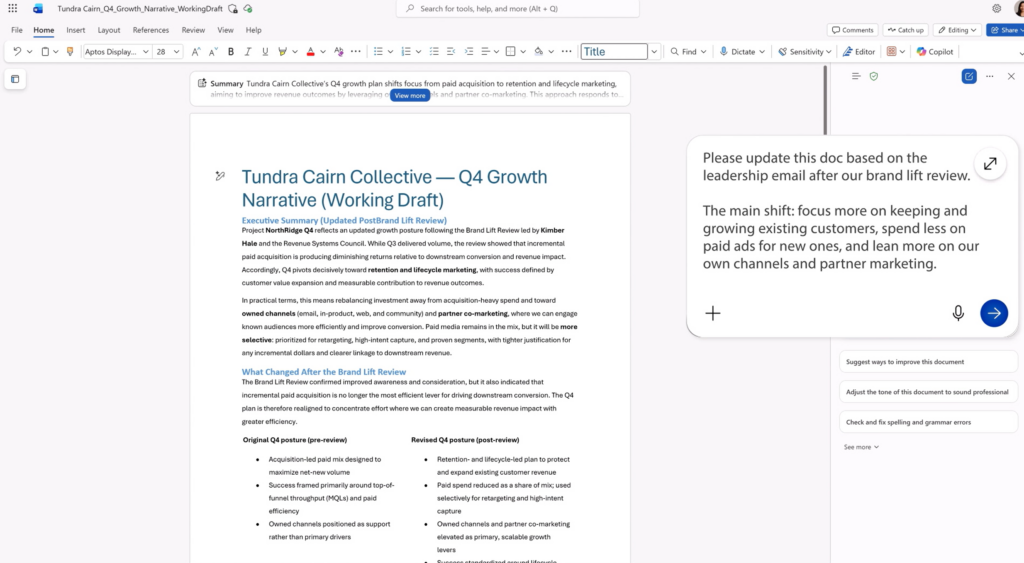
For many in-house marketing and communications teams, Microsoft Copilot has become a default AI layer, largely due to its integration within Microsoft 365 and alignment with existing IT policies.
It has already influenced how content is created. Drafting, ideation, and research have become faster. Execution, however, has remained more fragmented.
Campaign messaging is developed in Word, performance data analysed in Excel, and updates presented in PowerPoint. Moving between tools, refining outputs, and aligning work to brand and narrative still requires time and coordination.
Microsoft’s latest update is designed to address that gap.
Copilot now includes agentic capabilities across Word, Excel, and PowerPoint, allowing it to take multi-step actions directly within documents, spreadsheets, and presentations. Rather than generating outputs in isolation, it can now operate within the tools where work is completed, moving closer to execution than support.
While ChatGPT continues to attract attention and tools like Claude appeal to early adopters, Copilot is more often embedded within day-to-day enterprise workflows.
What’s Changed
The core shift is from suggestion to action.
Earlier versions of Copilot could generate content or propose edits, but implementation still sat with the user. With agentic capabilities, Copilot can now carry out tasks within the file itself, handling multiple steps while maintaining context.
For marketing and communications teams, that changes how common tasks are handled. A press release can be restructured and refined directly in Word, campaign data can be analysed and visualised in Excel, and stakeholder updates can be built out in PowerPoint without moving between tools.
The underlying change is not just functional, it is operational.
How It Works In Practice
Copilot operates natively within each application, allowing tasks to be completed in place rather than across multiple environments.
In Word, it can restructure documents, adjust tone for different audiences, and apply formatting. A product launch announcement, for example, can be adapted into versions for internal teams, media, and partners within the same document.
In Excel, it supports analysis by building formulas, organising data, and generating visual outputs. Campaign performance data can be explored and translated into summaries without requiring manual setup.
In PowerPoint, it helps turn inputs into structured narratives. Quarterly results or campaign updates can be shaped into presentation-ready decks aligned to existing templates.
Across these use cases, the common thread is continuity. Tasks that would typically be split across tools and steps can be carried through within a single environment.
Why It Matters For Marketing Teams
The value lies less in content generation and more in execution.
Most AI tools have focused on the start of the workflow, supporting ideation and first drafts. The more time-intensive stages, editing, formatting, aligning to brand, and preparing outputs, still require manual effort across multiple tools.
Copilot begins to address that second phase by operating within the environments where work is finalised.
This reflects a broader shift in how AI is being applied. Rather than sitting alongside workflows as a prompting layer, AI is increasingly being embedded within them.
For marketing and communications teams, that distinction is important. Much of the operational effort sits in adapting content for different audiences, translating data into clear narratives, and ensuring outputs are aligned to brand and context. Supporting those stages more directly has the potential to reduce time spent on execution rather than just creation.
Early Signals And Limitations
Microsoft reports increases in engagement, retention, and satisfaction following the rollout of these capabilities, particularly in Excel.
These signals are still early. The longer-term impact will depend on how reliably Copilot performs in more complex scenarios, and how comfortable teams are delegating elements of execution.
Accuracy remains a key consideration, especially in reporting and external communications where errors carry greater risk.
Control And Brand Alignment
Control remains central to how Copilot is positioned.
Outputs can be reviewed, edited, and refined before being finalised, which is essential in marketing and communications environments where tone, compliance, and brand consistency are closely managed.
In practice, Copilot is more likely to function as a first-pass executor, with responsibility for final output remaining with the user.
A Shift Towards Embedded AI
The broader direction is towards AI that sits within workflows rather than alongside them.
For marketing teams, that can reduce the need to switch between tools and manually rework outputs. A campaign report can move from raw data to presentation within a single environment, while a document can evolve from draft to final version without being transferred between systems.
Oversight is still required, but the nature of the work begins to shift from manual assembly to review and refinement.
What To Watch
The next phase of development is likely to focus on depth and reliability.
Microsoft is investing in more complex workflows, improved transparency around changes, and tighter integration across its ecosystem.
For marketing and communications teams, the practical questions remain consistent. How well these tools handle nuanced messaging, whether they maintain accuracy in data-heavy tasks, and the extent to which they reduce production time will ultimately determine their value.
A Gradual Shift In Execution
Copilot’s latest update reflects a broader shift in how work is carried out within existing tools.
For marketing and communications teams, the change is less about replacing current processes and more about embedding AI within them. Over time, that may reduce fragmentation and streamline execution, particularly as these capabilities mature.
The move from prompt-led usage towards workflow integration is gradual, but it is likely to define where meaningful efficiency gains are realised.























RECOMMENDED FOR YOU
ChatGPT Work Starts Doing The Work
ChatGPT Work is only six weeks old, but OpenAI…
ChatGPT Work is only six weeks old, but OpenAI…
Meta AI Takes On ChatGPT For Marketing
Meta is trying to move Meta AI from the…
Meta is trying to move Meta AI from the…
Google’s AI Answers Are Creating Brand Reputation Problems
Google’s AI search products are creating a new reputation…
Google’s AI search products are creating a new reputation…