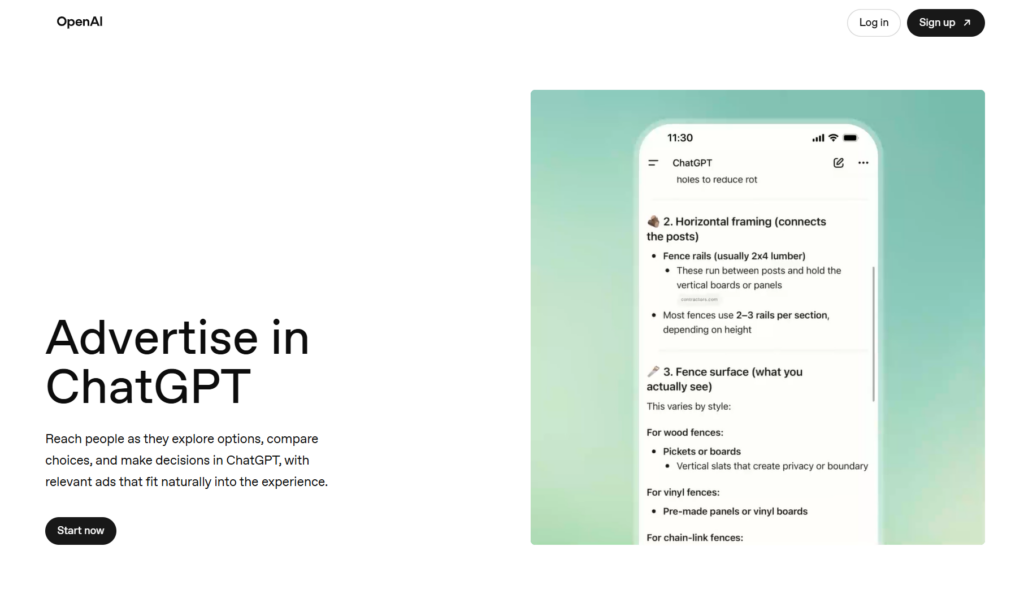
OpenAI is expanding ChatGPT ads into five more markets and testing multi-advertiser placements that can show several sponsored results inside a single ChatGPT ad unit.
The company is extending geographic targeting beyond the US, Canada, Australia and New Zealand to include the UK, Japan, South Korea, Brazil and Mexico. The move pushes ChatGPT ads from a limited pilot towards a broader international test.
Self-serve buying is already live where Ads Manager Beta is available, and marketing teams and agencies have been setting up campaigns in accessible markets. The international rollout expands available inventory, while OpenAI continues to add the controls buyers need to manage spend, bidding and pacing more efficiently.
The commercial pressure behind the rollout is clear. OpenAI is reportedly projecting US$2.5 billion in ad revenue this year, rising to US$102 billion by 2030. Those forecasts help explain the pace. ChatGPT ads are not being treated as a side experiment. They are becoming a core part of OpenAI’s growth plan.
The pace is the real signal. ChatGPT ads are moving quickly from test budget curiosity to a platform OpenAI clearly expects brands to buy at scale.
Multi-Advertiser Ads Begin Testing
The biggest product change is OpenAI’s test of multi-advertiser ad units inside ChatGPT.
Instead of showing a single sponsored result, the format can group multiple relevant advertisers together in one placement. Eligible ads will be sold through a second-price auction model, a familiar mechanism across digital advertising platforms.
The format gives OpenAI a way to increase ad density without turning ChatGPT into a feed. A single conversation can signal strong intent, especially when someone is comparing tools, researching a category, looking for suppliers or asking for product recommendations.
The comparison with existing platforms is useful, but only up to a point. Google still owns scalable search intent. Meta still owns audience-led discovery and creative automation. OpenAI is testing something different: ads triggered by the context of a conversation, not just a keyword, audience segment or feed behaviour.
Ads Manager Gets More Usable
The ad format is only one part of the build-out. OpenAI is also improving the self-serve buying tools already available through Ads Manager Beta, making the platform more practical for media teams and agencies managing live campaigns.
Advertisers can now convert existing campaigns from lifetime budgets to daily budgets. CPM campaigns can be cloned and converted to CPC bidding with one click. Impression-based campaigns now support custom CPM max bids. Bulk editing is available directly within Ads Manager.
Daily budgets are also moving to an average daily budget model, with weekly pacing flexibility.
None of that is headline-grabbing, but it removes practical friction for teams already testing the platform. Early ad products often attract trial budgets because they are new. Sustained spend needs cleaner buying, faster campaign changes and more predictable pacing.
Daily budgets, CPC bidding, CPM controls and bulk editing are standard expectations for advertisers used to Meta, Google, TikTok, LinkedIn and programmatic platforms. OpenAI is still behind mature ad managers on optimisation depth, conversion infrastructure and reporting history, but the product is becoming easier to buy.
Context Hints Shape Targeting
OpenAI is also giving advertisers more influence over where ads appear.
Context hints allow advertisers to describe the conversations, topics or keywords where they believe their products or services are relevant. Instead of relying only on traditional audience segments or keyword lists, advertisers can give OpenAI guidance around conversational moments.
ChatGPT queries often contain more context than a search query. A user may explain their problem, budget, category needs, preferences and decision criteria in the same conversation. The opportunity is not just to target a keyword, but to understand the situation a product should appear in.
A B2B software brand may not only want to appear against “CRM”. It may want to show up when someone asks how to choose a CRM for a growing sales team, compare platforms, or build a shortlist for procurement.
The planning task changes. Brands will need to map products and propositions to real customer questions, not just search terms.
Privacy Shapes Personalisation
OpenAI’s advertising rollout is also being shaped by privacy requirements.
The company’s updated EU ads policy says personalised ads for Free and Go users will rely on user consent. When users opt in, OpenAI may use signals such as past chats, memory, ad history and advertiser-provided data to personalise ads. Without that consent, users should receive more generic ads based on limited information, such as current conversation context, location and time.
The policy shows how carefully OpenAI will need to handle personalisation. The ad opportunity is built on rich conversational context, but that same context is also what makes user trust more fragile.
Advertisers should expect targeting and measurement to develop cautiously. Relevance will be valuable, but trust will set the pace.
Discovery Moves Into Conversation
OpenAI says the goal of multi-advertiser units is to improve product discovery while giving advertisers more opportunities to reach users during high-intent conversations.
Product discovery is the key phrase. ChatGPT is increasingly used for research, comparison, planning and decision support. Those behaviours sit close to the upper and middle parts of the funnel, but they can also move quickly towards purchase.
A user asking for “best project management tools for a remote creative team” is doing more than browsing. They are sharing a use case, audience, category and buying context. That could become a valuable placement if the ad is relevant, clearly labelled and useful.
The placement has to earn its place. Ads that feel intrusive, poorly matched or too similar to organic recommendations could weaken trust. Ads that help users compare suitable options may feel closer to utility.
A New Ad Stack Takes Shape
OpenAI is building its advertising stack piece by piece.
Geographic expansion increases inventory. Multi-advertiser units test new sponsored formats. Second-price auctions bring familiar market mechanics. Daily budgets, CPC conversion, CPM controls and bulk editing make campaign management easier. Context hints give advertisers a way to influence relevance inside conversations.
Taken together, these updates suggest OpenAI is moving beyond an experimental ad pilot and towards a more structured media product.
The early opportunity is not to shift search or social budgets wholesale into ChatGPT. It is to test where conversational placements add value: category research, product comparison, provider shortlists and guided recommendations. Those are the moments where OpenAI’s ad product may behave differently from keyword search or feed-based discovery.
The near-term priority is understanding how brands show up inside conversational journeys, what kinds of prompts trigger commercial placements, how OpenAI labels and ranks advertisers, and how users respond when ads appear inside AI-assisted decision-making.
ChatGPT ads are still early, but the product direction is becoming clear. OpenAI is building the mechanics of a media platform around conversational intent. The question for advertisers is no longer whether ads will appear in AI assistants, but which moments will be valuable, trusted and measurable enough to buy.













RECOMMENDED FOR YOU
[STUDY] AI Search Shapes Brand Decisions
AI search is starting to influence purchase decisions well…
AI search is starting to influence purchase decisions well…
LinkedIn Lets AI Multiply Ad Creative
LinkedIn is giving advertisers far more freedom to vary…
LinkedIn is giving advertisers far more freedom to vary…
Copilot Lets Marketers Build Apps By Chatting
Microsoft is giving Copilot users the ability to build…
Microsoft is giving Copilot users the ability to build…