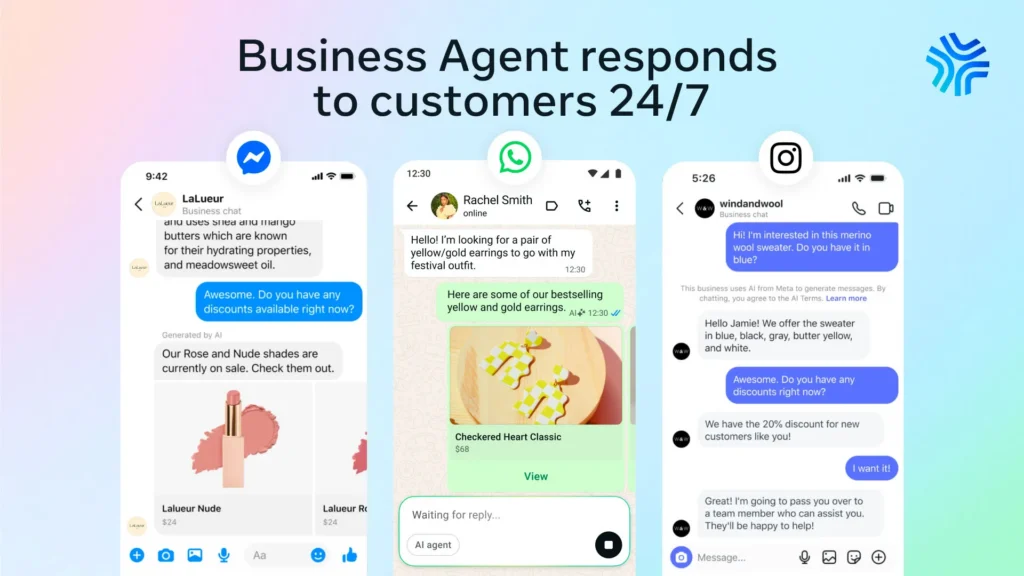
Customer service has always had an inbox problem. Meta now wants AI to help businesses answer it.
At its Conversations 2026 event in London, Meta announced wider global access to Meta Business Agent, its AI-powered tool for handling customer interactions across WhatsApp, Messenger and, soon, Instagram. The company also introduced a Meta Business Agent Platform, designed to help larger businesses build, customise and deploy agents across connected systems such as Shopify and Zendesk.
Meta Wants AI Inside The Inbox
On the surface, the pitch is straightforward. Customers expect fast answers. Businesses cannot have people sitting across every inbox, every hour of the day. Meta wants its AI agents to fill that gap by answering questions, recommending products, booking appointments, qualifying leads and escalating issues when human support is needed.
Meta says more than one million businesses are already using a Business Agent on WhatsApp and Messenger. It also says there are more than one billion active business threads across WhatsApp, Messenger and Instagram each day, which gives the company an obvious distribution advantage. If customer interaction already lives inside Meta’s messaging ecosystem, AI support becomes less a separate tool decision and more a feature sitting inside existing behaviour.
That is powerful, but it also needs to be read carefully. Meta is not simply helping businesses reduce inbox pressure out of goodwill. It is trying to turn the scale of WhatsApp, Messenger and Instagram messaging into a more reliable commercial engine.
Business Messaging Has Been Building For Years
Meta’s move into AI agents sits on top of a much larger messaging opportunity. Across its wider family of apps, Meta reported 3.58 billion daily active people on average in December 2025. WhatsApp, Messenger and Instagram are not fringe customer channels. For many businesses, they are now where discovery, enquiry, sales support and customer service increasingly collide.
The commercial challenge has never been reach. It has been scalability.
Messaging does not behave like feed advertising. A feed ad can reach thousands or millions of people at once. A customer conversation is slower, messier and more operationally demanding. Someone has to answer the question, check the order, qualify the lead, provide the quote, handle the complaint or move the customer to the next step.
Click-to-message ads have already shown there is demand for that behaviour. In its Q4 2025 prepared remarks, Meta said click-to-message ad revenue growth accelerated, with the US up more than 50% year on year. Paid messaging within WhatsApp also crossed a US$2 billion annual run-rate.
That gives the agent launch more strategic weight. AI gives Meta a plausible answer to the bottleneck that has held business messaging back: human capacity. If businesses cannot respond quickly and consistently, messaging loses commercial value. If agents can handle the first layer of enquiry, Meta can make more of those interactions commercially viable.
In other words, Meta is not just adding AI to customer service. It is trying to make messaging behave more like scalable performance media, without losing the conversational context that makes messaging valuable in the first place.
Messaging Is Becoming Business Infrastructure
For many brands, messaging has already shifted from a secondary service channel to a core part of sales, support and customer experience. Customers use DMs to ask about products, chase orders, check availability, resolve complaints and request appointments. For small businesses, that often means the owner or a small team juggling conversations around everything else.
Meta’s Business Agent is positioned as a practical answer to that pressure. It can be set up quickly, respond in a customer’s local language and use a business’s tone. For smaller operators, the immediate appeal is obvious: fewer missed enquiries, faster replies and less time spent answering repetitive questions.
For larger organisations, the more interesting development is the Agent Platform. By connecting agents into commerce, customer service and business systems, Meta is moving beyond chatbot-style responses and closer to action-based automation.
An agent that can answer a product question is useful. An agent that can check inventory, process a booking, qualify a lead and route the next step into the right system is much more consequential.
Agents Are Moving From Answers To Actions
The platform layer is where Meta’s ambitions become clearer. Shopify and Zendesk integrations are not just nice operational extras. They point towards agents that can sit across customer communication, commerce and service systems, taking action rather than simply replying.
That creates real upside. A well-designed agent could reduce response times, improve lead handling and take pressure off teams dealing with high volumes of repetitive requests. It could also give businesses better visibility into the questions customers are asking before, during and after purchase.
Yet the value will depend heavily on the quality of the underlying workflow. If product data is messy, policies are unclear or escalation rules are weak, AI will not fix the problem. It may just make the confusion available 24 hours a day.
Paid Access Changes The Calculation
Meta says getting started with Business Agent is currently free, but businesses will access the agent through paid subscription offerings in the coming months. That detail matters.
Early AI adoption often follows a familiar pattern. Platforms make new tools easy to test, usage grows, workflows become dependent on them, then pricing becomes part of the equation. Businesses should assume messaging AI will become another paid layer within the customer technology stack, not a free efficiency dividend.
That does not make it unattractive. For businesses with meaningful messaging volume, the business case may be relatively easy to justify. Reducing response times, qualifying more leads and extending service availability can create clear value.
The risk is comparing agent costs only against staff time. The better comparison is against the full customer outcome. Faster replies are not helpful if they are wrong, repetitive, off-brand or unable to recognise when a conversation needs human judgement.
Faster Replies Are Not Always Better Replies
Meta’s announcement leans heavily into productivity. Its language about every business showing up for every customer, in every moment, as if it had an infinite team behind it, is exactly the kind of platform optimism that should make experienced operators pause for a cup of tea.
No business has an infinite team. More importantly, most businesses should not want an infinite number of automated customer interactions unless they are well designed, well governed and properly measured.
AI agents can misunderstand intent, provide incomplete information, miss context or handle sensitive complaints poorly. The more systems they connect to, the more important permissions, escalation rules, audit trails and human oversight become.
Meta says its platform will include enterprise-grade controls, guardrails and measurement tools. That is encouraging, but the proof will sit in implementation rather than announcement copy. Businesses will need to decide what the agent is allowed to answer, what it can do, when it must hand over to a person and how performance will be judged.
A useful agent should not just reduce workload. It should improve the quality and consistency of the customer interaction. Those are related goals, but they are not the same thing.
WhatsApp Discovery Could Become More Commercial
Meta is also working on business discovery inside WhatsApp. Soon, people will be able to find businesses by typing their name in the search bar or by sharing a phone number or contact card in chats.
That may sound like a smaller update, but it points to a broader shift. Messaging apps are becoming discovery environments, not just communication tools. If users can search for businesses inside WhatsApp and immediately interact with an AI agent, Meta has another pathway to connect discovery, service and conversion inside its own ecosystem.
For brands, that raises practical questions. Is business information accurate across Meta properties? Are product catalogues clean and current? Are response flows aligned with actual customer needs? Is there a clear handover from automated chat to human service?
AI agents will only be as useful as the information and process design behind them. A messy catalogue, unclear policy or poorly maintained business profile will not magically become elegant because an agent is sitting in front of it. It may simply make the mess more responsive.
The Real Shift Is Workflow, Not Chatbots
Meta’s Business Agent push should not be dismissed as another chatbot announcement. The bigger story is that major platforms are turning messaging, commerce, support and AI automation into a more connected operating layer.
For marketing, sales and CX teams, the practical response is not to rush into full automation. It is to map the high-volume, low-risk conversations where AI can help, then identify the moments where human judgement still matters. Product questions, appointment booking and lead qualification may be good starting points. Complaints, complex service issues and sensitive customer situations need more caution.
The organisations that get the most value will not be the ones that simply switch the agent on. They will be the ones that redesign the workflow around it, clean up the information feeding it, define escalation rules and measure outcomes beyond response speed.
Meta’s AI business agents may well reduce labour pressure and improve customer availability. They may also create new dependencies, costs and governance problems if adopted lazily.
As usual with platform automation, the tool is less important than the operating model around it. The businesses that remember that will have a much better chance of getting useful AI, rather than just a faster inbox.














RECOMMENDED FOR YOU
Google Gives Advertisers More AI Max Visibility
Google is introducing new AI Max reporting capabilities, giving…
Google is introducing new AI Max reporting capabilities, giving…
[STUDY] AI Content Production Keeps Accelerating
93% of marketers now use AI to support content…
93% of marketers now use AI to support content…
Meta Launches AI Agent For Businesses
Meta is extending its AI capabilities beyond Facebook, Instagram…
Meta is extending its AI capabilities beyond Facebook, Instagram…