Small businesses have rarely been short of tools. The harder problem is getting those tools to work together around the jobs that actually need doing.
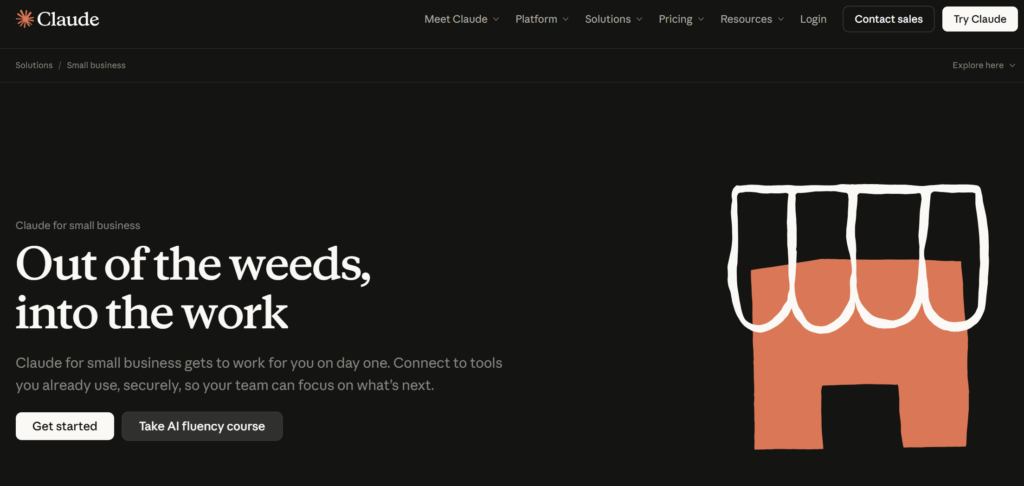
Claude for Small Business is Anthropic’s attempt to move AI into that gap. The product connects Claude to tools including HubSpot, Canva, DocuSign, Google Workspace, Microsoft 365, QuickBooks and PayPal. It then packages that access around ready-to-run workflows for jobs such as lead triage, campaign preparation, content production, business reporting, contract review, invoice chasing and customer follow-up.
For marketing and communications teams, the direction is familiar. Campaign work already depends on CRM records, documents, creative assets, approvals, sales signals, customer queries and reporting. A blank chat window can help with individual tasks, but it has limited value when the real work sits across systems.
Claude for Small Business is useful because it reflects that reality. It treats AI less as a writing interface and more as a connected work layer.
Claude Cowork Runs The Work
Claude for Small Business runs through Claude Cowork, Anthropic’s agentic work environment for business tasks. In practical terms, Cowork is where Claude can work across files, folders and connected tools, rather than only responding inside a chat interface.
Users toggle on Claude for Small Business inside Cowork, connect their existing tools and choose the job they want completed. Anthropic says Claude then plans and carries out the task, while the user approves before anything is sent, posted or paid.
That approval model is central to the offer. Claude can prepare the work, gather context and reduce manual assembly. A person still remains responsible for decisions that affect customers, money, contracts or brand reputation.
Connectors Turn AI Into A Workflow Tool
Claude’s connectors are authorised integrations into other business tools. They let Claude work with information and actions inside those systems, rather than relying only on whatever a user types into a prompt.
That distinction matters in practical use. A campaign idea produced from a prompt is only as useful as the information provided at the time. A workflow connected to approved documents, campaign history, customer data, revenue signals and creative assets starts from a better place.
Anthropic’s listed connectors cover a broad spread of small business operations. HubSpot brings CRM and campaign context. Canva supports campaign asset creation. Google Workspace and Microsoft 365 bring documents, email, calendars, spreadsheets and files. DocuSign connects contract workflows. QuickBooks and PayPal bring finance, invoicing, payment and cash-flow context.
For marketing and comms teams, the appeal is not a longer list of integrations. It is the possibility of reducing the distance between planning, production, approval and follow-up.
Workflows Matter More Than Features
Anthropic says Claude for Small Business includes 15 ready-to-run agentic workflows across finance, operations, sales, marketing, HR and customer service. It also includes 15 skills built around repeatable business tasks.
Several examples sit close to marketing and communications. Claude can help identify a slow stretch in revenue, analyse campaign performance, draft a promotional strategy and generate campaign assets. It can also support lead triage, customer pulse checks, content strategy and business insight summaries.
Those are not glamorous use cases. That is part of the point. The next stage of business AI adoption is less about impressive standalone outputs and more about repeatable work that sits inside the operating rhythm of a team.
Many organisations have already tested AI for writing, summarising and idea generation. Fewer have connected AI into planning, briefing, production, review, publishing, reporting and follow-up. A workflow that starts with business context, prepares work and routes outputs for approval is more useful than another prompt library.
Business Adoption Is Moving Into Systems
Claude for Small Business also lands as Anthropic’s business adoption appears to be rising quickly.
Ramp’s May 2026 AI Index found that Anthropic had overtaken OpenAI among businesses in its dataset. Anthropic was used by 34.4% of businesses, compared with 32.3% for OpenAI. Overall paid AI adoption reached 50.6%.
Ramp’s data is not total market share. It is based on businesses using Ramp, so it should be treated as a directional signal. Even so, spending data is useful because it shows AI moving from experimentation into recurring business software budgets.
That shift raises the standard. A recurring AI subscription has to do more than produce a good first draft. It needs to support regular work: campaign operations, reporting, customer understanding, content workflows and stakeholder updates. It also needs to reduce the coordination work that quietly eats the week.
Controls Will Decide The Value
Connected AI brings obvious benefits, but it also raises the stakes.
Marketing and communications teams deal with brand risk, customer expectations, legal sensitivity, stakeholder politics and commercial pressure. A campaign workflow that pulls from the wrong data, overstates an offer or misreads customer intent can create problems faster than a slower manual process would.
Anthropic says existing permissions hold. If an employee cannot access something in QuickBooks or Drive, they should not be able to access it through Claude. That is essential if AI is going to sit across customer records, campaign data, financial information and internal documents.
Human approval remains just as important. Connected AI should prepare work, not quietly replace judgement. Teams need to know what Claude can access, what it is allowed to do, who reviews the output and how mistakes are caught before anything reaches a customer or stakeholder.
Capability Still Matters
Anthropic has also partnered with PayPal on AI Fluency for Small Business, a free online course on using AI safely and responsibly in day-to-day operations.
The training element is a useful reminder that adoption is rarely solved by tool access alone. Most teams do not only have a tooling problem. They have a workflow problem.
For marketing and comms leaders, the practical question is not simply whether Claude, ChatGPT, Gemini or Copilot has the best model on a given day. The more durable question is which workflows should be redesigned around AI, which systems should be connected, which permissions are appropriate and which decisions still need human review.
Claude for Small Business does not remove that work. It makes the direction clearer. AI adoption is moving away from isolated prompting and towards connected systems, repeatable workflows and operational discipline.
Marketing teams will not get much long-term advantage from slightly better prompts. The advantage sits in cleaner workflows, clearer permissions, better source material and stronger review habits.








RECOMMENDED FOR YOU
[STUDY] AI Search Shapes Brand Decisions
AI search is starting to influence purchase decisions well…
AI search is starting to influence purchase decisions well…
LinkedIn Lets AI Multiply Ad Creative
LinkedIn is giving advertisers far more freedom to vary…
LinkedIn is giving advertisers far more freedom to vary…
Copilot Lets Marketers Build Apps By Chatting
Microsoft is giving Copilot users the ability to build…
Microsoft is giving Copilot users the ability to build…