Meta’s automated advertising business has reached serious scale.
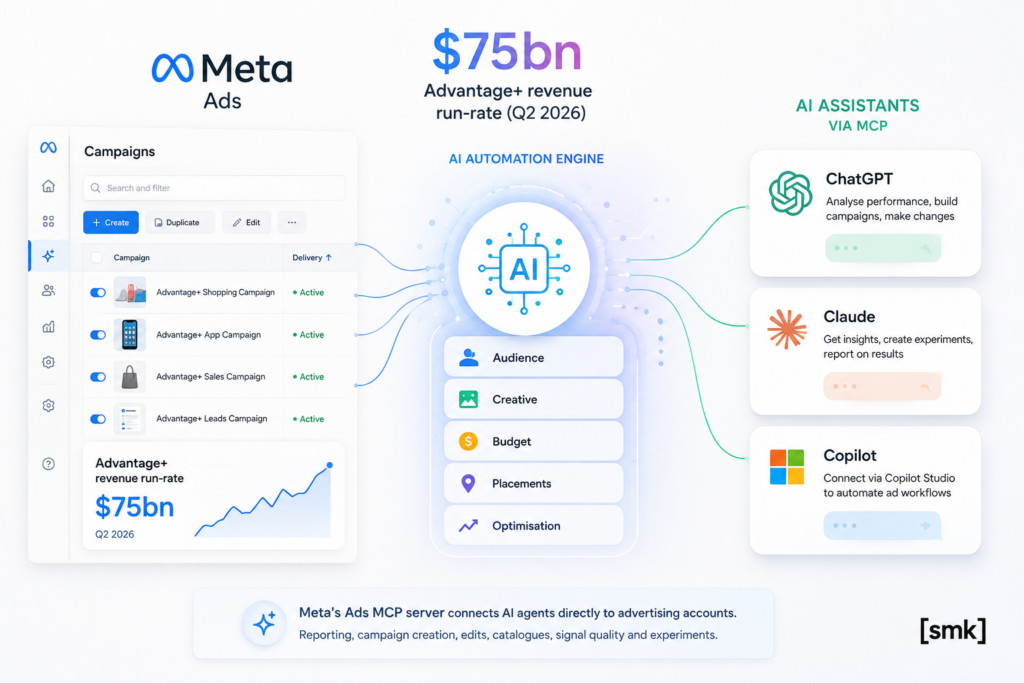
In its latest earnings call, Meta said advertising running through its Advantage+ solutions had reached a $75 billion annual revenue run-rate during the second quarter of 2026.
The number needs context. Advantage+ is not a separate $75 billion revenue stream sitting alongside Meta Ads. It reflects advertising revenue flowing through Meta’s increasingly automated campaign and delivery systems.
Meta generated $59.4 billion in advertising revenue during Q2, up 27% year on year. Against that backdrop, Advantage+ is becoming less of an optional collection of automation features and more representative of where Meta wants its advertising business to go.
The process is hardly end-to-end yet. Advertisers still determine objectives, provide creative and product information, supply conversion signals, establish budgets and make strategic decisions about what campaigns are trying to achieve.
Meta is, however, steadily taking on more of the execution underneath those choices.
Advantage+ Keeps Expanding With Mixed Results
Advantage+ first became familiar to many advertisers through automated shopping campaigns and audience expansion, but its scope has widened considerably.
Automation can now influence audiences, placements, campaign budgets, creative variations and optimisation. Rather than requiring advertisers to define every audience segment and campaign decision manually, Meta increasingly wants enough freedom to find likely customers itself.
There are good reasons advertisers have embraced parts of that model. Meta has enormous volumes of behavioural and conversion data, while broader targeting and automated optimisation can remove plenty of repetitive campaign work.
Results across the wider Advantage+ experience are less uniformly impressive.
Automated creative remains particularly uneven. Meta can generate backgrounds, resize assets, alter formats and produce copy variations. Some outputs are useful. Others can be clumsy, off-brand or simply worse than the original.
Unexpected asset changes, questionable crops or unwanted variations can create another layer of checking and troubleshooting. Meta’s models may understand which execution generates a conversion signal, but that does not mean they understand which parts of a brand should remain untouched or when an automatically generated asset simply looks bad.
Paid social was once heavily associated with detailed audience construction. Meta has steadily pushed advertisers towards broader audiences, stronger conversion signals and more automated delivery.
Advertisers increasingly provide the ingredients and guardrails. Meta decides more of how those ingredients should be deployed.
Targeting And Creative Are Converging
Greater automation also makes the traditional distinction between targeting and creative less useful.
Meta’s systems can interpret advertising content alongside behavioural and conversion signals when deciding where an ad should appear. Generative AI gives the platform more ability to produce and adapt the creative at the same time.
Audience, message, placement and optimisation therefore become increasingly interconnected.
The same direction is visible elsewhere. Google is moving Search beyond rigid keyword matching through AI Max, while ChatGPT Ads uses conversational context and advertiser-supplied context hints to help determine relevance.
Across all three, targeting is becoming less about marketers explicitly identifying every person, audience or keyword and more about providing systems with enough context to infer commercial intent.
That puts more weight on the inputs feeding the machine: strong creative, useful product information, reliable conversion signals and good first-party data.
Meta Wants To Go Much Further
Advantage+ is not the end-state Meta has in mind.
Mark Zuckerberg outlined a considerably more automated vision last year, describing a future where a business could provide Meta with an objective and budget, connect its bank account and allow the platform to handle much more of the creative, targeting and measurement.
That remains ahead of what Advantage+ can currently deliver, but Meta’s newer Ads AI Connectors make the direction more tangible.
Its Ads MCP server allows compatible AI agents to interact directly with Meta advertising accounts. Meta currently validates clients including ChatGPT and Claude, while the server is designed to work more broadly with AI clients that support the MCP standard.
Microsoft environments potentially fit into that picture too. Copilot Studio can connect agents to remote MCP servers, giving organisations already invested in Microsoft a route to build Meta advertising capabilities into a Copilot-based agent.
Current Meta capabilities include accessing campaign reporting, creating and editing campaigns, ad sets and ads, working with product catalogues, reviewing signal quality and setting up A/B tests and conversion lift studies.
Meta’s internal systems can therefore automate more of what happens inside a campaign, while external AI assistants can start automating parts of the workflow marketers currently perform around it.
A marketer may eventually spend considerably less time navigating Ads Manager and more time briefing an AI assistant to analyse performance, investigate issues or make changes.
That also raises new questions around permissions, governance and accountability. An AI agent capable of changing campaigns and budgets needs clear limits around what it can do without human approval.
Automation can remove clicks without removing responsibility.
Creative Becomes A More Important Input
As Meta takes over more campaign decisions, creative becomes one of the areas where advertisers can still meaningfully influence performance.
Generative AI makes producing variations easier, but volume alone is not much of a strategy.
Twenty slightly different versions of a mediocre advertisement do not give Meta twenty strong ideas.
A better creative system provides genuinely different propositions, formats, hooks, creator content, product demonstrations and customer problems. Meta can then determine which combinations appear to work for different people.
The production challenge therefore moves towards stronger source ideas, reusable assets, brand standards and deciding what is actually worth testing.
Making more ads is getting easier. Making more good ads remains considerably harder.
Media Buying Skills Are Moving Upstream
The same shift applies to media buying.
Audience construction, placement selection, budget allocation and optimisation can increasingly become machine decisions. Teams still need to determine the outcomes Meta should optimise towards, whether conversion tracking reflects genuine business value and how much confidence to place in platform attribution.
Meta has every incentive to demonstrate that greater automation improves advertiser results. Its own studies report performance gains from AI-driven advertising technologies, while its latest financial results show strong advertising growth.
Platform revenue growth and advertiser effectiveness are not necessarily the same thing.
A campaign can generate more Meta-attributed conversions without producing an equivalent increase in incremental sales, leads or customers.
Greater automation therefore increases the importance of independent measurement rather than reducing it.
Paid Social Is Becoming An AI System
The $75 billion Advantage+ milestone provides a useful marker for how far the transition has already progressed.
A substantial volume of Meta advertising now flows through systems designed to automate decisions marketers previously made themselves.
Meta also intends to push much further.
Advantage+ is automating more campaign execution. Generative tools are expanding creative production. Ads AI Connectors could increasingly automate the workflow around campaign management as well.
For smaller advertisers, that could lower the expertise and effort required to operate sophisticated campaigns.
Larger advertisers face a different challenge.
Meta can increasingly determine who receives an ad, where it appears, which creative variation is shown and how delivery is optimised. It may eventually automate much of the work required to operate the campaign as well.
It cannot decide a brand’s positioning, generate genuinely distinctive customer insight, determine what sustainable commercial growth means for the organisation or independently judge whether Meta itself deserves another dollar of budget.
Those responsibilities become more valuable as the platform absorbs more of the mechanics.
Meta’s $75 billion Advantage+ run-rate suggests paid social is becoming an AI-operated advertising environment in which marketers increasingly set the direction, inputs and boundaries while machines handle more of the execution.
Knowing what to delegate, what to control and how to judge the outcome will increasingly separate useful automation from simply having more of it.






















RECOMMENDED FOR YOU
Google Gives Advertisers More AI Max Visibility
Google is introducing new AI Max reporting capabilities, giving…
Google is introducing new AI Max reporting capabilities, giving…
[STUDY] AI Content Production Keeps Accelerating
93% of marketers now use AI to support content…
93% of marketers now use AI to support content…
Meta Launches AI Agent For Businesses
Meta is extending its AI capabilities beyond Facebook, Instagram…
Meta is extending its AI capabilities beyond Facebook, Instagram…