Google’s new AI Search reporting arrives as website traffic becomes a less reliable proxy for discovery.
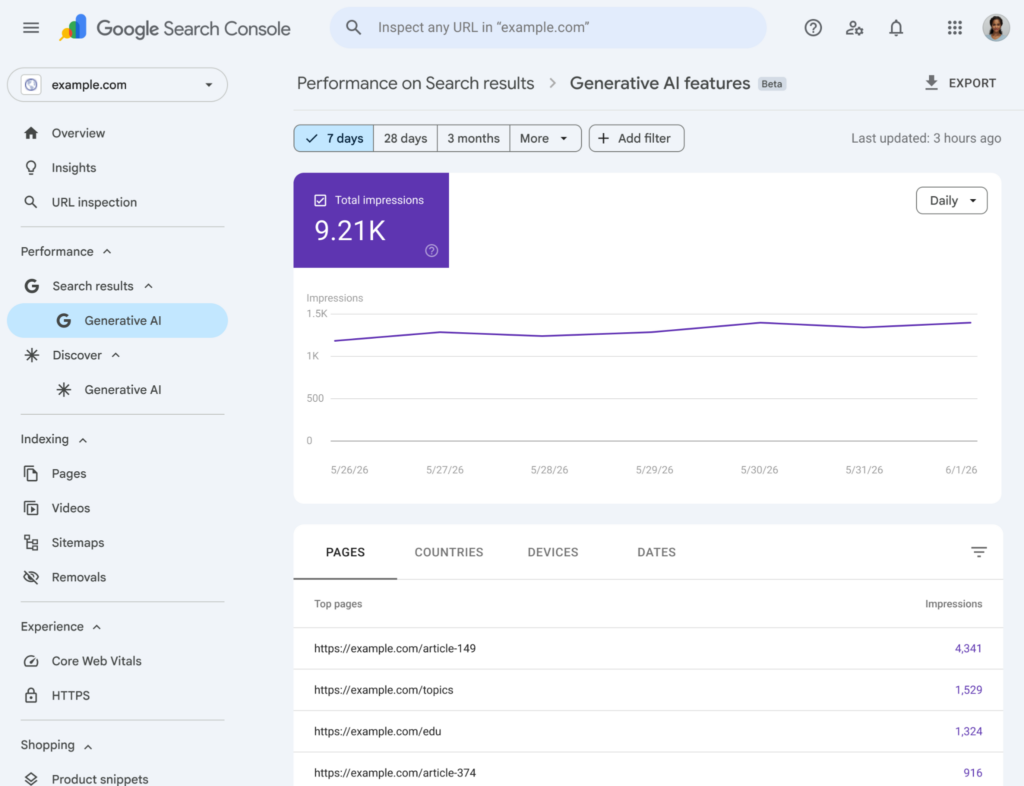
The company has announced new Search Console tools for generative AI Search features, including performance reporting for AI Overviews, AI Mode and AI Overviews in Discover. Google is also testing a new control that allows website owners to opt out of having their content appear in, and help ground, its generative AI Search experiences.
The rollout begins with a subset of website owners in the UK, with broader availability expected after testing. Google says the new reporting will show impressions, the pages that appeared in AI features, country-level visibility, devices and performance over time.
Useful, yes. Complete, no.
For years, Google Analytics has been the backbone of digital marketing reporting. It tells teams what happens after someone reaches the website: sessions, channels, landing pages, engagement, conversions and user journeys.
That model still matters, but it captures a smaller share of influence when more discovery and evaluation happen before the click. AI Overviews, AI Mode, ChatGPT, Copilot, Perplexity, social platforms and other answer-led environments are changing where people form opinions, compare options and decide what deserves attention.
AI Search Reporting Is Finally Arriving
Search Console has always sat closer to discovery than Google Analytics. It shows how a site appears in Google Search before a user arrives on the website. In a search environment increasingly shaped by AI-generated summaries and conversational results, that role becomes more important.
Google’s new generative AI report is a step in that direction. Website owners will be able to see how often their URLs appear in AI Search features, which pages are surfaced and where that visibility occurs geographically.
For teams trying to understand whether their content is being picked up by AI Overviews or AI Mode, that is a meaningful improvement. Until now, many have relied on manual checking, third-party tools, anecdotal testing or traffic movements that may or may not be connected to AI Search.
The limitation is obvious. Google’s first version does not include click data.
That means website owners may learn that their pages appeared inside AI responses, but not whether those appearances drove traffic. In practice, they will see exposure, but not the commercial value of that exposure.
Impressions Are Not Enough
Google says generative AI Search creates new opportunities for discovery. The company says AI Overviews now has more than 2.5 billion monthly active users, while AI Mode has surpassed one billion monthly users. Those figures show why AI Search cannot be treated as a side experiment. It is becoming central to how Google wants people to explore information.
The challenge is that appearing in an AI answer is not the same as earning a visit.
A user may ask a question, compare options, form an opinion, shortlist suppliers or get enough information to act without clicking through to a website. In that environment, a page can influence the answer while receiving little or no traffic.
That creates a reporting gap. GA can show what happened after the click. Search Console can increasingly show where a brand surfaced before the click. Neither, on its own, fully explains how AI Search is shaping discovery, preference or demand.
Recent research on AI Overviews underlines the problem. Studies have found that AI-generated search results can surface different sources from traditional organic rankings, display AI answers above standard results and, in some cases, reduce the need for users to visit the original website. The impact will vary by sector, query type and content format, but the direction is clear enough: reporting cannot stop at sessions.
Reporting Is Moving Upstream
For marketing teams, the practical shift is from post-click reporting to pre-click evaluation.
That means measuring not only what users do on the website, but where the organisation appears before users arrive. Are priority pages being cited? Are competitors appearing more often? Are brand descriptions accurate? Are AI tools using old, generic or third-party sources instead of owned content? Are important topics being answered without the organisation being present at all?
Those questions do not fit neatly into traditional channel dashboards. They require a wider evaluation model that combines Search Console, GA4, server logs, CRM data, brand search trends, AI referral traffic, third-party visibility tools and manual checks across priority prompts and queries.
For many organisations, that is messy. Marketing and communications teams are being asked to prove the value of work that may influence an answer, shape perception or support a later enquiry without producing a clean session or last-click conversion.
That does not make the work less valuable. It makes the evidence harder to assemble.
Bing Shows Where Reporting Is Heading
Google is not alone in moving AI visibility reporting into webmaster tools. Microsoft introduced AI Performance reporting inside Bing Webmaster Tools in 2026, giving site owners visibility into how their content is cited across Microsoft Copilot, Bing AI summaries and selected partner surfaces.
The Bing model points towards the kind of reporting marketers increasingly need: citation visibility, cited URLs, grounding queries and trends over time. It still does not solve every attribution problem. It does not provide a perfect read on influence, conversion or user interpretation. Yet it recognises that AI discovery cannot be evaluated through rankings and clicks alone.
ChatGPT, by contrast, remains a major blind spot for website owners. Marketers can see some referral traffic when ChatGPT sends users to a site, but there is no Search Console-style reporting layer showing when a brand was mentioned, which pages informed an answer, which prompts triggered inclusion or how competitors appeared.
That absence matters because ChatGPT may influence evaluation long before a measurable website visit occurs. At the moment, organisations are left to stitch together clues.
Third-Party Tools Are Filling The Gap
The measurement vacuum has created a fast-growing market for AI visibility tools. Platforms such as Profound are built around helping brands understand how they appear in AI-generated answers, which sources shape those answers and where competitors are winning visibility.
Established SEO platforms are also moving quickly. Semrush, Ahrefs and others have been expanding beyond rank tracking into AI visibility, brand monitoring and answer engine reporting. That is a logical shift. As blue-link visibility becomes only one part of search performance, SEO technology has to follow the user journey upstream.
Teams should still be careful. AI answers vary. Personalisation is increasing. Prompt samples are imperfect. A third-party dashboard should not be treated as absolute truth.
Even so, these tools are useful because they help organisations ask better questions. Visibility in AI Search is not only about whether a page ranks. It is about whether the brand is present, whether it is represented accurately and whether owned content is strong enough to shape the answer.
The Opt-Out Control Is A Strategic Choice
Google’s new Search Console toggle will let website owners choose whether their content appears in generative AI Search features. Google says sites that opt out will not receive traffic or impressions from those AI features, but the control will not be used as a ranking signal for standard search results.
The control is important, but it should not dominate the strategic conversation for most brands.
Some publishers may have strong commercial reasons to limit AI use of their content. Many organisations, however, will be better served by staying visible and improving the quality, clarity and structure of their owned assets.
Opting out may protect content from being summarised in AI Search. It may also remove the organisation from places where users are increasingly forming opinions. That trade-off needs careful evaluation, not a reflex response.
Better Content Still Matters
Google’s updated guidance reinforces the importance of unique, useful content, strong page experience, clear organisation and rich media. None of that is especially surprising, but it becomes more important in an AI-shaped search environment.
Generic content is weak content. AI Search only makes that weakness more visible.
Pages need to be useful enough to be cited, structured enough to be understood and distinctive enough to deserve inclusion. Original explanations, expert interpretation, proprietary data, useful tools, clear comparisons and well-produced multimedia assets are likely to matter more, not less.
For communications teams, the same principle applies. Press releases, backgrounders, executive commentary, FAQs, reports and issue explainers may all become source material for AI systems. The quality and consistency of those assets will influence how the organisation is described beyond its own website.
Measurement Needs A Wider View
Google’s new reporting is a meaningful step, but it does not give marketers full clarity. It gives them another signal.
That signal should be welcomed, especially as website traffic becomes a less complete proxy for discovery. Search Console is likely to become more important in marketing reporting because it sits closer to the point where visibility is created. Google Analytics will remain essential for understanding on-site behaviour and conversion, but it will capture a smaller share of influence if more evaluation happens before the click.
The practical response is to build reporting models that combine exposure, traffic, influence and outcomes. Search Console impressions, AI feature reporting and query visibility should sit alongside GA4 conversions, CRM data, brand search trends, Bing AI citation reporting, AI referral traffic, third-party AI visibility tools and manual review of priority prompts.
Google has given website owners more control. It has not given them the full measurement answer. As AI Search changes where discovery and evaluation happen, reporting has to move upstream.
The question is no longer only what people did after reaching the website. It is whether the brand appeared, how it appeared, what shaped the answer and what that visibility was worth before the click ever happened.















RECOMMENDED FOR YOU
[STUDY] Only 6% Of Marketing Teams See Major AI Returns
AI adoption is almost universal across marketing departments, yet…
AI adoption is almost universal across marketing departments, yet…
Canva’s New AI Model Targets Everyday Design Work
Canva has launched its own AI image generation model,…
Canva has launched its own AI image generation model,…
Instagram Edits Gets A Major AI Upgrade
Instagram is bringing AI-powered content analysis and planning into…
Instagram is bringing AI-powered content analysis and planning into…