Google is moving paid search further away from the traditional keyword model.
At the centre of that shift is AI Max, which Google launched last year as a way to give its advertising systems more freedom to interpret search intent, find relevant customers and adapt ads accordingly.
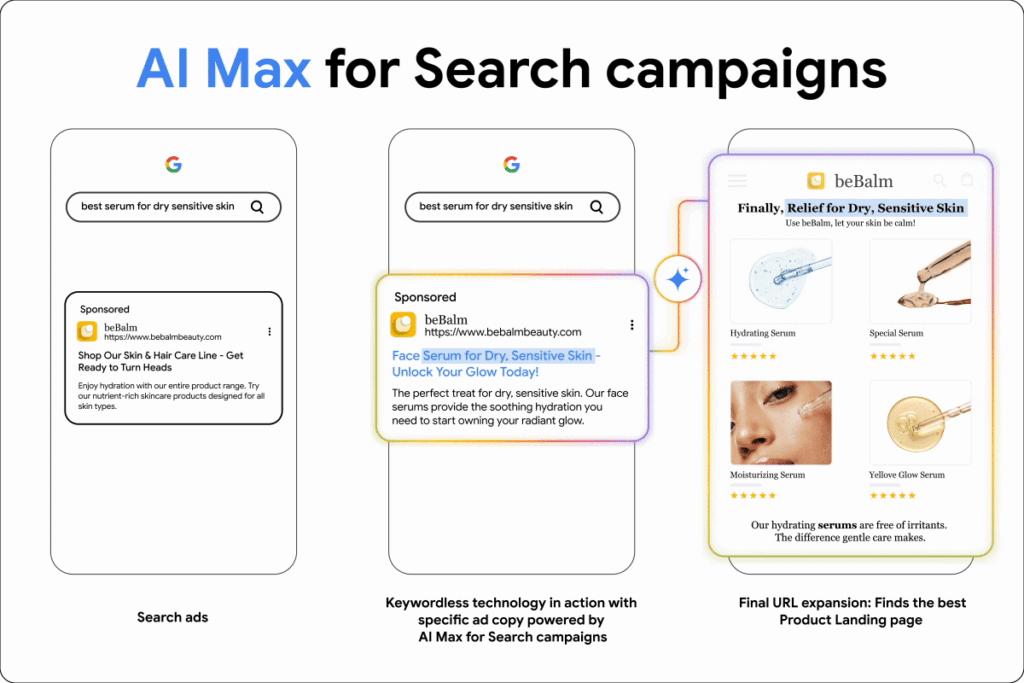
Rather than asking advertisers to predict every search someone might make, AI Max uses a wider set of signals, including keywords, website content, creative assets and campaign goals, to decide when an ad may be relevant. Google can then expand beyond the original keyword list, adjust the message and, in some cases, choose a different landing page.
The idea reflects how search itself is changing. People increasingly use longer, more conversational queries, while Google is also pushing AI Overviews and AI Mode deeper into the search experience. A paid search system built around anticipating every possible keyword becomes less practical as those behaviours evolve.
Until now, advertisers have largely been able to decide how far they wanted to move into AI Max.
From September, that starts to change.
Eligible Search campaigns already using Automatically Created Assets or campaign-level broad match will begin upgrading automatically to AI Max. Existing settings will largely carry across, so Google is not suddenly switching every AI feature on. However, AI Max increasingly becomes the environment in which those campaigns operate.
Google has been moving in this direction for years. Smart Bidding automated bid decisions, broad match gave Google greater freedom to interpret keywords, while Performance Max handed considerably more campaign execution to Google’s systems.
AI Max brings more of that automation directly into Search.
Targeting Is Becoming Less Explicit
Google’s direction with AI Max also reflects a wider change across digital advertising.
Platforms are increasingly asking marketers to define less of the audience or query themselves and instead provide stronger signals from which AI systems can infer relevance.
Meta has been moving this way for some time through Advantage+. Advertisers can still provide audience information, customer data and other targeting inputs, but Meta’s systems increasingly treat those as guidance rather than rigid boundaries, expanding beyond them when the platform predicts another user may deliver the desired result.
ChatGPT Ads introduces another version of the same model.
OpenAI allows advertisers to provide context hints describing the types of conversations, topics or keywords where an offer may be relevant. Those hints help steer ad delivery, but they do not operate like traditional exact-match search keywords. ChatGPT also considers the context and intent of the conversation, alongside the ad, landing page and advertiser inputs, when deciding what may be relevant.
Google’s AI Max sits somewhere between those models.
Search advertising still retains keywords and more familiar campaign controls, but Google increasingly uses the broader context surrounding an advertiser and a search to decide when an ad should appear.
The common direction is significant.
Digital targeting has traditionally depended heavily on marketers defining the audience they want or predicting the search terms customers will use. AI-driven advertising increasingly asks marketers to describe the business, provide high-quality signals and assets, establish boundaries and allow the platform to identify opportunities.
Targeting therefore becomes less about selecting people or keywords and more about giving an advertising system enough context to recognise a potentially valuable customer.
Paid Search Is Moving Beyond Keywords
Keywords remain important, but Google increasingly wants advertisers to give its systems enough information to understand the business rather than specify every search they want to target.
AI Max can look beyond an advertiser’s keyword list by using information contained within existing ads and landing pages to identify other searches Google believes are relevant.
Creative can become more flexible as well.
Google can adapt advertising text using existing assets and information from an advertiser’s website, while Final URL Expansion can send someone to a different page when Google believes it provides a stronger match for the search.
Google is therefore taking on more responsibility for three decisions that once sat much more firmly with the advertiser: which searches to target, what message to show and where someone should land.
Advertisers are not handing over unlimited control.
Brand exclusions, URL controls, location settings, negative keywords and other safeguards remain available, while Google has continued expanding reporting around what AI Max actually does.
However, campaign management is gradually shifting away from specifying every decision and towards establishing the parameters within which Google’s systems can operate.
Google Wants Advertisers To Provide Direction
Google is simultaneously developing new ways for advertisers to guide those systems.
Its recently announced AI Brief feature allows marketers to describe their business, messaging requirements and intended audiences using natural language. Advertisers can provide instructions about what ads should or should not say, the kinds of searches they want to prioritise and audiences they want Google to consider.
Paid search therefore starts looking less like programming a campaign and more like briefing one.
Google understandably presents that shift as an efficiency and performance improvement. The company says campaigns using the full AI Max feature set achieve an average 7% more conversions or conversion value at a similar CPA or ROAS than campaigns using search term matching alone.
Platform benchmarks deserve some caution.
Google benefits commercially when advertisers expand targeting and entrust more campaign decisions to its systems. Performance therefore still needs to be tested against individual business outcomes rather than assumed from a platform average.
Greater automation also makes visibility into those decisions more important.
Advertisers need to understand where additional conversions originate, which searches Google is matching against, what creative is being generated and where traffic is being sent.
Paid Search Skills Are Moving Upstream
Greater automation does not necessarily make paid search easier. It changes where the difficult work sits.
When Google handles more routine execution, there is less opportunity to gain an advantage through painstaking campaign mechanics alone. Competitive advantage starts moving towards the quality of the information and assets supplied to the system.
Website structure becomes more important because landing pages help Google understand what an advertiser offers.
Creative becomes more important because Google’s system needs strong source material from which to adapt advertising.
Conversion data becomes more important because automated bidding and matching systems need reliable signals about which outcomes actually create value.
Brand governance becomes more important because generative systems need boundaries around claims, language and positioning.
Measurement becomes more important because expanded targeting can produce apparently better campaign results without necessarily generating better incremental business outcomes.
None of those problems disappear when AI Max is switched on.
In some organisations, greater automation may actually expose weaknesses that detailed campaign management previously helped conceal.
Search Advertising Is Becoming More Automated
Google’s September migration fits a broader transformation underway across Search.
People are increasingly searching with longer questions, images and conversational prompts. AI Overviews and AI Mode are also changing how Google interprets queries and presents information.
An advertising system built predominantly around marketers predicting the exact words someone will type becomes harder to sustain within that environment.
Google’s answer is increasingly to ask advertisers for stronger business information, assets, objectives and constraints, then allow its models to decide how those ingredients should be assembled for individual searches.
There is an obvious attraction. Maintaining enormous keyword structures and endless minor campaign variations has never been the most strategically valuable use of marketing resources.
Fewer manual controls, however, do not eliminate the need for expertise. They change the expertise required.
Google’s move towards AI Max suggests paid search is gradually becoming less about configuring every element of a campaign and more about directing, supplying and evaluating an automated advertising system.
The same pattern is emerging across Meta and ChatGPT.
Platforms increasingly want marketers to provide the context, data, creative and commercial objectives, while their AI systems decide who should see the advertising and when.













RECOMMENDED FOR YOU
Google Gives Advertisers More AI Max Visibility
Google is introducing new AI Max reporting capabilities, giving…
Google is introducing new AI Max reporting capabilities, giving…
[STUDY] AI Content Production Keeps Accelerating
93% of marketers now use AI to support content…
93% of marketers now use AI to support content…
Meta Launches AI Agent For Businesses
Meta is extending its AI capabilities beyond Facebook, Instagram…
Meta is extending its AI capabilities beyond Facebook, Instagram…