For much of the past three years, ChatGPT has been the default reference point for generative AI.
It built the category, established the behaviour and became the product most people associated with AI search, research and everyday problem-solving. Google is now beginning to narrow that lead.
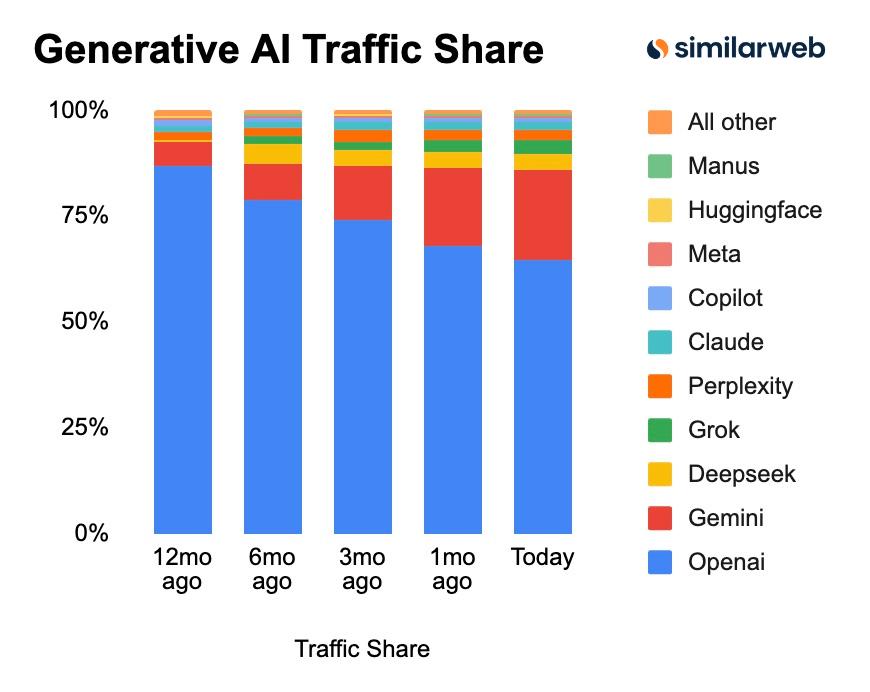
Similarweb estimates that ChatGPT’s share of worldwide generative AI website visits fell from roughly 76% in June 2025 to around 53% by May 2026. Gemini moved in the opposite direction, rising from under 9% to approximately 27% to 28% over the same period.
The shift does not suggest ChatGPT is shrinking. OpenAI said in February that ChatGPT had more than 900 million weekly active users, over 50 million consumer subscribers and more than nine million paying business users.
Similarweb measures estimated website visits, while OpenAI reports active users across its wider product, so the figures are not directly comparable. Together, however, they point to a market changing shape.
ChatGPT remains enormous, but Google is growing quickly around it. Gemini is now the only platform close to mounting a serious mass-market challenge, helped less by a simple chatbot contest than by Google’s ability to place AI inside Search, Chrome, Android and Workspace.
ChatGPT built the early habit. Google is using distribution to make Gemini part of the wider digital routine.
ChatGPT Still Has The Stronger AI Habit
ChatGPT remains the product most closely associated with generative AI because people deliberately choose to open it.
They use it to write, research, plan, analyse and solve problems, often across longer sessions involving follow-up questions and more complex work. OpenAI’s user figures suggest that behaviour is becoming deeply established rather than fading as the novelty wears off.
Similarweb also reports that total monthly web visits across generative AI platforms grew 70% year on year to 9.5 billion between June 2025 and May 2026. Unique visitors increased by 57%, meaning visits grew faster than the audience itself.
People are not merely experimenting with AI once. They are returning more frequently and using it for a broader range of tasks.
ChatGPT’s declining share therefore reflects a larger market forming around it rather than a retreat by OpenAI. A smaller percentage of a rapidly expanding category can still represent considerable growth and deeper adoption.
OpenAI’s advantage is therefore not only scale. It has also built a strong direct relationship with users and a clear habit around beginning work inside ChatGPT.
Google still has to prove that widespread exposure to Gemini creates the same depth of engagement. Its route into the market, however, looks very different.
Gemini Is Growing Through Google’s Ecosystem
Google reported in July that the Gemini app had reached 950 million monthly active users, with daily active users tripling over the previous year. AI Mode in Search had also passed one billion monthly users.
Those numbers need careful handling. Monthly users are not equivalent to ChatGPT’s weekly users, while an interaction inside Search is different from deliberately opening a standalone assistant.
Even with those caveats, Gemini is clearly no longer a niche product.
Google can place its AI across a wide collection of consumer and workplace services. Someone may continue using ChatGPT for detailed research while also receiving Gemini-generated answers in Search, drafting an email in Gmail or using AI assistance on an Android device.
Google does not necessarily need users to abandon ChatGPT. It can become a second AI layer woven through existing behaviour.
That distribution advantage is difficult for OpenAI to match. ChatGPT has a strong direct relationship with users, but Google controls many of the places where people already search, browse, communicate and work.
Gemini can therefore gain adoption without requiring a separate decision to switch platforms. Similarweb’s traffic figures show the standalone Gemini experience growing rapidly, while Google’s wider opportunity sits in the interactions that may never register as a visit to the Gemini website at all.
Search Gives Google A Different Route Into AI
Google’s most important advantage remains Search.
AI Overviews now reach more than 2.5 billion users each month, while Google says AI Mode has passed one billion monthly users. The company also claims that AI features are increasing overall search activity rather than simply replacing traditional queries.
Google has an obvious commercial interest in presenting AI as an extension of Search rather than a threat to it. Its product strategy nevertheless reflects that position clearly.
AI Overviews add generated summaries to familiar results. AI Mode offers a more conversational experience. Gemini provides a standalone assistant, while Chrome, Android and Workspace carry similar capabilities into other parts of the day.
Users do not have to choose between conventional search and generative AI in a single moment. Google can gradually introduce AI into habits that already exist.
ChatGPT created a new destination. Google is adapting an old one.
That difference helps explain why Gemini can gain ground so quickly despite ChatGPT’s stronger brand recognition in AI. Google is not asking every user to form a completely new behaviour. It is adding Gemini to behaviours that are already deeply embedded.
Google Does Not Need To Win A Chatbot Contest
Public discussion still tends to compare ChatGPT and Gemini feature by feature, as though the contest will be settled by which chatbot produces the better answer.
The commercial battle is broader.
OpenAI wants ChatGPT to become the primary place people begin knowledge work, research and increasingly complex digital tasks. Google wants Gemini to strengthen the products and behaviours it already controls, particularly Search and Workspace.
Those strategies overlap, but they are not identical.
A person may ask ChatGPT to develop a travel itinerary, then use Google to check locations, compare hotels and navigate to booking sites. A marketer may plan a campaign in ChatGPT but encounter Gemini inside Search, Gmail or Google Docs during the rest of the workflow.
Usage can be additive rather than exclusive.
Similarweb’s numbers suggest that pattern is already taking shape. Gemini is gaining share while the overall generative AI market continues to expand.
The market may not settle into a winner-takes-all model. ChatGPT can remain the leading standalone assistant while Google becomes the most widely encountered AI system.
Marketing Teams Need To Watch Both
Many organisations still treat AI visibility as shorthand for ChatGPT visibility.
That approach is becoming too narrow.
ChatGPT remains central because of its scale, strong user habit and growing role in product research, comparison and decision support. Gemini now matters because Google can expose brands through both its standalone app and AI-enhanced Search.
The answers across the two environments will not always be the same. Google and ChatGPT can rely on different sources, interpret prompts differently and recommend different organisations.
A brand may appear consistently in one while being weak or absent in the other.
Marketing teams should therefore compare the questions most relevant to their market across both platforms. The aim is not to produce an arbitrary blended visibility score, but to understand where meaningful differences emerge.
Category recommendations, brand comparisons, problem-based searches and questions that indicate active consideration are a sensible place to begin.
Conventional search performance still matters as part of that work. Google’s AI experiences are closely tied to its wider search ecosystem, while ChatGPT increasingly relies on live web retrieval and credible external information.
Strong owned content, digital PR, recognised expertise and third-party authority continue to support discoverability across both environments.















RECOMMENDED FOR YOU
[STUDY] AI Search Shapes Brand Decisions
AI search is starting to influence purchase decisions well…
AI search is starting to influence purchase decisions well…
LinkedIn Lets AI Multiply Ad Creative
LinkedIn is giving advertisers far more freedom to vary…
LinkedIn is giving advertisers far more freedom to vary…
Copilot Lets Marketers Build Apps By Chatting
Microsoft is giving Copilot users the ability to build…
Microsoft is giving Copilot users the ability to build…