
Apple’s long-promised Siri overhaul is finally arriving, after years in which asking Siri anything remotely complicated often felt like a test of patience rather than artificial intelligence.
The new Siri AI is designed to fix that.
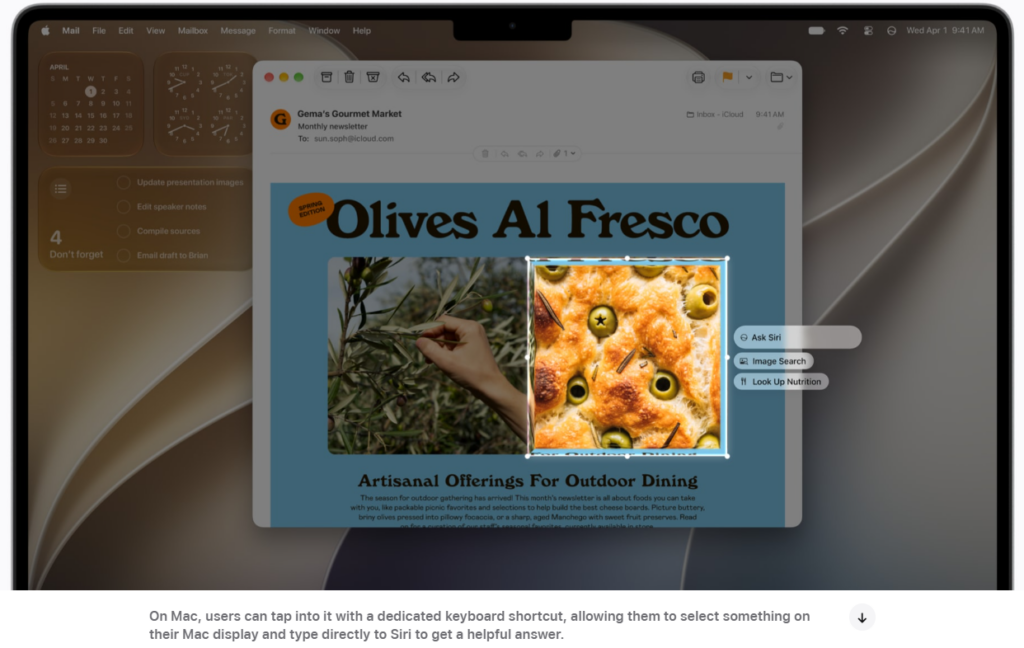
It can understand personal context across messages, emails, photos and other information on the device. It can interpret what is currently on screen, pull in current information from the web and take actions across Apple apps.
Apple is approaching AI differently from companies building destination chat products.
The assistant sits inside the operating system, alongside the customer’s messages, photos, email, browser, apps and current screen.
Discovery can therefore start from whatever somebody is already doing.
Discovery Does Not Need To Start With Search
Someone might be reading a restaurant recommendation in a message, looking at accommodation in Safari, viewing a product on Instagram or checking an event in Mail.
Siri AI can increasingly understand that surrounding context and help the user continue from there.
A person looking at a hotel could ask whether it suits a family trip. Someone reading an email about a conference could ask Siri to find nearby accommodation. A product on screen could become the starting point for comparison, further research or another action.
The traditional search box becomes only one route into discovery.
Google still owns enormous volumes of explicit search intent, while ChatGPT has established conversational discovery as a mainstream behaviour. Apple adds another layer by embedding AI into the point where the customer is already reading, viewing or doing something.
Apple Has A Different AI Advantage
Apple’s advantage is not simply another large language model.
It controls the device layer.
Siri AI can draw on personal context across Apple products, understand what is currently on screen and work across apps without forcing the user to repeatedly explain the situation.
A request such as “which of these should I book?” becomes much more useful when the assistant already knows what the person is looking at.
The same applies to travel, shopping, events, entertainment and local discovery.
Apple has been careful about how personal information is handled, and marketers should not assume every signal available on the device is being used to rank brands or commercial recommendations.
Even so, the surrounding context available to Apple is very different from a standalone chatbot receiving a fresh prompt.
Brand Discovery Becomes More Contextual
Traditional search usually starts with a query.
AI assistants increasingly start with context.
A hotel may be surfaced because Siri understands the destination mentioned in an email. A retailer may become relevant because of something currently visible on screen. A service provider may enter the journey after Siri looks to the web for additional information around an existing task.
Brand discovery starts to sit across several information sources rather than one search results page.
Websites, product information, location data, reviews, editorial coverage and app content can all become part of the environment AI uses to answer the next question.
Customers may still rely on the same underlying sources, while interacting with fewer of them directly.
The Customer Journey Becomes Harder To See
Device-level AI adds another layer between marketing exposure and customer action.
A customer could see something on social media, ask Siri about it, bring in information from the web and continue the task through an app.
Only parts of that journey may appear clearly inside conventional analytics.
Marketers are already dealing with similar visibility gaps around ChatGPT, Google AI and other AI discovery environments. Apple adds the operating system itself to that mix.
The immediate impact on attribution should not be overstated. Siri AI is still rolling out, consumer behaviour will take time to develop and many journeys will continue to involve conventional search and app usage.
Another intermediary is nevertheless entering the path between interest and action.
Apps Gain A Different Role
Apple’s deeper app integration also separates its approach from many web-first AI products.
Siri AI can increasingly perform actions rather than simply return information.
Apple has demonstrated system-wide actions such as drafting messages, editing and sharing photos and working with content already visible to the user.
As that capability expands, brands with useful apps may have another route into AI-assisted customer journeys.
The app stops being only a destination the customer chooses to open.
It can potentially become something Siri uses to complete part of a task.
Travel, retail, banking, media, transport, health and service businesses all have obvious reasons to watch how that develops.
The commercial value will depend heavily on which third-party app actions Apple opens up, how developers can participate and how reliably Siri chooses between different services.
Public Content Still Feeds The Experience
Siri can also go to the web when it needs current information.
Accurate websites, clear product and service information, structured location data, strong third-party coverage and consistent information across digital properties remain useful when an AI system is trying to understand a brand.
The difference sits in the interface.
A customer may get the answer through Siri without visiting every source used to construct it.
Content therefore continues to do discovery work even when the direct traffic it generates becomes harder to see.
The same pattern is already emerging across other AI platforms.
Siri Still Has Plenty To Prove
Siri has spent years as one of Apple’s more awkward products.
For a company that built its reputation around intuitive experiences, the gap between Siri and newer assistants such as ChatGPT became increasingly difficult to ignore.
Routine requests were usually fine. Anything involving context, follow-up questions or several steps could unravel quickly.
That history creates a higher bar for the new version.
Apple can ship Siri AI across hundreds of millions of devices, but distribution only gets the product onto the screen. People still need to trust it enough to use it for decisions that previously went to Google, an app or another AI assistant.
The rollout is also still limited. New capabilities are arriving in beta, language support is expanding gradually and availability varies by market.
Apple therefore has two jobs.
It has to make Siri genuinely useful, and then convince people who stopped expecting much from Siri to try again.
The second part may be harder than the first.
AI Moves Closer To The Decision
Search, social platforms and generative AI are already competing for different parts of discovery.
Apple brings AI directly into the device and operating system layer.
A customer can increasingly move from seeing something, to asking about it, to gathering additional information and taking an action without treating each step as a separate digital interaction.
Brands therefore have another environment to account for alongside Google, social feeds and standalone AI platforms.
If Apple can finally turn Siri from an occasional punchline into something people actually rely on, its position inside the device gives it a credible route into customer discovery and decision-making.

























RECOMMENDED FOR YOU
[STUDY] AI Search Shapes Brand Decisions
AI search is starting to influence purchase decisions well…
AI search is starting to influence purchase decisions well…
LinkedIn Lets AI Multiply Ad Creative
LinkedIn is giving advertisers far more freedom to vary…
LinkedIn is giving advertisers far more freedom to vary…
Copilot Lets Marketers Build Apps By Chatting
Microsoft is giving Copilot users the ability to build…
Microsoft is giving Copilot users the ability to build…