
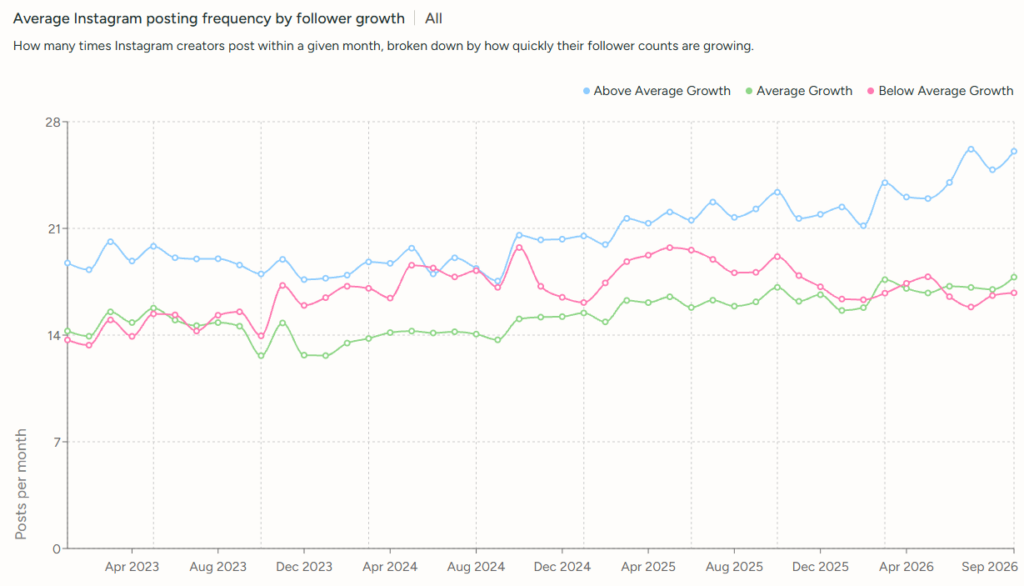
New Instagram benchmarks covering more than 27 million posts suggest that brands should take a closer look at how frequently they publish, particularly if audience growth and organic reach have stalled.
Updated in October, Buffer’s analysis draws on 273,000 active Instagram accounts and more than 13 billion engagements. It provides a substantial picture of current publishing behaviour, engagement and audience growth across the platform.
The headline findings are:
- 18 posts per month: Average publishing frequency, equivalent to just over four posts weekly.
- 4.3%: Median engagement rate across the accounts analysed.
- 1.3%: Average monthly follower growth rate.
- 270 accounts: Median reach per post across the full dataset.
The research also allows comparisons between accounts of different sizes, an important consideration given the substantial differences in performance between smaller creators and established brands.
Four Posts A Week Provides A Useful Benchmark
The average of 18 monthly posts offers brands a reference point for assessing their publishing schedules.
For an organisation posting once or twice weekly, the benchmark suggests a substantial difference between its current activity and the average account in Buffer’s dataset.
However, 18 posts is an observed average, not a recommendation or evidence of an optimal publishing frequency.
Earlier Buffer research provides additional context. Its analysis of 2.1 million Instagram posts found that accounts publishing three to five times weekly achieved 12% higher median reach per post than those posting once or twice.
Publishing six to nine times weekly was associated with an 18% improvement, rising to 24% for accounts posting ten or more times.
The same research found that accounts publishing three to five times weekly experienced more than twice the follower growth rate of those posting once or twice.
The figures suggest that increasing publishing frequency can deliver benefits beyond the additional exposure generated by producing more posts.
However, the incremental gains became smaller as publishing frequency increased, making production capacity an important consideration.
Engagement And Reach Tell Different Stories
Buffer’s latest benchmarks also provide useful context for evaluating performance.
The median engagement rate of 4.3% offers a reference point for understanding how audiences interact with Instagram content, while average monthly follower growth of 1.3% provides a separate measure of audience development.
The overall median reach of 270 accounts per post needs more careful interpretation. It combines accounts of widely varying sizes, making comparisons within similar follower bands considerably more meaningful than the headline figure alone.
Content format also affects performance.
Buffer’s broader research indicates that Reels tend to generate stronger reach, while carousels perform particularly well for engagement.
Brands increasing their publishing frequency should therefore consider the mix of content being produced, alongside the total number of posts.
TikTok And LinkedIn Reinforce The Pattern
Instagram’s findings are consistent with separate research examining publishing frequency on TikTok and LinkedIn.
Buffer’s analysis of 11.4 million TikTok posts found that publishing two to five times weekly was associated with 17% more views per post than publishing once weekly.
At six to ten weekly posts, the improvement increased to 29%, reaching 34% for accounts publishing eleven or more times.
Interestingly, much of TikTok’s improvement came from an increased likelihood of producing exceptionally successful videos, rather than consistent gains in the performance of a typical post.
On LinkedIn, research covering more than two million posts found that publishing two to five times weekly generated approximately 1,182 additional impressions per post compared with publishing once weekly. Accounts posting six to ten times achieved approximately 5,001 additional impressions.
Although the studies measure different outcomes, they point towards a similar relationship between publishing frequency and organic social performance.
Paid Social Is Demanding More Creative Too
A related development is taking place in paid social advertising.
Meta has increasingly encouraged advertisers to provide Advantage+ with a broader range of creative assets, giving its automated delivery systems more opportunities to identify effective messages, formats and visual approaches.
The mechanics differ from organic publishing. Meta’s emphasis is on genuine creative diversity, rather than simply increasing the number of advertisements or producing numerous near-identical variations.
Nevertheless, both developments place greater demands on creative production.
Brands are being encouraged to publish more consistently across organic social channels while maintaining a larger supply of creative assets for automated advertising.
Brands Face A Growing Production Challenge
The combined findings raise questions about how marketing teams resource social media activity.
A brand publishing two Instagram posts weekly may have a reasonable case for testing four or five. Extending that increase across TikTok and LinkedIn, while supplying additional creative variations for paid campaigns, creates a more substantial production requirement.
Agencies and internal teams may need to reconsider how content is planned, produced and adapted across channels. AI-assisted editing and production tools could help, particularly when repurposing existing footage or preparing multiple formats.
However, the research remains observational. More successful accounts may publish frequently because they have stronger creative capabilities, greater resources or established audiences. Higher posting frequency alone cannot guarantee better results.
Buffer’s broader 2026 social engagement research also identifies an important qualification: while more frequent publishing is associated with stronger overall growth, engagement and reach per post can weaken at higher volumes.
For brands, the opportunity is to test a sustainable increase in publishing frequency while measuring the additional reach, engagement and commercial value generated.
The latest Instagram benchmarks provide a useful starting point. The wider evidence suggests that creative production capacity is becoming an increasingly important consideration across both organic and paid social media.
























RECOMMENDED FOR YOU
Instagram Edits Gets A Major AI Upgrade
Instagram is bringing AI-powered content analysis and planning into…
Instagram is bringing AI-powered content analysis and planning into…
Meta AI Feeds Expand Organic Reach
Meta is using large language models to understand content…
Meta is using large language models to understand content…
Instagram Looks Beyond Short Form Video
Instagram is preparing for a future where short-form video…
Instagram is preparing for a future where short-form video…