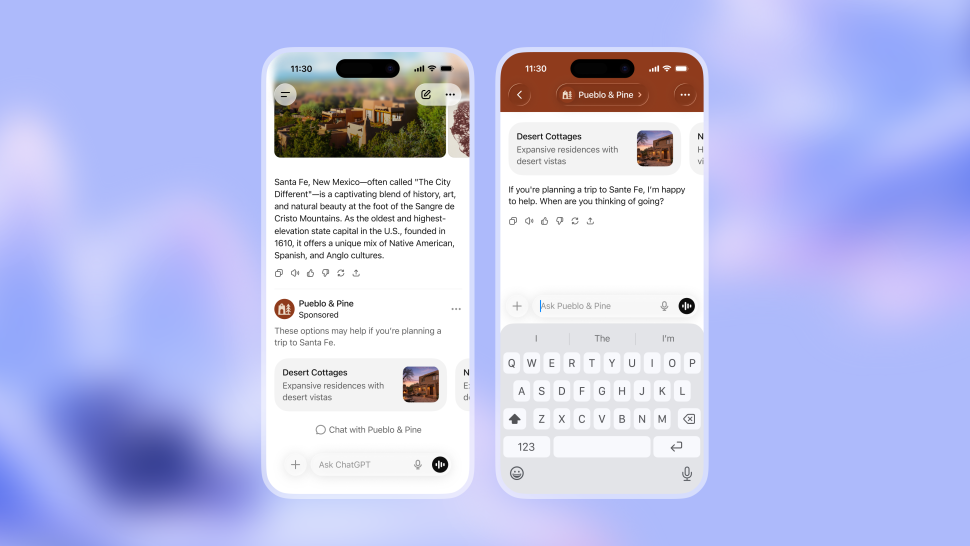
OpenAI has expanded ChatGPT advertising beyond the US, with Australia among the first international markets to go live. The rollout marks a shift from early testing to broader scale, as the company builds a new advertising channel within its AI products.
That expansion comes as ChatGPT usage continues to accelerate across markets. In Australia, usage has more than doubled over the past 12 months, while digital ad spend reached $18.4 billion in 2025, up 11.5% year on year. Together, those signals point to both growing audience scale and advertiser demand.
Ads are currently limited to logged-in adult users on Free and Go tiers. Plus, Pro, Business and Enterprise users remain ad-free, reinforcing a model that balances monetisation with a premium user experience.
Guardrails Focus On Trust And Control
As the rollout expands, OpenAI has been explicit about how advertising will operate. Ads will not influence responses, conversations remain private, and users retain control over their experience.
Those guardrails are central to adoption. Early results from the US pilot suggest low dismissal rates and no measurable impact on trust, an important signal as the platform moves into more commercially sensitive use cases.
A New Revenue Layer For AI Platforms
Beyond the product itself, the shift reflects a broader change in how AI platforms are monetised. Subscription models alone are unlikely to support long-term growth at scale, making advertising an increasingly important revenue layer.
OpenAI’s revenue expectations underline that direction. According to reporting from Axios, the company has told investors it could generate $2.5 billion in ad revenue in 2026, rising to $11 billion in 2027 and potentially reaching $100 billion by 2030.
Placed in context, that ambition is significant. Google generated $294.69 billion in ad revenue in 2025, while Meta reported $196.18 billion. OpenAI is still some way behind, but the projected growth signals clear competitive intent.
From Testing To Scale
The expansion beyond the US is not just geographic. It signals a transition from pilot to product. As more markets come online, the focus will shift from validating the model to scaling inventory and advertiser demand.
That introduces new challenges. Maintaining relevance, protecting user trust and ensuring consistent performance across regions will become more complex as the platform grows.
Where The Budget Will Come From
That growth, if realised, will not come from new spend alone. It will be driven by reallocation.
In the current climate, most advertisers are not increasing total budgets. Investment is being consolidated and directed towards channels that can demonstrate clear returns. Any meaningful rise in ChatGPT ad revenue will come at the expense of established platforms.
Pressure On Search Budgets
Google is the most exposed. ChatGPT overlaps directly with high-intent behaviours such as research, comparison and recommendation, which underpin Google’s search business. Even a partial shift in those queries at scale has revenue implications, particularly for non-branded search.
Retail Media In Scope
Amazon is also in scope. Product discovery and evaluation are already starting to move into conversational environments, especially for higher-consideration purchases. If those journeys begin in ChatGPT rather than on Amazon or Google, retail media budgets are likely to fragment.
Social Faces Indirect Risk
Meta is less directly exposed, but still vulnerable. Its strength lies in discovery and demand generation across Facebook and Instagram. As ChatGPT becomes more relevant in early-stage research and evaluation, it begins to overlap with that role, particularly in categories where consideration cycles are longer.
There are second-order effects as well. Affiliate and comparison platforms depend on users actively seeking out options. AI-generated recommendations reduce the need for those intermediary steps, putting further pressure on that part of the ecosystem.
At the centre of this shift is how intent is captured. Google relies on keywords. Meta relies on behavioural signals. Amazon relies on in-platform activity. ChatGPT captures intent through language, often with greater context and specificity.
For marketers, the implication is clear. This is not an incremental channel. It is a reallocation decision. If ChatGPT delivers performance, budget will move.
A Different Type Of Media Environment
That reallocation is already shaping how marketers approach the channel. ChatGPT introduces a different type of media environment, where interactions are conversational and inputs are more detailed than a typical search query.
As a result, intent signals are stronger, particularly in consideration and decision-making phases. At the same time, expectations around relevance are higher. Ads that do not align closely with user queries are more visible and more easily dismissed.
Paid Solves The Organic Gap
There is also a practical driver behind early adoption. Many marketing teams are still working out how to influence organic visibility within AI tools. Unlike search or social, where optimisation strategies are well established, AI-generated answers remain far less predictable.
That uncertainty creates a near-term gap.
Paid placements offer a more immediate and controllable route to visibility. Rather than attempting to decode how models prioritise information, advertisers can secure presence directly within the interaction. For teams under pressure to deliver results, that clarity is valuable.
As a result, early demand for ChatGPT ads is likely to be driven as much by necessity as by opportunity. It provides a way to participate in AI-driven journeys while organic approaches are still evolving.
Measurement And Early Advantage
Over time, that balance will shift. Organic strategies for AI will mature, and new optimisation frameworks will emerge. In the near term, however, paid media is likely to lead.
The competitive response is already underway. Google is integrating generative AI into search, while Meta continues to advance AI-driven optimisation across its platforms. OpenAI’s expansion adds further momentum to a broader move towards AI-led advertising.
For brands, the priority now is to test and learn. Emerging channels typically offer a window to understand performance before competition intensifies and pricing stabilises.
Measurement will also need to evolve alongside that. Standard metrics such as clicks and impressions are unlikely to capture the full value of conversational engagement. Greater emphasis will be placed on influence, consideration and contribution to conversion across the customer journey.
A Market In Transition
Taken together, these shifts point to a market in transition. OpenAI’s move into advertising reflects the economics of AI at scale, where infrastructure and development costs require more diversified revenue models.
The international rollout is still in its early stages, but the direction is established. ChatGPT is evolving into a new kind of media channel, and its growth will reshape how budgets are distributed across search, social and emerging AI platforms.





















RECOMMENDED FOR YOU
[STUDY] AI Search Shapes Brand Decisions
AI search is starting to influence purchase decisions well…
AI search is starting to influence purchase decisions well…
LinkedIn Lets AI Multiply Ad Creative
LinkedIn is giving advertisers far more freedom to vary…
LinkedIn is giving advertisers far more freedom to vary…
Copilot Lets Marketers Build Apps By Chatting
Microsoft is giving Copilot users the ability to build…
Microsoft is giving Copilot users the ability to build…